<?xml version="1.0" encoding="UTF-8"?>
<?xml-stylesheet type="text/xsl" href="/stylesheets/feed.atom.xml" media="screen"?>
<feed xml:lang="en-US" xmlns="http://www.w3.org/2005/Atom">
  <id>tag:ansari.nd.edu,2005:/news-events/news</id>
  <link rel="alternate" type="text/html" href="https://ansari.nd.edu"/>
  <link rel="self" type="application/atom+xml" href="https://ansari.nd.edu/news-events/news.atom"/>
  <id>tag:ansari.nd.edu,2005:/latest</id>
  <title>Ansari Institute for Global Engagement with Religion | News</title>
  <updated>2026-11-12T13:27:00-05:00</updated>
  <link rel="alternate" type="text/html" href="https://ansari.nd.edu/"/>
  <link rel="self" type="application/atom+xml" href="https://ansari.nd.edu//news-events/news.atom"/>
  <subtitle>The Ansari Institute for Global Engagement with Religion is dedicated to studying, learning from, and collaborating with religious communities worldwide for the common good.</subtitle>
  <entry>
    <id>tag:ansari.nd.edu,2005:News/187016</id>
    <published>2026-11-12T13:27:00-05:00</published>
    <updated>2026-11-12T13:27:05-05:00</updated>
    <link rel="alternate" type="text/html" href="https://ansari.nd.edu/news-events/news/2026-islam-in-ireland-report/"/>
    <title>Beyond immigration and integration: Rethinking Islam in Ireland</title>
    <summary type="text">
      <![CDATA[A report commissioned by the Keough-Naughton Institute for Irish Studies and University College Dublin’s Newman Centre for the Study of Religions examines the history, demographics, and lived experiences of Ireland’s Muslim communities.]]>
    </summary>
    <content type="html">
      <![CDATA[<p class="lede">On October 19, 2026, the University of Notre Dame’s Keough-Naughton Institute for Irish Studies and University College Dublin’s Newman Centre for the Study of Religions convened scholars and members of the public at Newman House in Dublin for the launch of a new report, “Islam in Ireland.”</p>
<figure class="image image-right"><img src="https://irishstudies.nd.edu/assets/685897/2026_islam_in_ireland_panel.jpg" alt="Panelists discuss at a Notre Dame and UCD event with a projector screen in the background." width="600" height="400">
<figcaption>From left, Daniel Deasy of University College Dublin, James Carr of the University of Limerick, Roja Fazaeli of the University of Galway, and Oliver Scharbrodt of the Institute of Ismaili Studies, discuss the “Islam in Ireland” report.</figcaption>
</figure>
<p>The report by <a href="https://research.universityofgalway.ie/en/persons/roja-fazaeli/">Roja Fazaeli</a>, professor of law and Islamic studies at the University of Galway, and <a href="https://pure.ul.ie/en/persons/james-carr/">James Carr</a>, associate professor of philosophy at the University of Limerick, was commissioned by the <a href="https://irishstudies.nd.edu/">Keough-Naughton Institute</a>, Notre Dame's <a href="https://ansari.nd.edu/">Ansari Institute for Global Engagement with Religion</a>, and <a href="https://www.ucd.ie/newman/">UCD's Newman Centre</a>. It examines the history, demographics, institutions, and lived experiences of Muslim communities in Ireland. Building upon a conference that the Keough-Naughton Institute and Ansari Institute hosted in 2022 at the Royal Irish Academy, the publication offers both a review of existing scholarship and a framework for future research.</p>
<p>The event opened with remarks from Colin Barr, the Thomas Moore and Judy Livingston Director of the Keough-Naughton Institute and professor of modern Irish history in the Keough School of Global Affairs, followed by a panel discussion featuring the report’s authors, UCD Associate Professor of Philosophy Daniel Deasy, and Professor Oliver Scharbrodt of the Institute of Ismaili Studies, who chaired the discussion.</p>
<h2>A changing Muslim population and a changing Ireland</h2>
<figure class="image image-right"><a href="https://irishstudies.nd.edu/assets/687098/islam_in_ireland_60pg_a4_final_web.pdf"><img src="https://irishstudies.nd.edu/assets/686026/300x/islam_in_ireland_cover.jpg" alt="Sunset viewed through a circular opening in a modern bridge, with city skyline." width="300" height="425"></a>
<figcaption>Click on this image to read the report.</figcaption>
</figure>
<p>Central to <a href="https://irishstudies.nd.edu/assets/687098/islam_in_ireland_60pg_a4_final_web.pdf">the report</a> and discussion was the need to move beyond understanding Islam and Irish identity as separate or competing categories. According to Ireland’s 2022 census, the Muslim population grew from nearly 4,000 in 1991 to more than 80,000 in 2022. More than half of Muslims in Ireland are Irish citizens, while nearly three-quarters are under the age of 40. These demographic changes highlight the increasingly established and multigenerational character of Muslim life in Ireland.</p>
<p>During the discussion, Fazaeli and Carr emphasized that scholarship must increasingly reflect these developments. While migration remains an important part of the history of Islam in Ireland, understanding Muslim communities primarily through immigration and integration overlooks the experiences of those born and raised in Ireland, as well as individuals who have converted to Islam.</p>
<p>The authors also called for research that moves beyond the securitization of Islam and the tendency to examine Muslim communities principally in relation to security concerns or questions of social integration. The report further highlights the socioeconomic diversity of Muslim communities. Early Muslim migration to Ireland was closely associated with international medical students and professionals, many of whom subsequently established families and contributed to the development of Muslim institutions. Today, however, Muslim communities encompass a much broader range of occupational backgrounds, economic circumstances, and social experiences.</p>
<h2>Religious diversity and the future of Islamic studies in Ireland</h2>
<p>The report and subsequent discussion highlighted the diversity of Islamic traditions, institutions, and forms of religious authority in Ireland, including the role of mosques, religious centers, and transnational networks. The panel explored how these differences shape community life, particularly in relation to gender roles and clerical authority. They highlight the importance of recognizing varied experiences within communities rather than treating Islam in Ireland as a uniform phenomenon.</p>
<p>The authors also identified significant gaps in the academic study of Islam in Ireland. Despite growing interest among younger scholars, dedicated institutional spaces and research opportunities remain limited. Beyond expanding institutional support, the authors emphasized the importance of recognizing Muslims not simply as subjects of research, but as scholars, community leaders, and active contributors to knowledge about contemporary Irish society.</p>
<h2>A full-room seminar and an active exchange</h2>
<p>The launch at Newman House was structured as a seminar-style discussion rather than a conventional lecture or formal presentation. With a full room of attendees, the format encouraged direct engagement between the panelists and audience.</p>
<figure class="image image-right"><img src="https://irishstudies.nd.edu/assets/685896/2026_islam_in_ireland_colin_barr.jpg" alt='A speaker presents "Islam in Ireland" at a podium in an ornate room with an audience seated.' width="600" height="400">
<figcaption>Colin Barr, the Thomas Moore and Judy Livingston Director of the Keough-Naughton Institute for Irish Studies and professor of modern Irish history in the Keough School of Global Affairs, speaks to a full room at the “Islam in Ireland” launch.</figcaption>
</figure>
<p>Following the authors’ discussion of the report, participants raised questions that extended the conversation into areas of public policy, institutional representation, and the future direction of research. Among the issues raised were the experiences of Muslim communities in Northern Ireland.</p>
<p>Audience members also considered how academic research might inform government decision-making, including opportunities for scholars and Muslim communities to contribute to public consultation and advisory structures. These exchanges reflected an interest in ensuring that research on Islam in Ireland remains connected to the broader social and political questions facing contemporary Irish society.</p>
<p>The launch of “Islam in Ireland” marked an important moment in a conversation that began at <a href="https://irishstudies.nd.edu/news/clingen-family-center-and-ansari-institute-host-islam-and-ireland-conference/">the 2022 conference</a> hosted by the Keough-Naughton Institute and Ansari Institute.</p>
<p>By bringing together existing scholarship and identifying areas requiring greater attention, the report offers a more comprehensive understanding of Muslim communities and their place in Irish society. The discussion at Newman House reinforced its central message: that understanding contemporary Ireland requires recognizing the diversity of Muslim experiences and the ways religion, citizenship, and belonging intersect across the island.</p>
<p class="attribution">Originally published by <span class="rel-author">Faiza Filali</span> at <span class="rel-source"><a href="https://irishstudies.nd.edu/news/2026-islam-in-ireland-report/">irishstudies.nd.edu</a></span> on <span class="rel-pubdate">November 04, 2026</span>.</p>]]>
    </content>
    <link rel="enclosure" type="image/jpeg" href="https://ansari.nd.edu/assets/687259/2026_islam_in_ireland_panel.jpg" title="Panelists discuss at a Notre Dame and UCD event with a projector screen in the background."/>
    <author>
      <name>Faiza Filali</name>
    </author>
  </entry>
  <entry>
    <id>tag:ansari.nd.edu,2005:News/186747</id>
    <published>2026-11-04T12:37:00-05:00</published>
    <updated>2026-11-04T12:37:57-05:00</updated>
    <link rel="alternate" type="text/html" href="https://ansari.nd.edu/news-events/news/notre-dame-program-on-church-state-society-hosts-book-workshop-for-3l-mintae-cha/"/>
    <title>Notre Dame Program on Church, State &amp; Society Hosts Book Workshop for 3L Mintae Cha</title>
    <summary type="text">
      <![CDATA[On October 3, 2026, Notre Dame Law School’s Program on Church, State &amp; Society hosted a dissertation-to-book workshop for 3L Mintae Cha. The workshop was held at the Law School’s Chicago campus and offered an opportunity for Cha to receive feedback from distinguished legal scholars and historians on his book manuscript, tentatively entitled The Making of a Modern Church: Religion and Constitutionalism in the Anglo-American World, 1760-1880. The project is based on Cha’s Ph.D. dissertation, which he defended successfully at Princeton University in 2023.]]>
    </summary>
    <content type="html">
      <![CDATA[<figure class="image image-right"><img src="https://churchstate.nd.edu/assets/685679/img_5141jpg.jpg" alt="A man in a suit smiles next to a banner for Notre Dame Law School's Church, State &amp; Society program." width="600" height="800">
<figcaption><em>3L Mintae Cha</em></figcaption>
</figure>
<p>On October 3, 2026, Notre Dame Law School’s <a href="https://churchstate.nd.edu/">Program on Church, State &amp; Society</a> hosted a dissertation-to-book workshop for 3L Mintae Cha. The workshop was held at the Law School’s Chicago campus and offered an opportunity for Cha to receive feedback from distinguished legal scholars and historians on his book manuscript, tentatively entitled <em>The Making of a Modern Church: Religion and Constitutionalism in the Anglo-American World, 1760-1880</em>. The project is based on Cha’s Ph.D. dissertation, which he defended successfully at Princeton University in 2023.</p>
<p>A historian of the eighteenth- and nineteenth-century Anglo-American world, Cha is interested in different forms of church-state relationships in the British Empire and United States. In his dissertation, which was <a href="https://aslh.net/aslh-dissertation-prize-winners-2024/">awarded</a> the American Society for Legal History’s 2024 William Nelson Cromwell Dissertation Prize, Cha found that debates about constitutional reform in secular politics—including disestablishment, expansion of the franchise, and imperial and federal reform—were mirrored within Presbyterian churches. The Cromwell Prize Committee described his dissertation as an “astonishingly ambitious project that seeks to refold religious ideas and practices into the history of Anglo-American constitutional thought.”</p>
<p>The workshop was designed to help Cha prepare a book proposal for an academic publisher and is part of Notre Dame Law School’s broader efforts to help prepare students for future professional opportunities in the legal academy. These efforts include, among other things, new courses for J.D. students preparing to go on the academic job market and other regularly scheduled workshops, including the <a href="https://churchstate.nd.edu/news-events/news/notre-dame-legal-history-colloquium-to-begin-third-year-of-meetings-now-accepting-presenter-applications/">Notre Dame Legal History Colloquium</a>.</p>
<p>Cha’s dissertation-to-book workshop was co-sponsored by Notre Dame’s <a href="https://ethicscenter.nd.edu/">de Nicola Center for Ethics and Culture</a>, <a href="https://strategicframework.nd.edu/initiatives/democracy-initiative/">Democracy Initiative</a>, <a href="https://ansari.nd.edu/">Ansari Institute for Global Engagement with Religion</a>, and <a href="https://constudies.nd.edu/">Center for Citizenship &amp; Constitutional Government</a>.</p>
<p>Of the workshop, Professor <a href="https://churchstate.nd.edu/directory/richard-garnett/">Richard W. Garnett</a>, the director of the Program on Church, State &amp; Society, said “We are thrilled to support students like Cha who are aspiring legal academics through manuscript workshops. For many years, the Program on Church, State &amp; Society has promoted research and scholarship in the field of law-and-religion, and workshops such as this one represent our continued effort to do so.”</p>
<p>To ensure that Cha received a diverse array of perspectives on his project, the workshop featured legal scholars and historians from Notre Dame and other institutions across the United States. Each proposed chapter of Cha’s project had two designated respondents who helped Cha to consider how best to refine the manuscript for publication. The respondents at the workshop included Garnett, Catherine Brekus (Harvard University), Christian Burset (University of Pennsylvania), Kate Carté (Southern Methodist University), Donald Drakeman (Notre Dame), Patrick Griffin (Notre Dame), R. H. Helmholz (University of Chicago), Brendan McConville (Boston University), Steven Pincus (University of Chicago), William Treanor (Georgetown University), and James Vaughn (University of Chicago).</p>
<p>The workshop was organized by Professor <a href="https://churchstate.nd.edu/directory/dennis-wieboldt/">Dennis J. Wieboldt III</a>, who serves as the Robert E. Rodes, Jr. Fellow in Law and Religion at Notre Dame. Established in 2022, the <a href="https://churchstate.nd.edu/robert-e-rodes-jr-fellowship/">Fellowship</a> is designed for early-career legal scholars who teach and research in the area of law-and-religion. Stefan McDaniel was the inaugural holder of the Rodes Fellowship and now serves as an Associate Professor of Law at Notre Dame Law School. In 2023, McDaniel was succeeded by Jorge Barrera-Rojas, who now serves as an Assistant Professor of Law at the University of St. Thomas School of Law (MN).</p>
<p class="attribution">Originally published by <span class="rel-author">Notre Dame Law School</span> at <span class="rel-source"><a href="https://churchstate.nd.edu/news-events/news/notre-dame-program-on-church-state-society-hosts-book-workshop-for-3l-mintae-cha/">churchstate.nd.edu</a></span> on <span class="rel-pubdate">October 04, 2026</span>.</p>]]>
    </content>
    <link rel="enclosure" type="image/jpeg" href="https://ansari.nd.edu/assets/686027/mintae_cropped.jpeg" title="Man in suit smiles by Notre Dame Law School banner with &quot;Church, State &amp; Society&quot; text."/>
    <author>
      <name>Notre Dame Law School</name>
    </author>
  </entry>
  <entry>
    <id>tag:ansari.nd.edu,2005:News/186267</id>
    <published>2026-10-16T14:29:00-04:00</published>
    <updated>2026-10-16T14:29:59-04:00</updated>
    <link rel="alternate" type="text/html" href="https://ansari.nd.edu/news-events/news/notre-dame-scholar-to-help-islamic-educators-engage-arts-humanities-to-foster-dialogue-scholarly-diversity/"/>
    <title>Notre Dame scholar to help Islamic educators engage arts, humanities to foster dialogue, scholarly diversity</title>
    <summary type="text">
      <![CDATA[…]]>
    </summary>
    <content type="html">
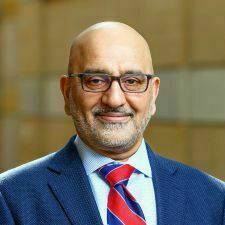
      <![CDATA[<figure class="image image-right"><img src="https://ansari.nd.edu/assets/656138/ebrahim_moosa_225.jpg" alt="The image features a man with glasses and a graying beard, dressed in a professional navy blue blazer and a red and blue striped tie. He is smiling warmly against a soft-focus architectural background, conveying a friendly yet distinguished presence." width="225" height="225"></figure>
<p>Notre Dame religion scholar<a href="https://keough.nd.edu/about/faculty-staff-directory/ebrahim-moosa/"> Ebrahim Moosa</a> will explore how using the arts and humanities in Islamic theological education might promote greater dialogue and scholarly diversity within Muslim communities and with other faith traditions.</p>
<p>Moosa, the Mirza Family Professor of Islamic Thought and Muslim Societies in Notre Dame’s <a href="https://keough.nd.edu/">Keough School of Global Affairs</a>, will work with two dozen Muslim theologians, artists and educators from Africa, North America and South Asia as part of the Pedagogies of Muslim Humanities project.</p>
<p>A product of traditional Islamic education himself, Moosa said he sees opportunities to address a gap in it. Many Islamic seminaries (both madrasas in the Sunni tradition and ḥawzas in the Shiʿa tradition) miss the opportunity to engage the humanities tradition produced by Muslim civilization, he said. Addressing that gap could help students cultivate traits such as curiosity, humility and openness to learning from other perspectives.</p>
<p>“Without these qualities, it is difficult for students to have meaningful, constructive conversations with people from different backgrounds,” Moosa said. “This project aims to revitalize the role of the arts and humanities in Islamic theological education to foster a culture of scholarly diversity and critical thinking, which is crucial for engaging with one’s own tradition as well as with people from other traditions.”</p>
<p>Key activities will include a 10-month virtual course on Islamic aesthetics, a 10-day residency at a museum of Islamic art and mentored community-based implementation where educators try out new curricula in their institutions. The project is supported by a three-year grant from the <a href="https://templetonreligiontrust.org/">Templeton Religion Trust</a>, which seeks to enrich the conversation about religion.</p>
<p>The project builds on Moosa’s earlier work as a religion scholar who is interested in revitalizing the intellectual culture of Muslim societies. In 2017, he launched the <a href="https://madrasadiscourses.nd.edu/">Madrasa Discourses</a> project engaging recently graduated Muslim theologians from South Asia.</p>
<p>Madrasa Discourses created opportunities for traditional Muslim scholars to deepen their theological and scientific literacy. Many explored their faith tradition and its resources to grapple with the philosophical challenges posed by new scientific worldviews and technologies. The project has hosted three cohorts in three countries, reaching over 100 educators.</p>
<p>Moosa is a core-affiliated faculty member of the Keough School’s <a href="https://ansari.nd.edu/">Ansari Institute for Global Engagement With Religion</a>, where he directs <a href="http://contendingmodernities.nd.edu/">Contending Modernities</a>, the global research and education initiative examining the interaction among Catholic, Muslim and other religious and secular forces in the world. He is also a faculty fellow of the Keough School's<a href="http://asia.nd.edu/"> Liu Institute for Asia and Asian Studies</a>.</p>]]>
    </content>
    <author>
      <name>Josh Stowe</name>
    </author>
  </entry>
  <entry>
    <id>tag:ansari.nd.edu,2005:News/186286</id>
    <published>2026-10-15T13:42:00-04:00</published>
    <updated>2026-10-15T13:42:01-04:00</updated>
    <link rel="alternate" type="text/html" href="https://ansari.nd.edu/news-events/news/for-older-adults-in-the-himalayas-family-and-social-connection-matters-the-most/"/>
    <title>For older adults in the Himalayas, family and social connection matters the most </title>
    <summary type="text">
      <![CDATA[Suraj Parajuli is a second-year master of global affairs student from Nepal who is majoring in governance and policy and working as a communications assistant at the Ansari Institute. His research sits at the intersection of public health, poverty and the political economy of development.…]]>
    </summary>
    <content type="html">
      <![CDATA[<p><em>Suraj Parajuli is a second-year master of global affairs student from Nepal who is majoring in governance and policy and working as a communications assistant at the Ansari Institute. His research sits at the intersection of public health, poverty and the political economy of development.</em></p>
<p>When I joined a research project on older adults in high-altitude regions of Nepal in 2024 as a co-investigator, I did not expect it to become such a meaningful part of my experience. Over the past couple of years, I have been involved in data collection, analysis and manuscript writing, and last month, we finally published our paper.</p>
<p><a href="https://journals.sagepub.com/doi/10.1177/30495334261485627">Our research</a>, published in SAGE Open Aging, looks at older adults in Lomanthang, a rural municipality in Nepal’s Mustang district, also known as a “district beyond mountains.” While health and access to services matter, our research shows that family, companionship, and social connection are equally central to how older adults experience their lives.</p>
<p>For me, one of the most important things this research brought into focus is that in the Himalayas, growing older is not only about living with physical challenges; it is also about who remains beside you. Family, friends, neighbors and community can provide something that physical facilities alone cannot: companionship, emotional support and a sense of belonging. It made me think differently about what it means to age well.</p>
<p><strong>About Project Site</strong></p>
<p><a href="https://whc.unesco.org/en/tentativelists/5256/">Lomanthang</a> sits at 3,800 meters above sea level in the Himalayas. Life there is shaped by terrain, geography, altitude, weather, migration, agriculture and limited access to services. My visit to Lomanthang village was an eye-opening experience. After travelling 12 hours on gravel and bumpy roads from Pokhara, a nearby city, I reached our project sites. Though the landscape was stunning with its mountains and rugged terrain, I also learned about the rapid environmental changes caused by climate change. Locals shared that temperatures have been rising in recent years, significantly altering their way of life, especially by reducing agricultural production.</p>
<p>Lomanthang’s terrain is arid and desert-like, with limited agricultural activities. The primary sources of income include hotel businesses and small-scale apple and potato farming. During the winter season, some older adults migrate to lower-altitude regions, while some elderly individuals remain behind to take care of their homes. Additionally, the village operates on an internal economic system, meaning that outsiders are not permitted to purchase land or property within Lomanthang. We wanted to understand what life looked like for people who had spent decades adapting to these conditions.</p>
<p><strong>The Research</strong></p>
<figure class="image image-left"><img src="https://keough.nd.edu/assets/682007/suraj_parajuli_.jpg" alt="Young man in a dark puffer jacket smiles in front of a monastery with snow-capped mountains beyond." width="600" height="600">
<figcaption>Suraj Parajuli in Nepal. Photo provided by Suraj Parajuli</figcaption>
</figure>
<p>We started this research with one simple question: What is the current status of older adults in the region in terms of their physical, mental and social well-being and what are the determinants of their quality of life.</p>
<p>To answer this question, we conducted a cross-sectional survey with narrative components designed to assess the health and quality of life comprehensively. We wanted to look beyond illness and physical health. We asked older adults about their everyday lives: who they live with, what they can do independently, what worries them, what brings them joy and what they miss.</p>
<p>Our research included 188 older adults between the ages of 65 and 89 years. Sixty-two percent of participants were living with their family members/relatives, while 38% were living without all of their family members because their children had moved to cities or abroad. In a community where youth migration is increasing, aging there means spending more time without the people who once surrounded you.</p>
<p><strong>Our findings</strong></p>
<p>Our findings showed that loneliness is the major problem that older adults in the Himalayas are going through. Loneliness emerged as a key factor shaping their physical, mental and social well-being. Our research participants described feeling happy when they could stay and talk with their children and grandchildren every day. Some talked about sitting in the sun and talking with friends and neighbors. Something as ordinary as gathering at a chautaro, a traditional resting place where people can sit and talk, could become an important part of daily life.</p>
<p>We also found loneliness among older adults (38%) was closely intertwined with regular alcohol use, which has been affecting their health status. This is because older people in Nepal often seek social connections, and they are not finding the family and social connections they need.</p>
<p>Our study found that over 90% of older adults are independently performing their activities of daily life. But in contrast, only 58% are comfortably using their in-house facilities like toilets and staircase. This highlights the mismatch between personal abilities and housing structure. This shows that housing architecture is not always age-friendly and can create functional limitations within the home.</p>
<figure class="image image-right"><img src="https://keough.nd.edu/assets/681998/fchv_lomanthang.jpg" alt="Group of people posing in front of the Lomanthang Rural Municipality building in Nepal." width="600" height="450">
<figcaption>Parajuli with Female Community Health Volunteers and research assistants in Lomanthang Rural Municipality, Mustang, Nepal. Photo provided by Suraj Parajuli</figcaption>
</figure>
<p>We also found that independence was closely connected to dignity. Participants often described the sadness of no longer being able to walk around the community, meet others, or visit the gumba. For them, dignity also lies in having the freedom to move through their community, participate in social life and remain connected to the people and places that matter to them.</p>
<p>This has broadened my understanding of “health.” In Lomanthang, however, people often described good health in much more practical terms. Being healthy meant being able to walk to see a neighbor, work in the fields, visit a gumba, a Buddhist monastery or religious site or complete daily chores without asking someone else for help.</p>
<p>So what can be done? We recommend that community-based care play a bigger role. Lomanthang already has Female Community Health Volunteers. We recommend strengthening the role of the volunteers, building their capacity, and expanding this program to other remote communities. Simple changes can also make a difference, from creating gathering spaces like chautaros to building safer, age-friendly walkways and staircases with handrails. These are small investments that can help older adults stay connected, independent, safe, and maintain their dignity.</p>
<p>Supporting older adults may not always mean only providing medical care or financial assistance, especially in highly socially connected communities like those in the Himalayas. Those things matter, but so do opportunities to remain socially connected, participate in community life, maintain independence and feel respected.</p>
<p>I am thankful to my colleagues from Nexus Institute of Research and Innovation for administering this research and to Kalash Foundation for funding this research. I am grateful to the Keough School professors for their feedback and guidance on my work and research.</p>
<p class="attribution">Originally published by <span class="rel-author">Suraj Parajuli</span> at <span class="rel-source"><a href="https://keough.nd.edu/news-and-events/news/for-older-adults-in-the-himalayas-family-and-social-connection-matters-the-most/">keough.nd.edu</a></span> on <span class="rel-pubdate">October 12, 2026</span>.</p>]]>
    </content>
    <link rel="enclosure" type="image/jpeg" href="https://ansari.nd.edu/assets/682928/data_colelction.jpg" title="Women sit on the ground with medical supplies, one is writing while others look on."/>
    <author>
      <name>Suraj Parajuli</name>
    </author>
  </entry>
  <entry>
    <id>tag:ansari.nd.edu,2005:News/186226</id>
    <published>2026-10-13T09:51:00-04:00</published>
    <updated>2026-10-13T09:52:00-04:00</updated>
    <link rel="alternate" type="text/html" href="https://ansari.nd.edu/news-events/news/prioritizing-people-and-the-planet-cardinal-turkson-stresses-dignity-integral-ecology-during-visit-to-notre-dame/"/>
    <title>Prioritizing people and the planet: Cardinal Turkson stresses dignity, integral ecology during visit to Notre Dame </title>
    <summary type="text">
      <![CDATA[Cardinal Peter Turkson visited campus October 4-6, meeting with faculty, students and administrators in the University’s Keough School of Global Affairs to share his perspectives as a leading voice on Catholic social teaching, justice and integral human development. ]]>
    </summary>
    <content type="html">
      <![CDATA[<figure class="image image-right"><img src="https://keough.nd.edu/assets/682335/katongole_turkson_class.jpg" alt="Cardinal Peter Turkson visited Rev. Emmanuel Katongole’s ethical practice seminar, where he took questions from global affairs students. Photo credit: Daniel Hilles." width="600" height="400">
<figcaption>Cardinal Peter Turkson visited Rev. Emmanuel Katongole’s ethical practice seminar, where he took questions from global affairs students. Photo credit: Daniel Hilles.</figcaption>
</figure>
<p>Human dignity and environmental sustainability are interconnected parts of a holistic vision that can help changemakers address global challenges as they work toward a more just and peaceful world, Cardinal Peter Turkson said during his recent visit to the University of Notre Dame.</p>
<p>Turkson, the chancellor of the Pontifical Academies of Social Sciences and Sciences, visited campus October 4-6, beginning with a celebration of the Eucharist at the Basilica of the Sacred Heart. He met with faculty, students and administrators in the University’s <a href="https://keough.nd.edu/">Keough School of Global Affairs</a> to share his perspectives as a leading voice on Catholic social teaching, justice and integral human development.</p>
<p>“Integral human development makes an important point,” the Ghanaian prelate said during a visit to an undergraduate global affairs class, where he explained the need for a moral framework that centers the dignity of each person and the whole person. “Everything is interconnected, and everything is interdependent.”</p>
<p>Turkson underscored that message throughout his visit, analyzing global challenges including conflict, climate change and poverty alleviation through a people-centered approach inspired by Catholic social teaching and the integral ecology of Pope Francis’ encyclical Laudato si’. The encyclical emphasized care for creation in a world threatened by climate change and Turkson led the team that produced the first draft through the Pontifical Council of Justice and Peace.</p>
<h2>Sharing insights with students</h2>
<figure class="image image-right"><img src="https://keough.nd.edu/assets/682288/shea_kelly.jpg" alt="Shea Kelly, a first-year global affairs major, asked Turkson about his perspective on sustainable development." width="600" height="400">
<figcaption>Shea Kelly, left, asked Cardinal Turkson about his perspective on sustainable development during Professor Katongole’s class. The first-year global affairs major appreciated the opportunity to interact with him. Photo credit: Daniel Hilles.</figcaption>
</figure>
<p>Turkson talked with students during a visit to an ethical practice seminar taught by <a href="https://keough.nd.edu/about/faculty-staff-directory/emmanuel-katongole/">Rev. Emmanuel Katongole</a>, professor of theology and peace studies and director of the Keough School’s <a href="https://ansari.nd.edu/">Ansari Institute for Global Engagement with Religion</a>.</p>
<p>Students like Shea Kelly, a first-year global affairs major, appreciated the opportunity to meet with the cardinal.</p>
<p>“It’s great to interact with people who are making big contributions in their fields,” said Kelly, who asked Turkson for his perspective on the United Nations’ <a href="https://sdgs.un.org/goals">Sustainable Development Goals</a>. “These are people we’re reading about as we try to understand ethical frameworks we can apply today. I’m a first-year student, so these new opportunities are really exciting to me.”</p>
<p>Drawing on his perspective of living in Ghana, a developing country, Turkson stressed the importance of subnational implementation efforts, hailing the work of the <a href="https://www.bethanylandinstitute.org/">Bethany Land Institute</a>, whose advisory board he sits on. The Uganda-based initiative, co-founded by Katongole, uses sustainable agriculture to address environmental and poverty issues. Turkson said such efforts, born of founders’ personal conviction, are often the most impactful change catalysts.</p>
<p>Johnny Jimenez, a junior global affairs major and peace studies minor, asked Turkson about the relationship between science and religion, which Turkson stressed were complementary. Jimenez found it helpful to hear the cardinal's insights.</p>
<p>“When you talk about global affairs, which is realistically how the world should be, it's super important to talk to the people whose whole life centers on that,” Jimenez said. “Getting to talk to them and hear their perspective is amazing.”</p>
<h2>Addressing today’s global challenges</h2>
<figure class="image image-right"><img src="https://keough.nd.edu/assets/682286/cardinal_turkson_forum_dean_gallagher.jpg" alt="Cardinal Turkson joined Dean Mary Gallagher for the Dean’s Forum on Global Affairs." width="600" height="400">
<figcaption>Cardinal Turkson joined Dean Mary Gallagher for the Dean’s Forum on Global Affairs. Photo credit: Daniel Hilles.</figcaption>
</figure>
<p>During his visit, Turkson also had a wide-ranging conversation with <a href="https://keough.nd.edu/about/faculty-staff-directory/mary-gallagher/">Mary Gallagher</a>, the Marilyn Keough Dean of the Keough School, as part of the <a href="https://keough.nd.edu/news-and-events/news/policy-perspective-connecting-scholarship-and-action-at-the-keough-school/">Dean’s Forum on Global Affairs,</a> a series designed to bring world leaders into conversation with Notre Dame students, faculty and the broader community around current global issues.</p>
<p>This year marks the 60th anniversary of Populorum Progressio, Pope Paul VI’s Encyclical on the development of peoples, and a call to hear the cry of the poor. Decades after that landmark document, this year’s forum explores the future of the good life, seeking to address its focus in a modern context.</p>
<p>“I was struck by how much optimism there was in the document about the idea that development will bring peace,” Gallagher said. “And now we are 60 years on and we have lots more development around the world, but we do not yet have peace.</p>
<p>“So we’re coming together this year to talk about some fundamental questions: What does it mean for people and communities to flourish? What kind of world are we trying to build? And what responsibilities do we have to one another as we think about the future? These questions are very much in line with the Keough School’s mission of advancing integral human development. And I think today's conversation is a wonderful way to begin that exploration.”</p>
<p>Discussion explored underappreciated aspects of integral human development and how economies should look behind technocratic measures such as Gross Domestic Product to ensure they are actually serving the common good.</p>
<p>The conversation also explored how to think about artificial intelligence. Turkson advocated for good governance that would ensure AI supports human dignity rather than undermining it. “This is the balance we need to strive for,” he said. “We view this as a tool to advance our own human endowments and human qualities. But when the tool replaces what we are, then it becomes problematic,”</p>
<figure class="image image-right"><img src="https://keough.nd.edu/assets/682284/cardinal_turkson_book_launch_panel.jpg" alt="During his visit, Cardinal Turkson joined contributors to Integral Ecology in the Anthropocene for a book launch and discussion on the application of integral ecology in Africa and beyond." width="600" height="400">
<figcaption>During his visit, Cardinal Turkson joined contributors to Integral Ecology in the Anthropocene for a book launch and discussion on the application of integral ecology in Africa and beyond. Photo credit: Daniel Hilles.</figcaption>
</figure>
<p>Conversation also unpacked Laudato si’s integral ecology, a holistic way of viewing humankind’s relationship with creation that moves beyond consumption and indifference and toward stewardship and solidarity, recognizing how humanity and nature are interconnected. Turkson shared anecdotes from his work promoting the message of the encyclical, noting that although government action for addressing climate change was mixed, integral ecology has received support from universities and multiple religious traditions. “We need to listen to the cry of the poor and the cry of the earth,” he said. “The two come together.”</p>
<p>In addition, Turkson addressed universities’ roles in connecting faith and evidence in the search for knowledge, and in supporting young people as they prepare to start their careers and shape a more humane future. He cited the 19th-century theologian and writer John Henry Newman as an inspiration for how educators should approach their craft: “Speaking heart to heart has become a model for professors and teachers who seek to form young people.”</p>
<p>Turkson also encouraged students seeking to become changemakers to avoid self-imposed limits. He drew on his personal story, which began in a small Manganese mining town in Ghana, where he was one of 10 children born to a carpenter and vegetable vendor. Yet he did not let these humble roots define him. He pursued education and a vocation to the priesthood, learned multiple languages and became a leader in the Catholic Church who has worked on major global issues including climate change.</p>
<p>“When you make the effort, you can exceed what you consider to be limits, some of which are self-imposed and not real,” Turkson said. “And so my advice would be this, that students set aside these preliminary limitations that they sometimes put on their capacities and mental abilities, and be open to the idea that the God who made man in his image also endowed us with a great capacity closer to his own divine mind.”</p>
<p class="attribution">Originally published by <span class="rel-author">Josh Stowe</span> at <span class="rel-source"><a href="https://keough.nd.edu/news-and-events/news/prioritizing-people-and-the-planet-cardinal-turkson-stresses-dignity-integral-ecology-during-visit-to-notre-dame/">keough.nd.edu</a></span> on <span class="rel-pubdate">October 12, 2026</span>.</p>]]>
    </content>
    <link rel="enclosure" type="image/jpeg" href="https://ansari.nd.edu/assets/682434/1200x675_cardinal_turkson_katongole_class.jpg" title="Cardinal Peter Turkson visited Rev. Emmanuel Katongole’s ethical practice seminar, where he took questions from global affairs students."/>
    <author>
      <name>Josh Stowe</name>
    </author>
  </entry>
  <entry>
    <id>tag:ansari.nd.edu,2005:News/186227</id>
    <published>2026-10-13T09:51:00-04:00</published>
    <updated>2026-10-13T09:51:08-04:00</updated>
    <link rel="alternate" type="text/html" href="https://ansari.nd.edu/news-events/news/istanbul-summer-program/"/>
    <title>Encounters in Türkiye: Notre Dame's Istanbul Summer Program—From the Stone Age to the Drone Age</title>
    <summary type="text">
      <![CDATA[Where History Comes to Life For many students, studying history entails…]]>
    </summary>
    <content type="html">
      <![CDATA[<figure class="image image-default"><img src="https://admissions.nd.edu/assets/681710/1040x/istanbulsummergrand_aml_ca_mosque.jpg" alt="Eight students smile in front of a city skyline." width="1040" height="650"></figure>
<h3>Where History Comes to Life</h3>
<p>For many students, studying history entails reading about distant civilizations, political conflicts, and religious traditions from a textbook. For students in Notre Dame’s <a href="https://ansari.nd.edu/student-opportunities/academics/academics-experiential-learning-courses/istanbul-summer-from-the-stone-age-to-the-drone-age/">Istanbul Summer program</a>, those lessons extend beyond the classroom.</p>
<p>Over the course of three weeks, students embark on a journey through Türkiye, with two weeks in Istanbul and the remaining week traveling throughout the country. Led by<a href="https://keough.nd.edu/about/faculty-staff-directory/mahan-mirza/"> Professor Mahan Mirza</a>, Executive Director of the Ansari Institute, the learning experience explores thousands of years of history, from the origins of religion in the Stone Age to the fall of Constantinople, the rise of the Ottoman Empire to the complexities of modern Türkiye.</p>
<p>The program, titled “Istanbul Summer: From the Stone Age to the Drone Age,” captures the breadth of the journey. Along the way, students visit some of the country’s most significant historical and religious sites, including the Hagia Sophia, Topkapı Palace, the Çamlıca Mosque, Konya, Ephesus, and Gallipoli.</p>
<p>The idea for the Istanbul Summer program grew out of an earlier Notre Dame course that brought students to Oman. In spring 2020, Mirza participated in a spring break dialogue journey to Muscat as part of a course called Holy Crossroads, which examined global educational networks of the Congregation of Holy Cross.</p>
<p>After Mirza approached <a href="https://global.nd.edu/">Notre Dame Global</a> with a proposal for a winter course in Oman and learned that Notre Dame did not currently offer courses for credit during the winter, they began exploring possible summer destinations.</p>
<p>Istanbul quickly emerged as a natural fit.</p>
<p>“Türkiye bridges Europe and Asia, East and West,” Mirza says. “It is a magical city with layers of history: Greek, Roman, Byzantine, Ottoman, and modern Turkish.”</p>
<p>That history is visible throughout Istanbul. Students visit archaeological sites, museums, mosques, churches, Sufi lodges, bazaars, and universities. For Mirza, the value of the program extends beyond simply seeing historic landmarks. “Classes like Istanbul Summer are bigger than any single topic or experience,” he says. “They are invitations to a culture of encounter.”</p>
<h3>Discovery Beyond the Classroom</h3>
<p>Throughout the program, students engage with questions of identity and belonging, religion and politics, innovation and nostalgia. Notre Dame student Joshua Barnard ‘28 had a longstanding interest in history and knew much of the region’s story. He found it surreal to stand in ancient sites he had spent many years in school reading about. This program allowed him to engage with these traditions while exploring a culture and religious tradition that were new to him.</p>
<p>One of the moments that affected him most was during a visit to a church in Ankara, where the congregation was composed of Turkish converts to Chrisitanity. Having the ability to share in</p>
<p>their faith in a very different geographic setting gave Barnard a new perspective on the global Christian community.</p>
<p>“History stops being abstract. The classroom gives students concepts and context; being there introduces texture, ambiguity, emotion, and sometimes discomfort. You begin to notice that the same place can carry very different meanings for different people,” Mirza says.</p>
<h3>Understanding the Unfamiliar</h3>
<figure class="image image-right"><img src="https://admissions.nd.edu/assets/681712/500x/lukemontanoat_the_roman_city_of_perce.jpg" alt="Man in white polo and sunglasses walks past a group of people by an ancient stone archway." width="500" height="667">
<figcaption>Joshua Barnard '28 at the Roman city of Perge</figcaption>
</figure>
<p>For Luke Montano, a Notre Dame junior who embarked on this journey to Istanbul, the opportunity to immerse himself in a culture different from his own was a major reason for participating. Having traveled extensively throughout Europe, Montano wanted to discover a place that felt less familiar. He had never visited a majority-Muslim country and was particularly interested in Islam and the history of Istanbul and Constantinople.</p>
<p>His time in Türkiye challenged some of the assumptions he had carried with him prior to arriving. Montano had grown up with the impression that Muslim-majority countries were populated largely by highly fundamentalist religious communities. Instead, he found that many people he interacted with described themselves as Muslim while distinguishing themselves from being particularly religious. This was a dynamic he found comparable to nominal Christianity in the United States.</p>
<p>“The country may be of a different religion, but the people are not as foreign to us as we have been taught to believe," Montano says.</p>
<p>Montano found that some of the most valuable lessons came not simply from observing religious sites, but from speaking directly with people. At the Blue Mosque, he visited an “Ask Me About Islam” stand, and spent about 30 minutes speaking with a Syrian man about questions ranging from the Assad regime to Islamic theology.</p>
<p>The conversation, Montano says, made his visit to the Blue Mosque far more meaningful than simply seeing the building itself. For him, travel was ultimately about the people he encountered and the conversations that followed.</p>
<h3>The Tensions of a Modern Identity</h3>
<p>The course then moves into the modern era, examining Türkiye’s role in the global balance of power. Students visit the Naval Museum and the Dardanelles, a strategically important waterway connecting the Sea of Marmara to the Aegean and broader Mediterranean.</p>
<p>“The ‘Drone Age’ part of the title is a poetic reference to Türkiye’s role in the balance of global power,” Mirza says. The program encourages students to consider how the country’s ancient past continues to shape its modern identity. That complexity is one of the central ideas students engage with throughout the course.</p>
<p>“Perhaps the biggest question is what happens when a place refuses to fit neatly into our categories,” Mirza says. “Is Türkiye European or Asian? Eastern or Western? Religious or secular? Modern or traditional? Of course, the answer in every case is both–and neither.”</p>
<p>Students consider how people inherit history without being imprisoned by it, how religious and national identities coexist, and how memories of conquest, displacement, coexistence, and conflict continue to shape the present.</p>
<p>For Montano, this tension became especially apparent when he and a friend debated Turkish attitudes toward the country’s Ottoman past and its modern history during a flight from Ankara. The conversation followed a visit to the burial place of Mustafa Kemal Atatürk, where Montano observed the significance of Atatürk to modern Turkish national identity.</p>
<p>“I understand the degree to which Turkey is caught between two worlds: the West/Europe and the Middle East/Islamic world,” Montano says. “It has a unique identity situated between both and has a fascinating history, culture, and active political tensions.”</p>
<figure class="image image-default"><img src="https://admissions.nd.edu/assets/681723/1040x/istanbulsummerlukeandjoshua.jpg" alt="Two men stand near ancient ruins with a hillside of green trees and ruins in the background." width="1040" height="650">
<figcaption>Left to right: Barnard and Luke Montano standing on a pillar at the Temple of Artemis in Ephesus, View of the Bouleuterion of Ephesus</figcaption>
</figure>
<h3>Learning Through Encounter</h3>
<p>Some of the program’s most meaningful lessons come not only from historical sites, but from interactions with the people students meet along the way. Students speak with Turkish scholars and religious leaders and explore different perspectives on religion, history, and identity.</p>
<p>Mirza recalls several moments that stayed with him, including a late-night visit to a Sufi lodge, a quiet moment of contemplation at the House of Mary, and conversations with a Greek Orthodox priest in Ephesus. In another instance, a student wearing a cross around his neck was confronted by a Turkish man who took offense to it. A woman wearing a headscarf stepped in to defend the student’s right to religious freedom. For Mirza, these exchanges demonstrated the complexity students discover when they move beyond the classroom.</p>
<p>Another conversation with a Greek Orthodox priest offered a different perspective. Rather than focusing on the tragedies of the past, the priest spoke optimistically about the schools, churches, educational programs, and relationships through which the community continues to thrive.</p>
<p>Students’ final assignment brings together five sources: the course’s common book, a poem by Rumi, a journal reflection, a book of their choosing, and an actual experience from their time in Türkiye. For Mirza, that approach reflects Notre Dame’s broader commitment to experiential learning.</p>
<p>“Notre Dame’s distinctiveness comes from its faith-based identity and mission,” he says. “Spiritual questions need not be bracketed. Rather, they are the essential fabric for the tapestry of the global classroom.”</p>
<p>The result is an academic immersion in which students are asked not only to learn about history, but to engage with it, reflect on it, and consider how it continues to shape the world around them.</p>
<figure class="image image-default"><img src="https://admissions.nd.edu/assets/681726/fullsize/istanbulcollagestudents.jpg" alt="Young man in cave, another man viewing fresco, and group conversing outdoors." width="852" height="1042">
<figcaption>Top (left): Montano in the underground city of Kaymakli; (right): Barnard in one of the rock cut chapels in a Cappadocian monastery; Bottom: Istanbul Summer students chat on the Hippodrome in Constantinople</figcaption>
</figure>
<p>  <br>For Montano, the journey also reinforced the value of traveling beyond familiar surroundings. Throughout the trip, he was struck by the hospitality of the people he met, recalling instances when locals went out of their way to help students who were lost or confused.</p>
<p>“My biggest takeaway about Türkiye itself is that, in the 21 countries I have visited, I have never encountered such friendly and welcoming people,” he says.</p>
<p>Both students ultimately came away with a deeper appreciation for what can happen when learning moved beyond the traditional classroom. For Barnard, the program brought history and Christian communities he had studied to life. For Montano, it challenged assumptions and encouraged conversations with people whose perspectives differed from his own.</p>
<p>“The biggest thing I took away was the value of traveling, seeing new places, and meeting people with experiences vastly different from my own,” Montano says.</p>
<p>Through Istanbul Summer, students move from ancient archaeological sites to modern geopolitical questions, from classrooms to religious spaces, and from historical texts to conversations with people living that history today. In the process, the program offers a different way of understanding the past, not as something distant and settled, but as something that continues to influence how people understand faith, identity, culture, and the world they inhabit.</p>
<p><em>Photo at top: Istanbul Summer program students at the Grand Çamlıca Mosque</em></p>
<p class="attribution">Originally published by <span class="rel-author">Jillian Pavalon</span> at <span class="rel-source"><a href="https://admissions.nd.edu/visit-engage/stories-news/istanbul-summer-program/">admissions.nd.edu</a></span> on <span class="rel-pubdate">October 12, 2026</span>.</p>]]>
    </content>
    <link rel="enclosure" type="image/jpeg" href="https://ansari.nd.edu/assets/682435/istanbulsummerlukeandjoshua.jpg" title="Two men stand near ancient ruins with a hillside of green trees and ruins in the background."/>
    <author>
      <name>Jillian Pavalon</name>
    </author>
  </entry>
  <entry>
    <id>tag:ansari.nd.edu,2005:News/185875</id>
    <published>2026-09-30T09:45:00-04:00</published>
    <updated>2026-10-01T12:28:13-04:00</updated>
    <link rel="alternate" type="text/html" href="https://ansari.nd.edu/news-events/news/in-rome-notre-dame-convening-engages-womens-voices-to-help-shape-afghanistans-future/"/>
    <title>In Rome, Notre Dame convening engages women’s voices to help shape Afghanistan’s future</title>
    <summary type="text">
      <![CDATA[A recent Notre Dame convening in Rome brought together women from the Afghan diaspora. The gathering sought to elevate women’s voices as part of ongoing conversations about building a peaceful, pluralistic future for the country.]]>
    </summary>
    <content type="html">
      <![CDATA[<figure class="image image-right"><img src="https://keough.nd.edu/assets/680516/women_in_afghanistan_1200x675.jpeg" alt="Afghan women are pictured. Notre Dame's Afghanistan Program for Peace and Development is working to elevate women's voices as it seeks broad input on what a peaceful and pluralistic future for Afghanistan might look like. Photo credit: Eric Draper / The White House." width="600" height="338">
<figcaption>The Afghanistan Program for Peace and Development is working to elevate women's voices as it seeks broad input on what a peaceful and pluralistic future for Afghanistan might look like. Photo credit: <a href="https://commons.wikimedia.org/wiki/File:Women_of_Afghanistan.jpg">Eric Draper / The White House</a>.</figcaption>
</figure>
<p>What is the role of religion in Afghanistan? Should a future state have an official religion? How — or should — the international community engage with the Taliban, or does doing so confer legitimacy on a repressive regime?</p>
<p>These questions were at the heart of a recent convening hosted by the <a href="https://kroc.nd.edu/policy-practice/afghan-peace-and-development-research-program/">Afghanistan Program for Peace and Development</a>, part of the<a href="https://kroc.nd.edu/policy-practice/afghan-peace-and-development-research-program/"> Kroc Institute for International Peace Studies</a> at the University of Notre Dame’s <a href="https://keough.nd.edu/">Keough School of Global Affairs.</a></p>
<p>Hosted by <a href="https://rome.nd.edu/">Notre Dame Rome</a>, the gathering brought together 20 women from the Afghan diaspora to wrestle with a variety of issues and imagine a peaceful and pluralistic future. The convening, which was organized to elevate women's voices, united this diverse group around a singular task: contributing to a larger vision for a just, inclusive and peaceful Afghanistan. It is part of a larger effort by the Afghanistan Program for Peace and Development to promote ongoing dialogue in an effort to build that future.</p>
<p>“Hope was a difficult word for me to say,” one participant said, reflecting a sentiment shared by other participants amid ongoing uncertainty over Afghanistan’s future. But hope animated the conversations that unfolded over several days.</p>
<p>Discussion explored core themes that included the role of religion and the importance of inclusion. Participants grappled with how to ensure meaningful representation across ethnic, gender, socioeconomic and regional lines, and called for the inclusion of people with disabilities, LGBTQ+ people and rural communities.</p>
<p>A central question was whether religious pluralism remains viable when some conservative interpretations of Islam disenfranchise vulnerable groups, including women. Participants recognized that religion would likely be part of Afghanistan’s future governance, thus making the work of reimagining its role even more important.</p>
<p>Conversation also focused on international engagement with the Taliban. Participants expressed concern that even minimal diplomatic contact by European and regional powers risks conferring tacit approval on an oppressive regime. This was in tension with another concern: finding leverage to demand that the regime uphold basic human rights.</p>
<p>Navigating this dilemma was further complicated by the reality articulated by an attending diplomat: There is no appetite globally or domestically for armed resistance. This dynamic has led the Afghan diaspora to seek accountability without relying on it.</p>
<p>Following virtual solidarity exchanges with veteran activists from Indonesia, Gaza, Syria, Myanmar and Northern Ireland, the focus shifted from vision to action. Drawing on insights from these contexts, participants formally committed to continuing their work together as they support building a diverse coalition to help shape Afghanistan’s future.</p>
<p>The Rome gathering is part of the broader <a href="https://kroc.nd.edu/policy-practice/afghan-peace-and-development-research-program/the-afghanistan-dialogue-and-visioning-process-dvp/">Dialogue and Visioning Process</a> organized by the Afghanistan Program for Peace and Development. The process brings together multiple constituencies, including scholars, human rights experts, political leaders, economists and activists.</p>
<p>The program has tasked each cohort with drafting a vision document of shared principles for the country's future. Earlier contributions had highlighted the need to elevate women’s voices as part of the conversation.</p>
<p>“Afghan women particularly from marginalized minorities bear the weight of the crisis like no other group,” said Aref Dostyar, program director for the Afghanistan Program for Peace and Development. “That’s why we built a dedicated space for women to facilitate internal dialogues. Their conversations will ripple outward and enrich the ongoing discussions we continue to support.”</p>
<h2>Related story</h2>
<p><a href="https://keough.nd.edu/news-and-events/news/new-partnership-aims-to-support-afghan-womens-access-to-higher-education/">New partnership aims to support Afghan women’s access to higher education</a></p>
<p class="attribution">Originally published by <span class="rel-author">Rebekah Go</span> at <span class="rel-source"><a href="https://keough.nd.edu/news-and-events/news/in-rome-notre-dame-convening-engages-womens-voices-to-help-shape-afghanistans-future/">keough.nd.edu</a></span> on <span class="rel-pubdate">September 30, 2026</span>.</p>]]>
    </content>
    <link rel="enclosure" type="image/jpeg" href="https://ansari.nd.edu/assets/680634/women_in_afghanistan_1200x675.jpeg" title="Afghan women are pictured. Notre Dame's Afghanistan Program for Peace and Development is working to elevate women's voices as it seeks broad input on what a peaceful and pluralistic future for Afghanistan might look like. Photo credit: Eric Draper / The White House."/>
    <author>
      <name>Rebekah Go</name>
    </author>
  </entry>
  <entry>
    <id>tag:ansari.nd.edu,2005:News/184952</id>
    <published>2026-08-20T14:07:57-04:00</published>
    <updated>2026-08-20T14:07:57-04:00</updated>
    <link rel="alternate" type="text/html" href="https://ansari.nd.edu/news-events/news/two-notre-dame-faculty-members-and-university-trustee-appointed-by-pope-leo-xiv-as-consultors-to-the-dicastery-for-promoting-integral-human-development/"/>
    <title>Two Notre Dame faculty members and University Trustee appointed by Pope Leo XIV as consultors to the Dicastery for Promoting Integral Human Development</title>
    <summary type="text">
      <![CDATA[On Tuesday (Aug. 18), Pope Leo XIV appointed two University of Notre Dame faculty members, Emmanuel Katongole and Clemens Sedmak, as consultors to the Dicastery for Promoting Integral Human Development. University Trustee Kathryn “Katie” Koch, president and CEO of TCW, a global investment management firm, was also named a consultor.]]>
    </summary>
    <content type="html">
      <![CDATA[<figure class="image image-right"><img src="https://news.nd.edu/assets/674559/600x400/katongole_sedmak_koch_2026.jpg" alt="Three headshots of smiling people: A man in a dark suit with clerical collar; A man in dark suit and light green dotted tie; And a woman in a leather jacket." width="600" height="400">
<figcaption>Emmanuel Katongole, Clemens Sedmak, and Kathryn “Katie” Koch have been appointed by Pope Leo XIV as consultors to the Dicastery for Promoting Integral Human Development.</figcaption>
</figure>
<p>On Tuesday (Aug. 18), Pope Leo XIV appointed two University of Notre Dame faculty members, <a href="https://news.nd.edu/our-experts/emmanuel-katongole/">Emmanuel Katongole</a> and <a href="https://news.nd.edu/our-experts/clemens-sedmak/">Clemens Sedmak</a>, as consultors to the Dicastery for Promoting Integral Human Development. University Trustee Kathryn “Katie” Koch, president and CEO of TCW, a global investment management firm, was also named a consultor.</p>
<p>Katongole, a professor of theology and peace studies and director of the <a href="https://ansari.nd.edu/">Ansari Institute for Global Engagement with Religion</a>; Sedmak, a professor of social ethics and director of the <a href="https://nanovic.nd.edu/">Nanovic Institute for European Studies</a>; and Koch are among 12 new consultors from around the globe—and the only three selected from within the United States. They have been appointed for a five-year term.</p>
<p>Consultors may be religious or laypeople and are chosen “from among the faithful who are distinguished by their expertise, proven ability, and prudence,” according to the Vatican’s announcement.</p>
<p>“These appointments are a tremendous honor not only for Emmanuel, Clemens, and Katie, but for the University as a whole,” said Notre Dame President <a href="https://president.nd.edu/about/">Rev. Robert A. Dowd, C.S.C.</a> “We congratulate them on their selection, and we are deeply grateful for the Holy Father’s recognition of their expertise and abiding commitment to the Church. We look forward to the ways their leadership and wisdom will guide the important work of the dicastery.”</p>
<p>Established by the late Pope Francis in 2016, the Dicastery for Promoting Integral Human Development supports the Church’s worldwide efforts in the areas of human dignity and human rights, economic justice, care for creation, migration, and displacement, as well as peace, conflict, and humanitarian crises.</p>
<p>Katongole, who came to Notre Dame in 2013, holds a joint appointment in the University’s <a href="https://al.nd.edu/">College of Arts and Letters</a> and <a href="https://keough.nd.edu/">Keough School of Global Affairs</a>. A native of Kampala, Uganda, and a priest of the Kampala Archdiocese, he is the founder and president of <a href="https://stories.nd.edu/stories/restoring-gods-creation/">Bethany Land Institute</a>, a residential agricultural institute that works with young people to realize the vision, spirituality, and practice of Laudato si’ in Uganda. Before joining the Notre Dame faculty, he served as an associate professor of theology and world Christianity at Duke University and was a founding co-director of the Duke Center for Reconciliation. He earned a Bachelor of Divinity at the Pontifical University Urbaniana in Rome, as well as a master’s in religious studies and a doctoral degree in philosophy from the Catholic University of Louvain in Belgium.</p>
<p>Sedmak, a concurrent professor of theology, holds a joint appointment in Notre Dame’s <a href="https://socialconcerns.nd.edu/">Institute for Social Concerns</a> and the Keough School. His research focuses on issues of poverty, justice, and the Catholic social tradition, as well as a collaboration with Notre Dame colleagues on the Church’s role in <a href="https://stories.nd.edu/stories/viaggi/">acclimating refugees into Italian society</a>. A native Austrian, Sedmak holds a doctoral degree in theology from the Catholic Private University of Linz and doctoral degrees in philosophy and social theory from the University of Innsbruck. Prior to joining Notre Dame, Sedmak served as the F.D. Maurice Professor for Moral Theology and Social Theology at King’s College London. He also held multiple positions at the University of Salzburg and was president of the Institute for Advanced Studies in Social Ethics in Salzburg.</p>
<p>Koch, a Notre Dame alumna, was <a href="https://news.nd.edu/news/notre-dame-elects-new-trustees-2/">named a University Trustee in 2023</a>. Prior to moving to TCW, she spent 20 years at Goldman Sachs in a variety of leadership positions, including chief investment officer of public equity. She graduated from Notre Dame in 2002 with a Bachelor of Arts in economics and English.</p>
<p class="attribution">Originally published by <span class="rel-author">Carrie Gates</span> at <span class="rel-source"><a href="https://news.nd.edu/news/two-notre-dame-faculty-members-and-university-trustee-appointed-by-pope-leo-xiv-as-consultors-to-the-dicastery-for-promoting-integral-human-development/">news.nd.edu</a></span> on <span class="rel-pubdate">August 20, 2026</span>.</p>]]>
    </content>
    <link rel="enclosure" type="image/jpeg" href="https://ansari.nd.edu/assets/674576/katongole_sedmak_koch_2026.jpg" title="Three headshots of smiling people: A man in a dark suit with clerical collar; A man in dark suit and light green dotted tie; And a woman in a leather jacket."/>
    <author>
      <name>Carrie Gates</name>
    </author>
  </entry>
  <entry>
    <id>tag:ansari.nd.edu,2005:News/184833</id>
    <published>2026-08-19T15:15:00-04:00</published>
    <updated>2026-08-19T15:15:03-04:00</updated>
    <link rel="alternate" type="text/html" href="https://ansari.nd.edu/news-events/news/the-twilight-of-constantinople-and-the-new-dawn-of-nostalgia/"/>
    <title>The Twilight of Constantinople and the New Dawn of Nostalgia</title>
    <summary type="text">
      <![CDATA[Many modern secularists and so-called enlightenment thinkers made the mistake of assuming that progress required a complete sterilization of the premodern world, that the more archaic practices and undesirable elements of the past somehow meant that all premodern values must be false or a hindrance to the future. Turkey is a prime example of this.]]>
    </summary>
    <content type="html">
      <![CDATA[<figure class="image image-right"><img src="https://ansari.nd.edu/assets/674097/istanbul_summer_josh.jpg" alt="The photograph captures two young men walking side by side down a stone path through ancient brick and marble ruins under a bright, clear blue sky. Both are dressed casually in dark sleeveless or short-sleeved tops and shorts, wearing dark footwear and sunglasses. Surrounding them are crumbling stone walls, archways, and pillars made of reddish brick and light-colored stone. In the background, other visitors are visible, along with rolling green hills against the horizon." width="450" height="253">
<figcaption>Joshua and another student walk along a stone pathway through the ruins of the Church of Mary in ancient Ephesus, Turkey.</figcaption>
</figure>
<p>I walked along the old Byzantine walls on the edge of the city’s Fatih district. On either side were the sounds of busy highways, car horns, and the thousands of people who lived nearby. While the rest of the city carried on as it had for nearly 600 years, I stood atop the battlements and pictured the inevitable armies of Mehmet the Conqueror as they defeated the unyielding last of the Christian Romans, who held the city until the very end. Thomas Madden, in his <em>Istanbul: City of Majesty at the Crossroads of the World</em>, proclaims that the city’s strength “was never solely in its mighty walls or its well trained militaries, but in the determination of its inhabitants to hold firm to it no matter the cost.” Nevertheless, the Islamic Ottomans would prevail over the Christians who first founded the magnificent city 1700 years ago. A short distance into the old city, the effects of this monumental event are still felt. The nearby Chora Church, now Karriye Mosque, stands as one of the last places where Byzantine iconography can still be seen.</p>
<p>Undoubtedly the most significant symbol of the great Islamic victory is the Hagia Sophia. Flanked by a skyline of minarets and mirrored by the splendour of the Blue Mosque, the Hagia Sophia remains a contentious reminder that this city was once the greatest Christian city in the world. Provocations between Christians and Muslims still continue within, and I too lamented seeing the beautiful mosaics of Mary and Jesus crumble and be covered by white sheets. A rich knowledge of history and fervor for religious faith leaves Constantinople a continual symbolic battleground between Eastern Christians and Muslims. Madden fittingly describes the city as “a meeting place and a battlefield for cultures...too important to abandon. Too strategic to avoid. Too beautiful to resist.” As a devoted Catholic and lover of history myself, especially Roman history, it was easy for me to want to dive into the historical nostalgia battle of Christian Byzantine against Islamic Ottoman, to lament the loss of a city and empire that fell 600 years ago. However, my encounter with the city revealed a somber truth that would make Mehmet and Constantine brothers despair. The splendour of Constantinople and the old world from which it came is fading. This fading is due neither to Christians nor Muslims, but to new forces that most of the world has already embraced. Secularism, consumerism, postmodernism, nationalism, the new order of the world has many labels and characteristics. Which ideology one blames for the fading of the old world is irrelevant. The world is forgetting, sometimes intentionally, the virtues and beauty of the past and the things that made Constantinople a magnificent city in the first place, under both Christians and Muslims.</p>
<figure class="image image-right"><img src="https://ansari.nd.edu/assets/673672/istanbul_summer_15x450jpg.jpg" alt="Looking up inside the Blue Mosque, a massive fluted marble pillar dominates the center, surrounded by soaring hand-painted domes, stained-glass windows, and low-hanging circular chandeliers illuminating visitors on the carpeted floor below. Photo credit Stephanie Mirza." width="450" height="338">
<figcaption>The inside of the Blue Mosque. Photo credit Stephanie Mirza.</figcaption>
</figure>
<p>Constantinople was the crossroads of the world—a place where east and west met, and where an Islamic realm met Christendom. Even after the Ottoman conquest, Constantinople continued to be home to a vibrant community of many Christian Greeks and Armenians, alongside Jews, Italians, and Muslims. It was a hub of international trade and home to dozens of different religious, philosophical, and scientific movements. Ottoman sultans built huge mosques across the city, almost as if to outdo the magnificence of the Byzantines before them, who had once built the city with a similar mindset. Caroline Finkel’s book <em>Osman’s Dream</em> expressed the Ottoman’s sense of divine purpose in its founding myth, in which the first sultan, Osman, “saw that a moon arose from the holy man's breast and came to sink in his own breast. A tree then sprouted from his navel and its shade encompassed the world..." Across both regimes, Constantinople’s magnificence was driven by its imperial character as a city that bridged many worlds and eras, ruled by men with bold ambitions and a deep religiosity.</p>
<p>The view of Constantinople and the premodern era that I have presented thus far is undoubtedly a romanticized view of history, one that does not take into account the many nuances and darker events of the past. Indeed, even as I toured the Topkapi Palace, the beauty and magnificence of the old Ottoman seat of power was constantly stood in juxtaposition with a history of fratricide, slavery, and a somewhat dehumanizing marriage system. Similarly, the beauty of the Hagia Sophia as a great temple to God appears in somewhat of a contradiction given that its patron, Emperor Justinian, had 30,000 rebels massacred within the city hippodrome. History is indeed filled with contrasts and darker elements that shouldn’t be ignored, but this doesn’t mean that an eye for nostalgia or romanticism has no place in society or politics. Across time and culture, nostalgia can be a tool not for turning back the clock and potentially reviving past evils, but instead for mapping out a future that restores certain diminished values from the past.</p>
<figure class="image image-right"><img src="https://ansari.nd.edu/assets/673710/istanbul_summer_34x450.jpg" alt="This photo was taken from the observation terrace at Çamlıca Hill (Çamlıca Tepesi) in the Üsküdar district of Istanbul, Turkey. The view looks west across the Bosphorus toward the European side of Istanbul, with the high-rises of the Levent and Maslak business districts visible on the skyline." width="450" height="253">
<figcaption>Part of the class stand at the Çamlıca Hill viewpoint overlooking the Istanbul skyline. Photo credit Mahan Mirza.</figcaption>
</figure>
<p>Many modern secularists and so-called enlightenment thinkers made the mistake of assuming that progress required a complete sterilization of the premodern world, that the more archaic practices and undesirable elements of the past somehow meant that all premodern values must be false or a hindrance to the future. Turkey is a prime example of this. Ataturk’s reforms brought about many promising changes for Turkey’s future, including vast improvements to the education system, deepened ties to the western world, increased international trade, and established a modern military. However, Ataturk and the Turkish Republic would simultaneously push religion out of the public sphere and in many respects repudiate the pre-republic history of Turkey, following the laïcité philosophy of the French Revolution. Under the modern republic, all national attention became detached from the transcendent interests of the premodern era.</p>
<p>Ironically or perhaps poetically, the modern state of Turkey is far less diverse than the Ottoman era, with a less than favorable track record on human rights or human dignity. During the rise of Turkish nationalism and into the early decades of the republic era, Greeks, Armenians, and other non-Turkish communities faced persecution, expulsion, and policies that ultimately transformed Turkey into a far more ethnically and religiously homogeneous nation. Madden details these events, bringing specific reference to the 1923 population exchange, 1955 pogrom, and 1964 expulsion all targeting Greek citizens. According to Madden, Greek Christians comprised nearly 150,000 out of 1 million total residents in 1896. By 2000, there were fewer than 1,000 left in the city. Despite its apparent indifference to religion and pluralistic philosophy in contrast to the explicitly Islamic Ottoman Empire, the Turkish Republic was arguably more oppressive to religious minorities and undoubtedly less diverse as ethnic-based nationalism replaced premodern identities centered on religion.</p>
<figure class="image image-right"><img src="https://ansari.nd.edu/assets/673669/istanbul_summer_13x450jpg.jpg" alt="A group of pedestrians walk away from the foreground along a paved walkway toward the monumental Imperial Gate of Topkapı Palace, which features classic Ottoman brickwork, arched passageways, and intricate gold Arabic calligraphy set against a brilliant blue sky. Photo credit Stephanie Mirza." width="450" height="338">
<figcaption>Students walk across the cobblestone courtyard toward the Imperial Gate of Topkapı Palace. Photo credit Stephanie Mirza.</figcaption>
</figure>
<p>These historical realities suggest that secularism and modernism are not necessarily conducive to greater tolerance. In fact, Turkey has only become more friendly to Greeks and to Christianity in recent years under President Erdogan, himself an Islamist and often described as a “neo-Ottoman.” During my time exploring Constantinople, I spoke with several Greek Christians in the city (as well as Ankara), all of whom agreed that life in Turkey had improved over the past 30 years. The reopening of Orthodox seminaries and the presence of the Turkish national police protecting Christian and Jewish places of worship were among the examples of improved relations between the Turkish government and religious minorities that residents mentioned. It is no coincidence that these changes occurred under the current Turkish government. Like the Ottomans they admire, the current Turkish government is reviving a more religious and transcendent societal outlook, representing a turn from their more secular predecessors. Despite being illiberal and outwardly Islamist , the current Turkish government shows more tolerance for religious minorities than had previously existed.</p>
<p>The feeling of nostalgia exists across many times and places, and my experience in Turkey reflects a sentiment felt by travelers across many ancient places. The poet Rumi, one of the most prolific authors of the premodern Islamic world, wrote a poem known as “The Song of the Reed.” Part of the poem goes as follows: “Since I was cut from the reedbed, I have made this crying sound. Anyone apart from someone he loves understands what I say. Anyone pulled from a source longs to go back.” The reed laments being cut from its original reed bed, torn from its divine source and longing to come home. I see this poem as a metaphor for the human soul longing for its divine creator, but it also fits as a metaphor for nostalgia, as it reflects a longing for a return to our premodern roots and to a world where the divine was not shunned from public life. Nostalgia, when understood in its proper context and without dismissing objective views of history, opens a window of opportunity for the future. Nostalgia allows a society to recall values and transcendent goals from the premodern era without undoing the progress that the modern world has brought.</p>
<p><strong>References</strong></p>
<p>Finkel, Caroline. <em>Osman's Dream: The Story of the Ottoman Empire</em>, 1300–1923. New York: Basic Books, 2006.</p>
<p>Madden, Thomas F. <em>Istanbul: City of Majesty at the Crossroads of the World</em>. New York: Viking, 2016.</p>
<p>Rumi, Mevlana Jalaluddin. <em>The Pocket Rumi.</em> Edited and translated by Kabir Helminski. Boulder: Shambhala Publications, 2017.</p>]]>
    </content>
    <link rel="enclosure" type="image/jpeg" href="https://ansari.nd.edu/assets/674452/istanbul_summer_josh_blogx1200jpg.jpg" title="A group of pedestrians walk away from the foreground along a paved walkway toward the monumental Imperial Gate of Topkapı Palace, which features classic Ottoman brickwork, arched passageways, and intricate gold Arabic calligraphy set against a brilliant blue sky. Photo credit Stephanie Mirza."/>
    <author>
      <name>Joshua Barnard</name>
    </author>
  </entry>
  <entry>
    <id>tag:ansari.nd.edu,2005:News/184916</id>
    <published>2026-08-19T15:10:00-04:00</published>
    <updated>2026-08-19T15:10:59-04:00</updated>
    <link rel="alternate" type="text/html" href="https://ansari.nd.edu/news-events/news/two-lamps-one-light-religious-identity-and-coexistence-in-turkey/"/>
    <title>Two Lamps, One Light: Religious Identity and Coexistence in Turkey</title>
    <summary type="text">
      <![CDATA[Before traveling to Turkey, I understood Greek-Turkish relations primarily through stories of conflict. Much of what I knew came from theology classes and conversations with a former professor who was himself a Greek Orthodox priest. Throughout this course, we discussed the population exchanges of the twentieth century and the changing identity of Hagia Sophia. Those conversations gave me an important historical foundation, but they also shaped the way I imagined the relationship between Greeks and Turks. I understood that Christians and Muslims had lived alongside one another for centuries, yet I assumed the wounds of history were too deep for genuine coexistence in the present.]]>
    </summary>
    <content type="html">
      <![CDATA[<figure class="image image-right"><img src="https://ansari.nd.edu/assets/672913/istanbul_summer_32_x_425.jpg" alt="A diverse group of individuals sits on a broad flight of outdoor stone steps in front of a grand white mosque with detailed architectural carvings, multiple domes, and tall minarets rising into a clear blue sky.  Photo credit Mahan Mirza." width="425" height="239">
<figcaption>A class photo taken on the steps in the central courtyard of the Grand Çamlıca Mosque (Büyük Çamlıca Camii) in Istanbul, Turkey. Photo credit Mahan Mirza.</figcaption>
</figure>
<p>Before traveling to Turkey, I understood Greek-Turkish relations primarily through stories of conflict. Much of what I knew came from theology classes and conversations with a former professor who was himself a Greek Orthodox priest. Throughout this course, we discussed the population exchanges of the twentieth century and the changing identity of Hagia Sophia. Those conversations gave me an important historical foundation, but they also shaped the way I imagined the relationship between Greeks and Turks. I understood that Christians and Muslims had lived alongside one another for centuries, yet I assumed the wounds of history were too deep for genuine coexistence in the present.</p>
<p>When I arrived in Turkey, I quickly realized how limited that understanding was. Through studying the Ottoman millet system, meeting Peder Daniel Zafiris, and reflecting on places such as Hagia Sophia, I came to realize that coexistence does not require religious communities to erase their differences. Rather, it requires spaces where distinct identities can survive while still participating in a shared society.</p>
<p>The encounter that most transformed my understanding was meeting Peder Daniel Zafiris, a Greek Orthodox priest living and working in Turkey. I expected his discussion to focus primarily on the struggles of being a religious minority in a Muslim-majority country. Those struggles are real and should not be ignored. However, Peder Daniel did not speak only about what his community had lost. Instead, he spoke about what his community was preserving and building for the future. He described receiving a scholarship as a member of the Greek minority to pursue doctoral studies in Turkey. He explained that Greek minority schools continue to educate students and discussed his efforts to create religious education programs that allow Orthodox children to learn their faith and traditions.</p>
<p>Peder Daniel’s story demonstrated resilience rather than resignation. Although the Greek Orthodox population in Turkey has declined dramatically over the past century, the existence of churches, schools, and religious education programs reflects a remarkable continuity. The political structures surrounding minority communities have changed significantly since the Ottoman period, but the desire to preserve religious and cultural identity has remained constant. This encounter helped me reconsider the Ottoman millet system. I often thought about historical systems of religious organization in simple terms: either they represented tolerance or oppression. However, the millet system contained elements of both. It did not create equality according to modern democratic standards, but it provided a structure through which religious communities could maintain their own institutions, traditions, and identities.</p>
<figure class="image image-right"><img src="https://ansari.nd.edu/assets/673674/istanbul_summer_17x450jpg.jpg" alt="A group of students and their instructor pose for a group photo inside an ornate Eastern Orthodox church, framed by dark marble columns, a large ornate chandelier overhead, and a towering, elaborate golden iconostasis in the background. Photo credit Stephanie Mirza." width="450" height="338">
<figcaption>The group gathers inside the ornate interior of St. George's Cathedral at the Ecumenical Patriarchate in Istanbul, standing before the historic golden iconostasis. Photo credit Stephanie Mirza.</figcaption>
</figure>
<p>As Thomas Madden explains regarding the organization of the Ottoman Empire, “As dictated by Muslim law (sharia), non-Muslims were forbidden to have weapons and forced to pay a special head tax.” They were also excluded from certain positions within the government. These restrictions reveal the unequal position occupied by Christian and Jewish communities under Ottoman rule. Yet Madden also explains the other side of this system when he writes, “Other than that, non-Muslims were allowed to live their lives and worship as they chose.”</p>
<p>The millet system did not make Muslims, Christians, and Jews equal citizens, and minority communities existed within a hierarchy that placed Muslims in a privileged legal position. At the same time, the system recognized that different religious communities could preserve many aspects of their own communal life. Greek Orthodox Christians maintained their churches, schools, religious leaders, and traditions for centuries.</p>
<p>David Fromkin’s discussion of the Ottoman Empire’s collapse helped me understand why these questions remain relevant today. In <em>A Peace to End All Peace</em>, Fromkin writes: “The continuing crisis in the Middle East in our time may prove to be nowhere near so profound or so long-lasting. But its issue is the same: how diverse peoples are to regroup to create new political identities for themselves after the collapse of an ages-old imperial order to which they had grown accustomed.”</p>
<p>Before this course, I often thought of the collapse of the Ottoman Empire primarily as a political event involving new borders and governments. However, Fromkin’s argument helped me see that the collapse was also a question of identity. For centuries, Muslims, Christians, and Jews had lived within one imperial structure while maintaining distinct communal identities. After that structure disappeared, new nation-states determined who belonged, what citizenship meant, and how minority communities would fit into national identities. Meeting Peder Daniel helped me understand that Fromkin’s question was not only about governments or political boundaries. It was also about ordinary people deciding how to preserve their identities after the systems that once organized society had changed.</p>
<p>After studying the Ottoman period and listening to Peder Daniel describe the continued existence of the Greek Orthodox community in Turkey, I found myself approaching Hagia Sophia differently. Instead of asking whether Hagia Sophia belonged to Christianity or Islam, I began asking how a single place could hold the memories and meanings of multiple communities. Standing inside Hagia Sophia, I realized I was searching for an answer that the building itself refused to provide. I wanted to categorize it as either a church or a mosque, but its history resisted that simple choice. The building’s Christian and Islamic histories were not competing layers where one had to replace the other. Instead, they were both embedded within its walls. The mosaics of Jesus and the Virgin Mary reflected its Byzantine Christian past, while the minarets, calligraphy, and centuries of Islamic worship reflected its Ottoman history.</p>
<figure class="image image-right"><img src="https://ansari.nd.edu/assets/673734/istanbul_summer_40x450.jpg" alt="Visitors sit in wooden pews inside the sanctuary of the Neve Shalom Synagogue (Neve Şalom Sinagogu) located in the Beyoğlu district of Istanbul, Turkey. The interior features a central bimah platform surrounded by brass railings, a grand marble wall framing the Aron Kodesh (Ark), and a large round stained-glass window shaped like the Star of David above the wooden doors." width="450" height="253">
<figcaption>Students sit inside the sanctuary of the Neve Shalom Synagogue in Istanbul, Turkey. Photo credit Mahan Mirza.</figcaption>
</figure>
<p>In my daily journal, I wrote, “The more I learned, the harder it became to view the building as belonging exclusively to one faith or the other because both histories are deeply embedded within its walls.” Looking back on that reflection, I realize that Hagia Sophia represented the same lesson I learned from Peder Daniel. Identity does not always require choosing one history and rejecting another. Communities, like places, can carry multiple experiences at once.</p>
<p>Before this trip, I had unconsciously approached history as though different identities existed in competition with one another. I assumed that if a space was significant to Christians, then its Islamic history somehow diminished that meaning, or vice versa. Hagia Sophia challenged that assumption. Its history demonstrated that cultural and religious identities are not always separated by clear boundaries. Instead, they often overlap, influence one another, and exist together in ways that are complicated but meaningful.</p>
<p>This idea reminded me of Rumi’s poem “The Water Is Calling the Thirsty,” particularly his reflection: “Surely there is a window from heart to heart: they are not separate and far from each other. Though two earthenware lamps are not joined, their light mingles.”</p>
<figure class="image image-right"><img src="https://ansari.nd.edu/assets/673203/istanbul_summer_51x1000.jpg" alt="A diverse group of thirteen people stand lined up together in a sunlit, stone-paved courtyard directly in front of a historic, rustic stone building surrounded by lush green foliage. Photo credit Stephanie Mirza." width="600" height="338">
<figcaption>A photo of the class taken at the House of the Virgin Mary (Meryemana Evi), a Catholic and Muslim shrine located on Mount Koressos near Ephesus and Selçuk in Izmir Province, Türkiye. Photo credit Stephanie Mirza.</figcaption>
</figure>
<p>These lines became the most fitting metaphor for what I learned throughout this course. The lamps remain separate. They are not combined into one object, and their differences are not erased. Likewise, the Greek Orthodox community has preserved its own traditions, schools, language, and religious practices. Turkish Muslims have maintained their own religious identity and traditions. Yet, as Rumi suggests, their light can still mingle.</p>
<p>Meeting Peder Daniel helped me understand this metaphor in a practical way. His commitment to preserving Orthodox identity did not come from a desire to separate completely from Turkish society. Instead, his work showed that maintaining one’s traditions and participating in a broader community are not opposites. Religious communities can preserve what makes them unique while still sharing a common society with others.</p>
<p>Another line from Rumi’s poem also remained with me: “No sound of clapping comes forth from only one hand.” Growing up, I often learned history through narratives of opposing sides: one group acted, another group suffered; one side was right, another side was wrong. While recognizing injustice and violence remains essential, my time in Turkey taught me that history is rarely that simple. The relationship between Greeks and Turks has included conflict, displacement, and political struggles, as well as coexistence, exchange, and mutual influence.</p>
<p>Acknowledging complexity does not mean ignoring suffering. The inequalities of the Ottoman millet system, the decline of the Greek Orthodox population, and the struggles faced by religious minorities in modern Turkey are real. However, focusing only on conflict creates an incomplete picture. It overlooks the ordinary people and communities who continued preserving their identities despite changing political circumstances.</p>
<p>My time in Turkey taught me that understanding another culture begins not by searching for evidence that confirms what we already believe, but by allowing our assumptions to be challenged. The greatest lesson I took from this experience was not simply about Turkey, the Ottoman Empire, or the Greek Orthodox community. It was about learning to see history and humanity with greater humility. People and places are rarely defined by only one story. Like Hagia Sophia itself, they are shaped by layers of memory, faith, and experience that continue to exist together.</p>
<p>Works Cited</p>
<p>Fromkin, David. <em>A Peace To End All Peace: The Fall of the Ottoman Empire and the </em><em>Making of the Modern Middle East.</em> NY: Holt Paperback, 1989.</p>
<p>Madden, Thomas F. <em>Istanbul: City of Majesty at the Crossroads of the World.</em> NY: Penguin Books, 2016.</p>
<p>Helminski, Kabir (Ed.). <em>The Pocket Rumi.</em> Boulder, CO: Shambhala Publications, 2008.</p>]]>
    </content>
    <link rel="enclosure" type="image/jpeg" href="https://ansari.nd.edu/assets/674453/istanbul_summer_aicha_blogx1200.jpg" title="A diverse group of thirteen people stand lined up together in a sunlit, stone-paved courtyard directly in front of a historic, rustic stone building surrounded by lush green foliage. Photo credit Stephanie Mirza."/>
    <author>
      <name>Aicha Samake</name>
    </author>
  </entry>
  <entry>
    <id>tag:ansari.nd.edu,2005:News/184701</id>
    <published>2026-08-17T14:01:02-04:00</published>
    <updated>2026-08-17T15:25:21-04:00</updated>
    <link rel="alternate" type="text/html" href="https://ansari.nd.edu/news-events/news/notre-dame-symposium-explores-religions-role-in-supporting-democracy/"/>
    <title>Notre Dame symposium explores religion’s role in supporting democracy </title>
    <summary type="text">
      <![CDATA[Scholars and practitioners from the University of Notre Dame and across the globe recently gathered in Rome to examine how religion can serve as a resource for democratic renewal amid authoritarian attempts to weaponize it. The convening aligns with larger work of the Notre Dame Democracy Initiative. ]]>
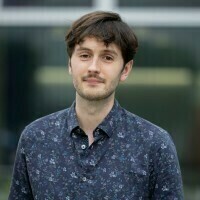
    </summary>
    <content type="html">
      <![CDATA[<p>Scholars and practitioners from the University of Notre Dame and across the globe recently gathered in Rome to examine how religion can serve as a resource for democratic renewal amid authoritarian attempts to weaponize it.</p>
<figure class="image image-right"><img src="https://ansari.nd.edu/assets/672943/rome_symposium_3x450jpg.jpg" alt="In a indoor panel setting featuring name cards reading" width="450" height="300">
<figcaption>Ansari Institute Book Prize winner, Erin Wilson, left, outlined how religion shapes institutions and norms in ways that policymakers often fail to see. Photo credit: Alessandro Sgarito.</figcaption>
</figure>
<p>The June 29 through July 1 symposium, “<a href="https://ansari.nd.edu/conference/religion-and-global-politics-across-disciplines-and-publics/">Religion and Global Politics across Disciplines and Publics</a>,” convened scholars, diplomats and religious leaders to discuss topics ranging from including religious voices in policy discussions to examining the ways religious institutions have both enabled and mobilized against autocratic rule.</p>
<p>The conference aligns with the <a href="https://strategicframework.nd.edu/initiatives/democracy-initiative/">Notre Dame Democracy Initiative</a> and with Notre Dame’s <a href="https://keough.nd.edu/">Keough School of Global Affairs</a>, which supports research on democracy and human rights and explores how religion connects to policy through the school’s <a href="https://ansari.nd.edu/">Ansari Institute for Global Engagement with Religion</a>. The gathering was supported by a <a href="https://strategicframework.nd.edu/initiatives/democracy-initiative/democracy-initiative-funding-opportunity/democracy-catalyst-grant-recipients/">Democracy Catalyst Grant</a> from the initiative.</p>
<p>“Religious authority is one of the few forms of trust still intact in many polarized and divided societies, and whether that trust serves the dignity and rights of all people is a central puzzle,” said <a href="https://strategicframework.nd.edu/people/joel-day/">Joel Day</a>, managing director of the Democracy Initiative. “This relationship between democracy and religion is a thematic priority of the Notre Dame Democracy Initiative for exactly this reason. This symposium underscored how the University, through the Keough School and its Ansari Institute, convenes scholars working at the forefront of these issues.”</p>
<h2>Religion still matters to politics, even when it’s ignored</h2>
<p><a href="https://ansari.nd.edu/conference/ansari-book-prize-symposium/third-symposium-religion-and-world-politics-connecting-theory-with-practice/">Erin K. Wilson</a>, recipient of the 2026 Ansari Book Prize for her book, “Religion and World Politics: Connecting Theory with Practice,” opened the symposium by challenging a common assumption in diplomacy and scholarship alike: that religion has become irrelevant to serious policymaking.</p>
<p>Wilson argued that religion continues to shape institutions and norms in ways policymakers often fail to see, precisely because they have been trained to operate in a secular idiom. The resurgence of Christian nationalism in the West, she said, is one clear sign that religion has not receded from politics. It has simply gone unaddressed. </p>
<p>Presentations throughout the symposium extended this argument across multiple contexts, including the Philippines, Kenya and Peru.</p>
<h2>Building the next generation of scholarship</h2>
<p>The symposium also showcased the Ansari Institute’s investment in emerging scholars. Its six <a href="https://ansari.nd.edu/people/global-fellows/">2025-26 Global Fellows</a> spent the academic year refining dissertations into book manuscripts with Notre Dame faculty mentors. One fellow, Jacob Katumusiime, recently signed a contract with Columbia University Press.</p>
<figure class="image image-right"><img src="https://ansari.nd.edu/assets/672944/rome_symposium_1x450jpg.jpg" alt="In a brightly lit auditorium setting filled with seated audience members, three men in the foreground wearing white shirts engage in conversation, including a smiling man in round glasses positioned centrally, a man with glasses and a beard to his left, and a bald man in profile to his right." width="450" height="300">
<figcaption>Notre Dame scholars Ebrahim Moosa, left, and Rev. Emmanuel Katongole, right, talk with Ansari Institute Global Fellow Jacob Katumusiime. Photo credit: Alessandro Sgarito.</figcaption>
</figure>
<p>On the symposium’s final day, fellows joined current and former participants in the <a href="https://ansari.nd.edu/student-opportunities/rome-summer-seminars/">Rome Summer Seminars</a>, a multiweek writing and policy-centered workshop for graduate student work on religion and global politics. The seminars were co-sponsored with John Cabot University at the European Academy of Religion’s annual conference, extending the network of scholars working at the intersection of these two academic fields of study.</p>
<p>“This convening underscores the Ansari Institute’s <a href="https://ansari.nd.edu/about/">wide-ranging work</a> to support human dignity and flourishing through research, teaching and outreach that explores how religion shapes our world,” said <a href="https://keough.nd.edu/about/faculty-staff-directory/emmanuel-katongole/">Rev. Emmanuel Katongole</a>, professor of theology and peace studies and director of the Ansari Institute. “Discussions like this are an important part of our work to connect with religious communities, faith and civic leaders, scholars and journalists as we work to inform larger conversations around religion and policy.”</p>]]>
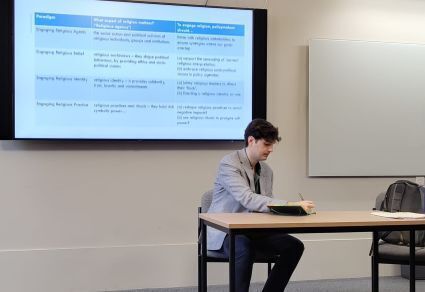
    </content>
    <link rel="enclosure" type="image/jpeg" href="https://ansari.nd.edu/assets/673237/rome_symposium_4x1200jpg.jpg" title="In a indoor panel setting featuring name cards reading &quot;Timothy Matovina,&quot; a dark-haired woman with glasses, red lipstick, and a sleeveless dark green top speaks into a microphone held near her mouth while gesturing with her hand, turning slightly toward an older man seated beside her in a light-colored button-up shirt in front of a backdrop depicting the Colosseum in Rome. Photo credit Alessandro Sgarito."/>
    <author>
      <name>Joshua Lupo</name>
    </author>
  </entry>
  <entry>
    <id>tag:ansari.nd.edu,2005:News/182970</id>
    <published>2026-07-09T11:07:59-04:00</published>
    <updated>2026-07-09T11:07:59-04:00</updated>
    <link rel="alternate" type="text/html" href="https://ansari.nd.edu/news-events/news/fr-emmanuel-katongole-offers-keynote-at-the-kroc-institute-for-strategic-peace-building/"/>
    <title>Fr. Emmanuel Katongole Offers Keynote at the Kroc Institute for Strategic Peace Building</title>
    <summary type="text">
      <![CDATA[How does spiritual renewal shape international peacebuilding? In this video from the Kroc Institute for International Peace Studies&#39; 2026 Strategic Peacebuilding Academy, Fr. Emmanuel Katongole draws on Laudato Si’ and the work of Thích Nhất Hạnh, Martin Luther King Jr., Maggy Barankitse and Desmond Tutu to explore why healing and sustainable peace demand more than just policy changes—they require a &quot;profound interior conversion.&quot;]]>
    </summary>
    <content type="html">
      <![CDATA[<figure class="image image-right"><img src="https://ansari.nd.edu/assets/665791/fr_emmanuel_keynote.jpg" alt="A medium shot captures a man with short, graying hair and dark skin speaking passionately from behind a clear acrylic lectern, gesturing with his hands while wearing a dark gray patterned blazer over a white clerical shirt and collar, set against a background of a gray wall with vertical panels." width="600" height="437"></figure>
<p>How does spiritual renewal shape international peacebuilding? In this video from the Kroc Institute for International Peace Studies' 2026 <a href="https://t.e2ma.net/click/yd0mgo/aj8xar0/eqo2vtb" target="_blank" data-saferedirecturl="https://www.google.com/url?q=https://t.e2ma.net/click/yd0mgo/aj8xar0/eqo2vtb&amp;source=gmail&amp;ust=1783695732856000&amp;usg=AOvVaw1eEGUZ4mxNkEKt7iWlCWMm" rel="noopener">Strategic Peacebuilding Academy</a>, Fr. Emmanuel Katongole draws on <em>Laudato Si’</em> and the work of Thích Nhất Hạnh, Martin Luther King Jr., Maggy Barankitse and Desmond Tutu to explore why healing and sustainable peace demand more than just policy changes—they require a "profound interior conversion."</p>
<p>Watch the keynote <a href="youtube.com/watch?si=TyqbTQb6F0_tJiLm&amp;v=OTvEJSsimTA&amp;feature=youtu.be">here</a>.</p>]]>
    </content>
    <link rel="enclosure" type="image/jpeg" href="https://ansari.nd.edu/assets/665791/fr_emmanuel_keynote.jpg" title="A medium shot captures a man with short, graying hair and dark skin speaking passionately from behind a clear acrylic lectern, gesturing with his hands while wearing a dark gray patterned blazer over a white clerical shirt and collar, set against a background of a gray wall with vertical panels."/>
    <author>
      <name>Rebekah Go</name>
    </author>
  </entry>
  <entry>
    <id>tag:ansari.nd.edu,2005:News/182404</id>
    <published>2026-06-10T13:14:00-04:00</published>
    <updated>2026-06-10T13:18:44-04:00</updated>
    <link rel="alternate" type="text/html" href="https://ansari.nd.edu/news-events/news/ansari-institute-works-with-lead-integrity-to-host-conversation-on-faith-and-climate-justice/"/>
    <title>Ansari Institute Works with Lead Integrity to Host Conversation on Faith and Climate Justice</title>
    <summary type="text">
      <![CDATA[The Ansari Institute for Global Engagement with Religion convened an interdisciplinary dialogue on faith, climate justice, structural violence, and sustainable development on May 22nd 2026. Conducted in collaboration with Lead Integrity as part of the Youth Roster on Faith and Development Initiative, the event brought together young scholars from Nigeria, Ethiopia and the United States. The discussion provided a platform for examining how religion, spirituality, and moral imagination influence responses to pressing global challenges.]]>
    </summary>
    <content type="html">
      <![CDATA[<p>The Ansari Institute for Global Engagement with Religion convened an interdisciplinary dialogue on faith, climate justice, structural violence, and sustainable development on May 22nd 2026. Conducted in collaboration with <a href="https://www.lead-integrity.com/">Lead Integrity</a> as part of the Youth Roster on Faith and Development Initiative, the event brought together young scholars from Nigeria, Ethiopia and the United States. The discussion provided a platform for examining how religion, spirituality, and moral imagination influence responses to pressing global challenges. At a moment marked by ongoing conflicts in Europe and the Middle East, growing climate insecurity, and economic disruptions that reverberate beyond national borders, the conversation highlighted the urgent need to better understand how faith communities can contribute to building resilience, social cohesion, and advancing sustainable futures.</p>
<figure class="image image-right"><img src="https://ansari.nd.edu/assets/651525/shiza_kamil_headshot_200.jpg" alt="This professional headshot features a woman with long, dark wavy hair and a friendly smile, posed against a soft-focus indoor architectural background. She is wearing a classic navy pinstripe blazer over a white top, accented by elegant pearl earrings for a polished and approachable look." width="200" height="200"></figure>
<p>The dialogue forms part of the ongoing Youth Roster on Faith and Development Initiative, organized in collaboration with Lead Integrity, which seeks to connect young leaders, researchers, and practitioners working at the intersections of faith, social cohesion, climate justice, and sustainable development. Through conversations like this, the initiative aims to foster cross-regional learning, encourage interdisciplinary collaboration, and amplify the voices of emerging leaders working to address the defining challenges of our time.</p>
<p>Moderated by Shiza Kamil, the conversation featured Father Emmanuel Ojeifo, Elsa Barron, and Geleta Berisso, whose work encompasses political theology, peacebuilding, environmental justice, governance, and community engagement. The participants examined how religious institutions and moral frameworks contribute to more just and humane futures, reflecting on the influence of faith traditions in shaping community understandings of suffering, inequality, environmental collapse, and social transformation.</p>
<figure class="image image-left"><img src="https://ansari.nd.edu/assets/661532/emmanuel_ojeifo_headshot_copy.jpg" alt="The image shows a formal headshot of a smiling Black man wearing glasses, a goatee, and a black clerical shirt with a white collar against a light blue, textured background." width="200" height="200"></figure>
<p>Father Emmanuel Ojeifo began by situating his reflections within the broader context of Sub-Saharan Africa, where poverty, conflict, environmental degradation, and governance are deeply interconnected. Drawing on his research into land violence and human flourishing in countries such as Nigeria, Kenya, the Democratic Republic of Congo, and South Africa, he emphasized that the crises facing African societies are interdependent and cannot be understood in isolation.</p>
<p>“This is a region of the world that is abundantly blessed with human and material resources,” he explained, “but it’s also the region of the world where so many countries are on the lowest rung of the ladder of human development.”</p>
<p>Father Emmanuel conceptualizes “human flourishing” as extending beyond economics or governance. He describes flourishing as deeply relational, encompassing the environment, politics, economics, spirituality, and interpersonal relationships. His research centers on the idea that land and the environment are foundational to human dignity and collective wellbeing, rather than merely resources for extraction.</p>
<p>“What I’m really exploring in this research,” he noted, “is how land constitutes an enabling condition, a necessary enabling condition for human flourishing.”</p>
<figure class="image image-right"><img src="https://ansari.nd.edu/assets/661530/nigeria_landscape.jpg" alt="This image shows an aerial view of a lush, expansive green landscape in Nigeria featuring scattered wetlands and a winding dirt road cutting through the terrain under an overcast sky." width="425" height="239">
<figcaption>A drone view of Nigeria’s landscape reveals a stunning mix of lush forests, rolling hills, winding rivers, and vast savannahs via Wikimedia Commons.</figcaption>
</figure>
<p>A central theme in his reflections was the enduring impact of colonialism on African societies and their relationships with land, spirituality, and identity. Father Emmanuel argued that colonial systems disrupted Indigenous understandings of community and environmental stewardship, replacing reciprocal relationships with extractive models focused on land, labor, and resources.</p>
<p>“The goal has always been the same,” he said of colonial systems, “which is the extraction of land, lives, and labor.”</p>
<p>He further reflected on the displacement of Indigenous spiritual systems and the severing of cultural relationships with the environment caused by colonialism. Referencing Chinua Achebe’s <a href="https://www.goodreads.com/en/book/show/37781.Things_Fall_Apart">Things Fall Apart</a>, Father Emmanuel highlighted that many African communities historically viewed land as central to identity, spirituality, and social order, beyond its role as a source of sustenance.</p>
<p>Quoted from Achebe’s work, he asked “Does the white man understand our relationship with the land?” He described the question as symbolic of the broader rupture colonialism introduced into African societies.</p>
<figure class="image image-left"><img src="https://ansari.nd.edu/assets/661533/elsa_barron_headshot_copy.jpg" alt="The image shows a professional headshot of a smiling woman with wavy red hair and bangs, wearing large hoop earrings and a cream-colored blazer against a softly blurred background." width="200" height="200"></figure>
<p>The discussion then shifted to climate justice, guided by Elsa Barron, whose work addresses environmental peacebuilding, climate diplomacy, and the experiences of Pacific Island nations facing climate change. Elsa emphasized that climate change is fundamentally a question of justice and moral responsibility, not solely an environmental or scientific issue.</p>
<p>“I’m really interested in the ways in which climate change is a global injustice,” she explained, pointing to how countries and communities least responsible for carbon emissions are often the ones experiencing the harshest consequences.</p>
<p>Drawing on her engagement with Pacific Island communities and the United Nations climate negotiations, Elsa described the intersection of faith traditions, Indigenous knowledge systems, and moral leadership within climate advocacy. She noted the prophetic clarity often demonstrated by Pacific leaders confronting existential environmental threats.</p>
<figure class="image image-right"><img src="https://ansari.nd.edu/assets/661528/fiji_rising_sea_levels.jpg" alt="This Copernicus satellite image shows an aerial view of a portion of Viti Levu island and its surrounding coral reefs in the Pacific Ocean, with a specific label highlighting Togoru village." width="425" height="270">
<figcaption>Fiji, an island nation in the Pacific Ocean, is facing a grave threat from climate change via Wikimedia Commons.</figcaption>
</figure>
<p>“In Fiji, certain communities have already been relocated,” she shared. “Families talk about the loss of ancestral burial grounds to sea level rise.”</p>
<p>Elsa also discussed the role of faith in fostering empathy, stewardship, and collective responsibility, especially where climate skepticism and political polarization hinder public engagement with environmental issues. Referencing the Christian tradition, she described stewardship as a moral obligation to care for creation and one another, rather than as domination over the earth.</p>
<p>“The world is not here for humans to exploit and make our riches off of,” she reflected, “but rather something beautiful, created, that is something to love and to care for and to cultivate.”</p>
<p>Elsa also acknowledged the limitations of policy discussions that focus exclusively on scientific or technical solutions. Too often, these fail to address the emotional and spiritual dimensions of climate grief and loss. Citing a declaration by the Pacific Conference of Churches, she highlighted the increasing emphasis by faith communities on resilience, lament, and mourning in response to irreversible environmental destruction.</p>
<p>“We knelt together in prayer,” she quoted from the declaration, “and lamented the exploitative and extractive systems of neocolonialism and enduring colonialism that continue to exacerbate the plight of many of our Pacific brothers and sisters experiencing climate change.”</p>
<figure class="image image-left"><img src="https://ansari.nd.edu/assets/661535/geleta_tesfaye_berisso_headshot.jpg" alt="The image shows a professional headshot of a smiling Black man with a well-groomed beard and mustache, wearing wire-rimmed glasses, a dark suit, a white shirt, and a black tie against a blurred hallway background." width="200" height="200"></figure>
<p>Geleta Berisso contributed another critical perspective through his research on political theology, structural violence, and peacebuilding in Ethiopia and Sub-Saharan Africa. His work examines how religion shapes community interpretations of suffering, inequality, and systemic injustice.</p>
<p>“Religion is the primary lens through which people process structural violence,” Geleta explained.</p>
<p>Drawing on peace research and political theology, he argued that many forms of violence remain invisible because they are embedded in political, economic, and social structures. He further noted that religious narratives often determine whether these injustices are perceived as political issues or interpreted through spiritual frameworks.</p>
<p>“The dominant theological imaginations available to people,” he argued, “are redirecting moral and political energy away from the structures producing suffering, and toward individual spiritual practices.”</p>
<figure class="image image-right"><img src="https://ansari.nd.edu/assets/661527/church_kenya.jpg" alt="Muyeye Catholic Church, a simple white building with a brown wooden gable above the entrance, flanked by green trees and a dirt yard under a blue sky with scattered clouds." width="425" height="319">
<figcaption>A Catholic Church located in Kenya via Wikimedia Commons.</figcaption>
</figure>
<p>Using examples from Ethiopia, Geleta described how unemployment, drought, and poverty are frequently interpreted as personal spiritual failures or divine punishment, rather than as outcomes of structural inequalities or state failures. He suggested that this perspective can depoliticize social suffering and limit collective action for systemic change.</p>
<p>“When poverty or climate change strikes,” he explained, “people fast, they pray, they do whatever they work on, but they don’t really see what really caused it.”</p>
<p>Geleta also emphasized the transformative potential of faith communities. Drawing inspiration from liberation theology movements in Latin America, he argued that religious institutions can cultivate critical consciousness and help communities recognize the structural roots of injustice.</p>
<p>“The churches or religious communities should focus on forming subjects who see their problems as structurally produced,” he said, emphasizing the importance of reconnecting spiritual life with material and political realities.</p>
<p>Throughout the discussion, participants consistently recognized that faith is a powerful force shaping community understandings of dignity, suffering, belonging, responsibility, and hope. The conversation demonstrated that religion and spirituality continue to influence both local realities and global dialogues on development and justice, whether through environmental stewardship, critiques of extractive systems, or reinterpretations of structural violence.</p>
<p>Reflecting on the conversation as moderator, Shiza Kamil noted the importance of integrating faith perspectives into broader development discourse - an area that is often overlooked despite its significance across communities around the world.</p>
<p>“This lens of integrating faith into development work,” she reflected toward the close of the discussion, “is something that we also oftentimes overlook.”</p>
<p><strong id="docs-internal-guid-aa3cc84d-7fff-6829-414a-2a6bca77bf07"> </strong></p>]]>
    </content>
    <link rel="enclosure" type="image/jpeg" href="https://ansari.nd.edu/assets/662203/nigeria_landscape_x_1200.jpg" title="This image shows an aerial view of a lush, expansive green landscape in Nigeria featuring scattered wetlands and a winding dirt road cutting through the terrain under an overcast sky."/>
    <author>
      <name>Shiza Kamil</name>
    </author>
  </entry>
  <entry>
    <id>tag:ansari.nd.edu,2005:News/182302</id>
    <published>2026-06-04T11:49:00-04:00</published>
    <updated>2026-06-11T12:14:11-04:00</updated>
    <link rel="alternate" type="text/html" href="https://ansari.nd.edu/news-events/news/ansari-institute-awards-book-prize-to-erin-k-wilson-for-religion-and-world-politics-connecting-theory-to-practice/"/>
    <title>Ansari Institute awards Book Prize to Erin K. Wilson for "Religion and World Politics: Connecting Theory with Practice"</title>
    <summary type="text">
      <![CDATA[The Ansari Institute for Global Engagement with Religion is pleased to award its 2026 Book Prize to Dr. Erin K. Wilson, Professor of Politics and Religion at the University of Groningen. In Religion and World Politics: Connecting Theory with Practice, Wilson contends that the definitions and descriptions of religion which are operative in policy circles and in media are inadequate and misleading, because they fail to incorporate groundbreaking insights from the critical study of religion. Religion “is not an object ‘out there’ that is clearly identifiable, definable and measurable,” she writes, “but rather a fluid, dynamic and ever-changing category made up of rituals, practices, discourses, narratives, institutions, organisations, actors, beliefs and norms that are all context-dependent and variable…”]]>
    </summary>
    <content type="html">
      <![CDATA[<p>The Ansari Institute for Global Engagement with Religion is pleased to award its 2026 Book Prize to Dr. Erin K. Wilson, Professor of Politics and Religion at the University of Groningen.</p>
<p>In <a href="https://www.routledge.com/Religion-and-World-Politics-Connecting-Theory-with-Practice/Wilson/p/book/9780367684051"><em>Religion and World Politics: Connecting Theory with Practice</em></a>, Wilson contends that the definitions and descriptions of religion which are operative in policy circles and in media are inadequate and misleading, because they fail to incorporate groundbreaking insights from the critical study of religion. Religion “is not an object ‘out there’ that is clearly identifiable, definable and measurable,” she writes, “but rather a fluid, dynamic and ever-changing category made up of rituals, practices, discourses, narratives, institutions, organisations, actors, beliefs and norms that are all context-dependent and variable…”</p>
<figure class="image image-right"><img src="https://ansari.nd.edu/assets/660584/erin_wilson_book_prize_450.webp" alt="This image features a side-by-side composition showing a professional portrait of author Erin K. Wilson on the left and the front cover of her book on the right. Wilson is smiling with crossed arms against a brick wall, while her book, titled Religion and World Politics: Connecting Theory with Practice, displays colorful, abstract brushstrokes on its top and bottom borders." width="450" height="304"></figure>
<p><em>Religion and World Politics</em> demonstrates how the integration of such reinterpretations of religion provides a framework for analysis that should inform public-facing scholarship, educational programs, and policy deliberations. Religious literacy is no longer a niche interest, Wilson argues, but a vital competency for global stability. The book illustrates this theme with case studies that address three critical policy-relevant issues: conflict and security; development and humanitarianism; and human rights and public life.</p>
<p>The selection committee for this year’s Ansari Book Prize was led by Scott Appleby, the Keough-Hesburgh Professor of Global Affairs and interim director of the Ansari Institute. “Erin Wilson has done a great service to students of religion and global politics by crafting a concise, legible text that serves simultaneously as a re-introduction to the field, a handbook for researchers and policy analysts, and a model of educational method,” Appleby commented. “We look forward to celebrating her achievement during a conference in Rome this summer, where the book will serve as a starting-point and touchstone for a series of discussions of religion’s shifting roles in shaping national and transnational movements, organizations and politics.”</p>
<p>The <a href="https://ansari.nd.edu/academics/ansari-institute-book-prize/">Ansari Institute Book Prize on Religion and the World </a>highlights the work of scholars who reimagine the connection of religion and global affairs. Such work serves as an example of what Rabbi Jonathan Sacks once described as religion’s capacity “to be a source of systemic and structural good in a manner that is relevant to global affairs.”</p>
<p>Professor Wilson responded to news of the award by writing: “I am surprised, delighted and honoured to receive this award. I wrote this book primarily with the hope of providing policymakers, practitioners, and people new to the field of religion and world politics a clear, systematic way to move beyond the essentialising and homogenising assumptions about what religion is and what it does that have coloured our analysis for so long. This award suggests that maybe I achieved what I hoped for.”</p>
<p>Wilson is set to receive her award at the European Academy of Religion’s 2026 conference, hosted on the campus of LUISS University in Rome. There she will headline an "Author Meets Critics" panel, chaired by Professor Appleby and featuring three distinguished scholars of religion and global politics: <a href="https://schar.gmu.edu/profiles/pmandavi">Peter Mandaville</a> (George Mason University), <a href="https://www.luiss.edu/faculty/355678">Kristina Stoeckl</a> (LUISS University), and <a href="https://www.unibo.it/sitoweb/gregorio.bettiza/en">Gregorio Bettiza</a>, (University of Bologna).</p>
<p>Wilson will also be the keynote speaker at the Ansari Institute’s Global Fellows Rome Symposium where she will reflect on critical public-facing religion and global politics. The symposium is the culmination of the institute’s inaugural <a href="https://ansari.nd.edu/news-events/news/ansari-institute-launches-global-fellows-program/">Global Fellows Program</a>. The keynote will be followed by a full day of interactive sessions featuring the global fellows, their faculty mentors, and other invited scholars and practitioners. Participants will also include members of the <a href="https://rome.nd.edu/research/projects-activities/rome-summer-seminars-on-religion-and-global-politics/">Rome Summer Seminars on Religion and Global Politics</a>.</p>
<p>The Ansari Institute for Global Engagement with Religion is dedicated to studying, learning from, and collaborating with religious communities worldwide. The institute's work includes research, teaching, outreach, and interaction with religious communities, faith and civic leaders, academics and journalists, and the general public. The institute advances research by embracing diverse faith traditions, partnering respectfully with local and global actors, and collaborating across disciplines in order to foster deliberation, participate in culturally appropriate modes of dialogue, and implement transformative educational programs.</p>]]>
    </content>
    <link rel="enclosure" type="image/webp" href="https://ansari.nd.edu/assets/660583/erin_wilson_book_prize_1000.webp" title="This image features a side-by-side composition showing a professional portrait of author Erin K. Wilson on the left and the front cover of her book on the right. Wilson is smiling with crossed arms against a brick wall, while her book, titled Religion and World Politics: Connecting Theory with Practice, displays colorful, abstract brushstrokes on its top and bottom borders."/>
    <author>
      <name>Rebekah Go</name>
    </author>
  </entry>
  <entry>
    <id>tag:ansari.nd.edu,2005:News/181989</id>
    <published>2026-06-04T11:33:00-04:00</published>
    <updated>2026-06-11T12:15:04-04:00</updated>
    <link rel="alternate" type="text/html" href="https://ansari.nd.edu/news-events/news/ansari-institute-to-host-symposium-in-rome/"/>
    <title>Ansari Institute to Host Symposium in Rome</title>
    <summary type="text">
      <![CDATA[The Ansari Institute for Global Engagement with Religion is pleased to host a symposium on Religion and Global Politics across Disciplines and Publics at Notre Dame Rome. This gathering, which marks the capstone of the inaugural Global Fellows program, will showcase the fellows’ scholarship following a year of faculty and peer critique and monograph development.]]>
    </summary>
    <content type="html">
      <![CDATA[<figure class="image image-right"><img src="https://ansari.nd.edu/assets/662212/rome_at_dusk.jpg" alt="This wide-angle panoramic photograph of Rome captures the illuminated stone arches of the Ponte Sant'Angelo stretching across the Tiber River under a pastel sunset sky, with the glowing dome of St. Peter's Basilica rising prominently in the background." width="600" height="303"></figure>
<p>The Ansari Institute for Global Engagement with Religion is pleased to host a symposium on <em>Religion and Global Politics across Disciplines and Publics</em> at <a href="https://rome.nd.edu/">Notre Dame Rome</a>. This gathering, which marks the capstone of the inaugural <a href="https://ansari.nd.edu/news-events/news/ansari-institute-launches-global-fellows-program/">Global Fellows</a> program, will showcase the global fellows’ scholarship following a year of faculty and peer critique and monograph development.</p>
<p>The event brings together three cohorts: the Ansari Institute’s global fellows; their mentors, who are senior scholars at the University of Notre Dame; and participants of the <a href="https://rome.nd.edu/research/projects-activities/rome-summer-seminars-on-religion-and-global-politics/">Rome Summer Seminars on Religion and Global Politics</a>. The summer seminarians—a new generation of graduate students researching the intersection of religion and global politics—are hosted by John Cabot University with substantive support from the Ansari Institute. Together these three groups will cultivate a scholarly exchange and celebrate the global fellows' achievements.</p>
<figure class="image image-left"><img src="https://ansari.nd.edu/assets/660582/erin_wilson_headshot_200.jpg" alt="This professional portrait features a smiling woman with shoulder-length brown hair and bangs leaning against a brick wall with her arms crossed, wearing a dark jacket over a teal top adorned with a colorful bird pin." width="200" height="301"></figure>
<p>The first day of the symposium will feature a keynote with scholar and author Dr. Erin K. Wilson, professor of politics and religion in the faculty of Religion, Culture, and Society at the University of Groningen and recipient of the <a href="https://ansari.nd.edu/conference/ansari-book-prize-symposium/">2026 Ansari Institute Book Prize</a>. Wilson will offer commentary on<em> </em>the emerging field of religion and global politics, and reflect on the ways by which diplomats, civil servants, policymakers, journalists, and civil society practitioners might understand and incorporate religious literacy into their respective roles.</p>
<p>The second day of the symposium will include a full set of panels addressing themes relevant to the study of religion and global politics, including religion, post-colonialism, and new nations; religion, democracy, and state agendas; and religious networks, identity politics, and religio-political theory. Each session will feature the global fellow(s) who study one or more of these themes, their faculty mentors, and the chair of the session—a senior scholar who will also serve as a critical interlocutor with the panelists. The audience will participate in the discussion following the panelists’ presentations.</p>
<p>The final day of the symposium will be integrated into the <a href="https://www.europeanacademyofreligion.org/euare2026">European Academy of Religion’s Ninth Annual Conference</a> with each session open to all conference participants. There will be panels on new directions in the study of religion and global politics, religion and international order, interreligious engagement, and managing pluralism. The sessions will feature recent Rome summer seminarians, current global fellows, and members of the Ansari Institute faculty including Interim Director <a href="https://ansari.nd.edu/about/director/">Scott Appleby</a>, Executive Director <a href="https://ansari.nd.edu/about/executive-director/">Mahan Mirza</a>, and Senior Fellow <a href="https://www.johncabot.edu/directory/michael-driessen">Michael Driessen</a>.</p>
<figure class="image image-right"><img src="https://ansari.nd.edu/assets/658020/rome_keyhole.jpg" alt="This photo captures the famous view through the Aventine Keyhole at the Villa del Priorato di Malta, perfectly framing St. Peter’s Basilica in the distance. The garden's manicured hedges create a natural &quot;tunnel&quot; effect, leading the eye directly toward the iconic dome of the Vatican." width="600" height="309"></figure>
<p>The symposium will end with an "Author Meets Critics" plenary held at the conference. Five scholars of religion and global politics will discuss <a href="https://www.routledge.com/Religion-and-World-Politics-Connecting-Theory-with-Practice/Wilson/p/book/9780367684051"><em>Religion and World Politics: Connecting Theory with Practice</em></a>. The panelists include the author, Erin Wilson, as well as <a href="https://schar.gmu.edu/profiles/pmandavi">Peter Mandaville</a> (Georgetown and George Mason Universities), <a href="https://www.luiss.edu/faculty/355678">Kristina Stoeckl</a> (LUISS University), <a href="https://www.unibo.it/sitoweb/gregorio.bettiza/en">Gregorio Bettiza</a> (University of Bologna), and Scott Appleby (Notre Dame). The panel will be followed by a reception.</p>
<p>The Global Fellows Symposium is taking place in Rome to draw upon the religious and geopolitical resources of the Eternal City, and to bring together (for the first time in person) the global fellows, their mentors, the summer seminarians, and the scholars who gather at the European Academy of Religion. It is expected that this unique combination of place, time, and people will offer fruitful discussion about the emerging field of religion and global politics.</p>]]>
    </content>
    <link rel="enclosure" type="image/jpeg" href="https://ansari.nd.edu/assets/662212/rome_at_dusk.jpg" title="This wide-angle panoramic photograph of Rome captures the illuminated stone arches of the Ponte Sant'Angelo stretching across the Tiber River under a pastel sunset sky, with the glowing dome of St. Peter's Basilica rising prominently in the background."/>
    <author>
      <name>Rebekah Go</name>
    </author>
  </entry>
  <entry>
    <id>tag:ansari.nd.edu,2005:News/182205</id>
    <published>2026-06-01T10:11:00-04:00</published>
    <updated>2026-06-10T10:20:36-04:00</updated>
    <link rel="alternate" type="text/html" href="https://ansari.nd.edu/news-events/news/andrew-dickson-religious-engagement-in-contemporary-british-foreign-policy/"/>
    <title>Andrew Dickson: Religious Engagement in Contemporary British Foreign Policy</title>
    <summary type="text">
      <![CDATA[Andrew Dickson is an Ansari Institute Global Fellow who recently completed an ESRC-funded PhD in International Relations at the University of Sussex, where he served as Programme Coordinator for the University&#39;s Religion and Foreign Policy Initiative. His research explores religion and secularism in International Relations across foreign and development policy, de-radicalisation programmes, and human rights advocacy. He also holds an MA in Conflict, Security and Development from King’s College London, and a BA in Philosophy, Politics and Economics from Hertford College, Oxford. He was previously Centre Manager for the LSE Faith Centre and Religion and Global Society Research Unit, and Research and Projects Manager for the Lokahi Foundation.]]>
    </summary>
    <content type="html">
      <![CDATA[<p><em>Andrew Dickson is an Ansari Institute Global Fellow who recently completed an ESRC-funded PhD in International Relations at the University of Sussex, where he served as program coordinator for the University's Religion and Foreign Policy Initiative. His research explores religion and secularism in International Relations across foreign and development policy, de-radicalization programs, and human rights advocacy. He also holds an MA in Conflict, Security and Development from King’s College London, and a BA in Philosophy, Politics and Economics from Hertford College, Oxford. He was previously center manager for the LSE Faith Center and Religion and Global Society Research Unit, and research and projects manager for the Lokahi Foundation.</em></p>
<figure class="image image-right"><img src="https://ansari.nd.edu/assets/632339/andrew_dickson.jpg" alt="Picture of a Caucasian male with shortish brown hair. He is looking at the camera with a slight smile." width="200" height="200"></figure>
<p><em>Editor's Note: This conversation took place several months ago; some references may reflect past events.</em></p>
<p><strong>Tell me a little bit about yourself, how you came to work on the topic you're working on, and how you got to your dissertation.</strong></p>
<p>This topic builds on a lot of long-standing academic interests, as well as some work I had been doing in the field. I attended the University of Oxford for my undergraduate degree in Philosophy, Politics, and Economics, where I was particularly interested in political theory and philosophy of religion. I did a master's at King’s College London in Conflict, Security, and Development, where I looked at recent research into radicalization. I also spent several years working for an organization called the Lokahi Foundation which did a lot of interfaith work and research, and projects working with local communities. I was working with different religious groups and civil society actors exploring how they were tackling different social issues, engaging with state services like the police. I was also conducting research on the Prevent program in the U.K. – which is Britain’s de-radicalization strategy, looking at how governments had worked with grassroots de-radicalization ‘intervention’ providers.</p>
<p>I then started working on a big EU-funded program in 2017, which was really tackling the main topic of my thesis in the end. There were a range of experts and policy officials exploring how the EEAS (the EU equivalent of a ministry of foreign affairs) could increase its engagement or outreach with religious leaders or faith-based organizations within the EU’s work, because of the multiple ways that religion contributes to tackling a range of social issues around the world. But those policy officials were really at a "blank piece of paper" stage. So the charity I was working for set up a pilot program. We ran weeklong courses bringing together civil society people, religious leaders, NGOs, people working with the UN, and so on, who – in different ways – were dealing with social or political issues that either had a religious dimension, or where they were working with religion as part of their attempt to tackle these problems. It was a really interesting program.</p>
<figure class="image image-left"><img src="https://ansari.nd.edu/assets/661174/andrew_dickson_1.jpg" alt="In the image, a man in a light grey blazer sits at a wooden desk and writes in a notebook. Behind him, a large flat-screen display mounted on the wall shows a presentation slide with a detailed table about engaging with religion." width="425" height="292">
<figcaption>Andrew presents at a workshop.</figcaption>
</figure>
<p>Yet, it is also an agenda that I had ambivalent feelings about, just because I also had this background of the de-radicalization world, where the relationship – a lot of people would say – was very exploitative. In order to prevent further Islamophobic narratives and logics in the UK, a lot of religious leaders or community members received a little bit of government support for a bit but they lost a lot of credibility. Or they had government support only if they were saying the “right things” – funding which eventually got pulled. I had been thinking about doing a PhD for a while, but I began to think, “there is a topic there,” comparing what is going on internationally and what's happened with de-radicalization.</p>
<p>So these were the kinds of questions I had: what's going on? Are these religious leaders and religious civil society actors, who are doing really interesting work, actually going to benefit from working more closely with big government organizations like the EU? Or is it going to be exploitative? What are the agendas being furthered? And more theoretically, what does it say about secularism if we have supposedly very secular countries and secular government organizations suddenly saying, “oh, actually, we need to be prioritizing religion because of the ways that prioritizing religion can help us achieve our goals?”</p>
<p>So that was the background and then the project took off from that.</p>
<p><strong>You talked a bit about the comparative work above. Can you explain that a bit further?</strong></p>
<figure class="image image-right"><img src="https://ansari.nd.edu/assets/661179/andrew_dickson_2.jpg" alt='In the image, a white, spiral-bound booklet features the prominent purple title "Lokahi Global Exchange" alongside the dates "9 to 14 December 2018." The bottom of the cover is decorated with an illustration of a tree whose branches and leaves are formed by words written in various global scripts and languages.' width="375" height="500">
<figcaption>Materials produced for the EU funded project.</figcaption>
</figure>
<p>The initial idea – it has changed a bit since then – was basically to compare how the British state worked with grassroot Muslim groups on de-radicalization versus how they work with religious actors on international religious freedom or international development. However, it didn't really work because the different case studies were so different: the dynamics, the role of race, the power disparities, the political agendas. There were so many differences that it couldn't really fit into a comparative study, so I ended up instead providing a broad historical sweep of 17th-, 18th-, 19th-century British imperial history into the present day. Then I tried to include what has happened with the War on Terror as part of that historical background to see how we got to where we are now. Then I used all of that material to contextualize what's going on with foreign policy.</p>
<p><strong>Would you call yourself a historian? A social scientist?</strong></p>
<p>I would love to be a historian. I am absolutely not. I have jumped between lots of different disciplines. I started in philosophy and then did things which were much more practical – a master's degree in conflict, security, and development. Then my PhD was in International Relations, so it's been lots of jumping between different disciplines. Recently, I found it most interesting diving into history and using that to tell a particular story. I guess if I had to pick, I would say a social scientist, but, some people are very attached to saying, “I am in this discipline, and this is what this discipline should be about, and this is what it should do.” That is less my thinking. My thinking is, “what do these different tools let us explore about the world around us?”</p>
<p>What I wanted to do was provide a bit more theoretical grounding for the question of what even is “religious engagement”? Religion is big and means lots of different things. And what are governments trying to get out of engaging? The main finding in my PhD was that if you look at the Foreign, Commonwealth &amp; Development Office in the UK, the overarching approach they have taken is to focus on how religion can solve problems. It is a very problem-solving approach. Other academics have shown that other nation-states are interested in soft power, for instance, and suggested religious engagement can help them with that. However, soft power was less the case with the UK. It was about problem-solving.</p>
<figure class="image image-left"><img src="https://ansari.nd.edu/assets/661181/andrew_dickson_4_x_425.jpg" alt='In this image, a large group of people stands on a stage in front of a massive blue screen that reads "2022 International Ministerial Conference on Freedom of Religion or Belief." They are facing a dense, seated audience under a complex ceiling grid of stage lighting and presentation equipment.' width="425" height="292">
<figcaption>Photo from the UK's FoRB Ministerial Conference.</figcaption>
</figure>
<p>The other finding involved looking at different ways of thinking about religion. So I came up with this set of – what I called – religious engagement paradigms. These were basically different understandings of how religion matters, how policymakers think religion is going to help them achieve their goals. I proposed four, where the first three were based on a popular typology within the social sciences for studying religion. That typology highlights three elements: belief, behavior, and belonging. So religious belief (religious worldviews), religious belonging (things like religious identity, solidarities), and religious behavior (things like ritual and practice).</p>
<p>I suggested that in a similar way, governments could try to engage religious beliefs, engage religious identities, or engage religious practices. Engaging religious beliefs has been a big theme in counter-terrorism, for example: governments suggesting you need to “tackle the ideology” and propose counter-narratives. There are also lots of experts and practitioners suggesting that religious worldviews have really rich, fulfilling understandings of human flourishing and social organization, which can provide innovative answers to policy problems and global challenges: policymakers could embrace some of those ideas, which is another way for governments to engage religious belief. When thinking about the other two paradigms, there is also lots of recent research on governments seeking to embrace religious identity through religious nationalism, or funding and promoting religious rituals, to try and win the loyalty of religious communities or promote their standing internationally.</p>
<p>However, my finding was that British foreign policymakers actually do not use these three paradigms all that much. That’s where this fourth paradigm comes in, which I called ‘engaging religious agents’. Instead of focusing on belief, identity or practices, that paradigm basically says “well, none of that really matters to us - we’re really just talking about powerful people, institutions, and leaders. We don't really need to get involved in the theology. Let's just work with the most powerful socio-political actors. If they happen to be religious, that's great. We'll just work with them the same way that we would with anybody else.” That's the approach and the way of thinking about religion that I say has been really dominant, in the UK, and also internationally.</p>
<figure class="image image-right"><img src="https://ansari.nd.edu/assets/661190/andrew_dickson_6.jpg" alt='In the image, a woman stands at a transparent podium on a stage speaking into a microphone during a conference panel. Seated behind her are six diverse panelists under a large blue backdrop that reads "CO[OPERA] 2022" and features an integrated display screen.' width="394" height="525">
<figcaption>Photo of the terza loggia within the Vatican</figcaption>
</figure>
<p>I conducted interviews with diplomats, met with different religious organizations and charities that have been involved in this kind of world, and I analyzed those data sets. Interviews were the main driver for the contemporary analysis, and the history was to help us to understand what the religious context is in the UK, because it is very different from the US, or France, or Turkey, or any other country that has different relationships between the religion and the state, or different understandings of what secularism means.</p>
<p><strong>Did you only interview individuals who had identified religion as part of why they do what they do explicitly? For example, religious leaders or individuals for whom religion is important in their life? Or did you also interview people who happened to be the leader of an organization or governmental unit, without any knowledge of their religion?</strong></p>
<p>For most of the people I interviewed, religion was a part of their work: people working on freedom of religion or belief, people who worked on policy dialogues, people who were ambassadors to countries where religion was a key theme. But they were not all explicitly focused on religion, or encouraging more engagement with religion. For instance, I interviewed a high-profile former ambassador to a Middle Eastern country, who saw religion as very relevant in that context, but really was not pushing for religion to be a bigger theme for diplomats to think about across the board. He said, “well, we already get why religion matters, and we already do think about it. If it's important, diplomats engage, and if it is not, they do not.” So the interviews were a bit of a mix.</p>
<p><strong>What is your next step now that you are engaging in this year as a Global Fellow?</strong></p>
<p>I am going to do a few more interviews, because I think another five or 10 would provide a slightly bigger picture. I like interviews. I like meeting people, and chatting, and seeing how people view the world. Then, it is hard to say, because I've obviously never written a book before, but I think the big thing is going to be starting to think about my audience for the book. I think this is the space to sit back and think about the kind of impact I want this book to make and what my contribution should be. Then lots of redrafting chapters, sending book proposals to publishers, and starting to think about the next project after this one!</p>
<p><strong>Do you have a sense yet of the thesis of this book?</strong></p>
<p>I do not know if I do, I am still searching for the elevator pitch. That is partly why I want a few more interviews to get a slightly bigger picture. I may be closer than I think, and I just need a bit of space from my dissertation, and a slightly different angle from some newer material.</p>
<p><strong>Do you think there are going to be some policy implications from your work? And if so, do you have any idea what those might be?</strong></p>
<figure class="image image-left"><img src="https://ansari.nd.edu/assets/661180/andrew_dickson_3.jpg" alt="In the image, a man with a light beard and dark hair takes a close-up selfie while wearing a blue lanyard. He is standing in front of an ornate, grand staircase with red carpeting, surrounded by classical architecture featuring high arched windows and decorative wall patterns." width="394" height="525">
<figcaption>Working on PhD placement in the FCDO.</figcaption>
</figure>
<p>I have tried to stay away from those. Yet, as much as I say “I am just here to analyze what's happened, I am not saying what governments should do instead”, people kind of expect you to propose an alternative anyway. I think putting forward clear policy implications would be a very different project, really. But the big thing I feel at the moment is that I see so much power within religion when it comes to fighting back against a lot of scary things that are happening, including (or especially) where aspects of religion are contributing to those problems. But yes, religion can often be a real force for emancipatory politics, building coalitions, and fighting back against anti-immigration sentiment and so on. It is doing a lot of that at the grassroots level already. The big question is, how much do governments want to do that? And is religious engagement actually going to achieve what religious communities want to achieve? I do not really know what the answer to that is yet. So that may be what I should be looking into over the next year.</p>
<p><strong>How do you think, being part of this cohort of international scholars as part of the Global Fellows program will help over this next year?</strong></p>
<p>I am really excited by it. There are lots of shared challenges we are facing, which means that there is much to learn from each other's work. Additionally, there is the fact that it is such a specialist group. We are doing different things but with a lot of overlap. For instance, I am new to the scholarship on religious freedom in South America, but there are loads of similarities with my research on freedom of religion or belief in British foreign policy. This is my first time working with a group of academic colleagues that together are focused on this sub-discipline of religion and politics, and you can already see how the various methods and subject areas complement one another. So, I'm really excited. I think it is a really intellectually stimulating year and it is a really supportive, very friendly cohort.</p>]]>
    </content>
    <link rel="enclosure" type="image/jpeg" href="https://ansari.nd.edu/assets/661302/andrew_headshotjpg.jpg" title="Picture of a Caucasian male with shortish brown hair. He is looking at the camera with a slight smile."/>
    <author>
      <name>Rebekah Go</name>
    </author>
  </entry>
  <entry>
    <id>tag:ansari.nd.edu,2005:News/181370</id>
    <published>2026-05-07T08:13:00-04:00</published>
    <updated>2026-06-30T11:23:29-04:00</updated>
    <link rel="alternate" type="text/html" href="https://ansari.nd.edu/news-events/news/fr-emmanuel-katongole-named-director-of-ansari-institute-for-global-engagement-with-religion/"/>
    <title>Fr. Emmanuel Katongole named director of Ansari Institute for Global Engagement with Religion</title>
    <summary type="text">
      <![CDATA[Fr. Emmanuel Katongole, professor of theology and peace studies in the Keough School of Global Affairs, has been appointed director of the Ansari Institute for Global Engagement with Religion, effective July 1, 2026.]]>
    </summary>
    <content type="html">
      <![CDATA[<figure class="image image-right"><img src="https://ansari.nd.edu/assets/658490/katongole_300.jpg" alt="The image is a professional headshot of a middle-aged Black man with short, graying hair and a friendly, subtle smile. He is wearing a light blue and white checkered button-down shirt, set against a softly blurred indoor background with neutral tones and a hint of greenery." width="300" height="300"></figure>
<p>Fr. Emmanuel Katongole, professor of theology and peace studies in the Keough School of Global Affairs, has been appointed director of the Ansari Institute for Global Engagement with Religion, effective July 1, 2026.</p>
<p>“The Ansari Institute plays a vital role in advancing Notre Dame’s commitment to understanding religion as a force for good in global affairs,” said Mary Gallagher, the Marilyn Keough Dean of the Keough School. “Fr. Katongole brings extraordinary scholarly insight, global experience and a deep commitment to integral human development, a pillar of the Keough School’s research, teaching and policy work. His leadership will strengthen the institute’s mission and expand its global impact.”</p>
<p>A Catholic priest ordained by the Archdiocese of Kampala, Uganda, Katongole serves as a faculty fellow and advisory committee member for the Ansari Institute and is a core affiliated faculty member at the Kroc Institute for International Peace Studies. His research focuses on the Christian social imagination, integral ecology and faith-based approaches to justice and reconciliation.</p>
<p>An accomplished scholar, Katongole is the author of ten books exploring the intersections of faith, society and the environment in Africa. His book, <em>Who Are My People? Love, Violence, and Christianity in Sub-Saharan Africa</em>, received widespread recognition.</p>
<p>Katongole is also a co-founder and director of <a href="https://www.bethanylandinstitute.org/">Bethany Land Institute</a> in rural Uganda. At this institute, he advances the vision of "integral ecology” as proclaimed in Pope Francis’ 2015 encyclical <a href="https://www.vatican.va/content/francesco/en/encyclicals/documents/papa-francesco_20150524_enciclica-laudato-si.html"><em>Laudato Si.</em>’</a> The institute offers a two-year program in regenerative agriculture and entrepreneurship aimed at addressing poverty and environmental degradation.</p>
<p>“I am greatly honored to be invited to lead the Ansari Institute at this particular time and thus contribute to the mission of the Keough School through a dynamic, interdisciplinary and ongoing engagement with religion in all its dimensions,” said Katongole. “I am excited by the opportunity to deepen and strengthen the programs underway at the Ansari, while building up the Institute as a preeminent program for the study, research and advancement of religion as a force for good in the world and the promotion of integral human development.”</p>
<p>During his five-year term as director, Katongole will work closely with faculty and staff to shape a distinctive vision for the institute, with a particular focus on the relationship between religion and integral human development.</p>
<p>Katongole earned a Ph.D. in philosophy from the Catholic University of Louvain, as well as undergraduate degrees in philosophy and in theology from the Pontifical Urbaniana University in Rome. He also holds a diploma in theology and religious studies from Makerere University in Kampala, Uganda. Prior to joining Notre Dame, he served as associate professor of theology and World Christianity at Duke University, where he was the founding co-director of the Duke Divinity School’s Center for Reconciliation.</p>]]>
    </content>
    <link rel="enclosure" type="image/jpeg" href="https://ansari.nd.edu/assets/658489/katongole_headshot.jpg" title="The image is a professional headshot of a middle-aged Black man with short, graying hair and a friendly, subtle smile. He is wearing a light blue and white checkered button-down shirt, set against a softly blurred indoor background with neutral tones and a hint of greenery."/>
    <author>
      <name>Rebekah Go</name>
    </author>
  </entry>
  <entry>
    <id>tag:ansari.nd.edu,2005:News/178503</id>
    <published>2026-05-03T10:00:00-04:00</published>
    <updated>2026-03-02T13:17:40-05:00</updated>
    <link rel="alternate" type="text/html" href="https://ansari.nd.edu/news-events/news/dina-osama-lotfy-religious-institutions-stances-toward-autocratization/"/>
    <title>Dina Osama Lotfy: Religious Institutions Stances Toward Autocratization</title>
    <summary type="text">
      <![CDATA[Dr. Dina Osama Lotfy is an Ansari Institute Global Fellow and currently an Assistant Professor of Political Science at Cairo University. Her research focuses on autocratic transitions, religion and politics, and terrorism. She earned her B.A., M.Sc., and Ph.D. in Political Science from Cairo University.…]]>
    </summary>
    <content type="html">
      <![CDATA[<p><em>Dr. Dina Osama Lotfy is an Ansari Institute Global Fellow and currently an Assistant Professor of Political Science at Cairo University. Her research focuses on autocratic transitions, religion and politics, and terrorism. She earned her B.A., M.Sc., and Ph.D. in Political Science from Cairo University. Her work has also been published in several leading international journals, such as Democratization, Government and Opposition, and Politics and Religion. She developed strong quantitative and analytical skills through her participation in the 2022 ICPSR Summer Program in Quantitative Methods for Social Research, held at the University of Michigan – Ann Arbor, United States. In addition, she earned the First-Place Best Doctoral Dissertation Award in the field of political science and African studies from the Kemet Boutros Ghali Foundation for Peace and Knowledge, Cairo, Egypt.</em></p>
<p><strong>Can you please tell me a little bit about yourself? What did you study in your undergrad and your graduate school, and where did you study?</strong></p>
<figure class="image image-right"><img src="https://ansari.nd.edu/assets/632342/dina_osama_lotfy_300.jpg" alt="Headshot of a Muslim woman with a white shirt and dark colored suit jacket on. She has on a mauve headscarf and a silk neck scarf." width="225" height="225"></figure>
<p>I actually entered with the faculty of Economics and Political Science at Cairo University, so I specialized in political science for my bachelor degree. Then I also did my master's and doctoral dissertation at Cairo University as well, specializing in political science in general, and comparative politics, specifically. Now I am an Assistant Professor at Cairo University.</p>
<p><strong>Tell me a little bit about your dissertation research. What was your thesis, and what were your findings through your research?</strong></p>
<p>My PhD was about religious institutions' stances towards autocratization. So, I was interested in examining the different positions of different religious institutions across different regions towards democratic backsliding, towards certain autocratic practices. I was examining whether they actually supported it, whether they actually opposed it, or whether they were just neutral and calling for peace, and so on.</p>
<figure class="image image-left"><img src="https://ansari.nd.edu/assets/645319/dina_photo_5.jpg" alt="Abstract cover of Dina Osama Lotfy paper &quot;Religious Instutions' Stances toward Autocratization in the Post-Third Wave Period&quot;" width="400" height="438">
<figcaption>First paper published from the PhD dissertation in Government and Opposition Journal</figcaption>
</figure>
<p>I gathered the data from the news, from their own pastoral letters, from anything documented online that I could reach, actually. This was the only way to get such information, because it was not easy to secure funding for archival work on such a sensitive topic, and it was also difficult to collect data from multiple countries, since I actually worked across different regions: Africa, Latin America, Asia, Eastern Europe, and so on. So I got the data online from any official documents, or from international news, or local news and, mainly I used quantitative methods in explaining the variances in the positions, why religious institutions have different positions, in the post-third wave period, third wave of democratization.</p>
<p>So, my own theoretical argument was that if there is religious competition from other religious denominations,the position of the religious institution will be oppositional. It will oppose such autocratization. And what I added to the literature is the historical pro-democratizing role, whether the religious institution already had a historical democratic role before, during the third wave of democratization. So, whether there is a stable commitment or not. I was also studying the interaction between such two variables, religious competition and having a historical pro-democratizing role. And what I found in my own results is that a historically pro-democratizing role is strengthened – they will have a stable commitment towards democracy – when they are facing higher religious competition from other religious denominations. Such interactions I also witnessed in my own study.</p>
<p>Then, I gave examples throughout my thesis, I focused specifically on Rwanda and Democratic Republic of Congo as two case studies in Africa. Because in both of these two countries, the Catholic Church was actually facing high competition from other religious denominations. So why, in the case of Rwanda, the Catholic Church was not having an oppositional position towards autocratic practice, while the DRC, the Democratic Republic of Congo, the Catholic Church, has a very strong opposition. The determining factor was the historical pro-democratizing role that I was speaking about. Because in Rwanda the Catholic Church did not have such a strong historical democratizing role compared to the Catholic Church in the DRC.</p>
<figure class="image image-right"><img src="https://ansari.nd.edu/assets/645321/dina_photo_2.jpg" alt="Abstract cover of Dina Osama Lotfy paper &quot;Catholic churches' stance toward electoral manipulation in the post-Third Wave period&quot;" width="420" height="416">
<figcaption>Second paper published from the PhD dissertation in Politics and Religion Journal</figcaption>
</figure>
<p>So that was all my own thesis. It was published in three papers. The first one was in Government and Opposition, the second one was in Politics and Religion Journal. And the final one was in the African Social Research Journal. So it was like a three-paper thesis in its structure.</p>
<p><strong>When you researched religious institutions, did you see variance within the religious institutions as well?</strong></p>
<p>Concerning this kind of internal divisions, yeah, it was witnessed, but it was very difficult to actually gather data on whether there are internal divisions or not. That's why, even in the book that I'm working on, I'm not saying these institutions are monolithic institutions. There are, of course, divisions inside, but what I focus on here were the statements that came out from such an institution regardless of the internal division. Because at the end of the day, I have a statement that came out from an official institution. But of course, in my own conclusions, that's what I actually recommend for future studies. Like, “please, do some qualitative work and see why there are internal divisions.” And I give examples, for instance, like in Myanmar, there are divisions among the Buddhist monks regarding the coup d'etat.</p>
<p><strong>Now you are an Ansari Institute Global Fellow. What are you looking forward to during the fellowship year?</strong></p>
<figure class="image image-left"><img src="https://ansari.nd.edu/assets/645323/dina_photo_3.webp" alt='Abstract cover for Dina Osama Lotfy paper "Religious Markets and Autocratization in Africa"' width="450" height="301">
<figcaption>Third paper published from the PhD dissertation in African Social Research Journal</figcaption>
</figure>
<p>What I like is that my colleagues – the other global fellows – are working in certain countries, or in certain regions inside the countries. So this actually gets me introduced to a speciality of certain countries and regions and so on. Because, as I told you, I'm focusing across different regions and so getting to talk with people who actually study certain countries in depth is very important as well. Additionally, we have colleagues who are focusing on foreign policies or international relations, so that also helps to try to connect the comparative politics that I specialize in with those who are actually engaging with international relations.</p>
<p>These conversations also introduce me to new topics. So while they are talking about their own topics, I'm gathering new ideas.</p>
<p>Also, it's my first time to write a book. I have experience in writing journal articles. But transferring my own work into a book – and such a book is not going to be a repetition of what I did in my PhD, because I would like to have a new contribution -- I'm looking forward to the comments that I'm going to receive from the other global fellows. It's a good opportunity to engage with diverse readers from different regions, because that is who I want to reach at the end of the day. I don't want my own book to be for only Americans. I don't want my own book to be for only Egyptians. I would like to reach diverse academic backgrounds as well.</p>
<p><strong>After your experience as an Ansari Institute Global Fellow, what will be your next steps?</strong></p>
<figure class="image image-right"><img src="https://ansari.nd.edu/assets/645318/dina_photo_43.jpg" alt="Photo of a woman receiving an award in front of a large picture of herself. The woman is wearing a hijab and smiling at the camera." width="400" height="267">
<figcaption>Receiving the First-Place Best Doctoral Dissertation Award in Political Science and African Studies from the Kemet Boutros Ghali Foundation for Peace and Knowledge, Cairo, Egypt.</figcaption>
</figure>
<p>I would like to have another institutional experience. I feel like, being 10 years at Cairo University, from Bachelor until now, is like a safe zone. I am here, I have a job. But, it would be better to have another institutional experience, not in Egypt. In political science specifically, Cairo University and the American University in Cairo are the top universities in political science. So, if I would like to have another institutional experience, it will be very hard to have it here in Egypt. So that's why it's better to have it abroad, and then return back. So I'm not saying that I'm going to leave but postdocs or visiting fellowships are what I'm targeting right now, to have another institutional experience.</p>]]>
    </content>
    <link rel="enclosure" type="image/jpeg" href="https://ansari.nd.edu/assets/645322/dina_photo_4.jpg" title="Photo of a woman receiving an award in front of a large picture of herself. The woman is wearing a hijab and smiling at the camera."/>
    <author>
      <name>Rebekah Go</name>
    </author>
  </entry>
  <entry>
    <id>tag:ansari.nd.edu,2005:News/180825</id>
    <published>2026-04-15T13:36:00-04:00</published>
    <updated>2026-04-15T13:36:57-04:00</updated>
    <link rel="alternate" type="text/html" href="https://ansari.nd.edu/news-events/news/interfaith-dinner-a-celebration-of-many-faiths-at-notre-dame/"/>
    <title>Interfaith Dinner: A Celebration of Many Faiths at Notre Dame</title>
    <summary type="text">
      <![CDATA[[gallery:&#39;interfaith-dinner&#39;] The Ansari Institute was pleased to host an Interfaith Dinner on Tuesday, March 31, welcoming faculty, staff, and students from across the University of Notre Dame. The evening fostered joyful community building and featured guest speakers from the Hindu, Jewish,…]]>
    </summary>
    <content type="html">
      <![CDATA[<p><script src="https://ansari.nd.edu/javascripts/lb.js?v=2023-05-17" defer></script><ul id="gallery-969" class="gallery-lb gallery-969" data-count="16"><li><a href="https://ansari.nd.edu/assets/656183/fullsize/interfaith_dinner_1x1600.jpg" title="" data-title=""><img src="https://ansari.nd.edu/assets/656183/300x300/interfaith_dinner_1x1600.jpg" alt="A man wearing a patterned kufi and a blue suit speaks into a microphone while doing the Islamic call to prayer. He appears to be leading a religious observance or offering a recitation for an attentive audience." width="300" height="300" loading="lazy"></a></li><li><a href="https://ansari.nd.edu/assets/656185/fullsize/interfaith_dinner_3x1600.jpg" title="" data-title=""><img src="https://ansari.nd.edu/assets/656185/300x300/interfaith_dinner_3x1600.jpg" alt="A group of observant Muslims stands in prayer, with their hands folded respectfully during the Asr service that preceded the dinner. This moment of quiet reflection underscored the interfaith theme of the evening, bringing together tradition and community within the university setting." width="300" height="300" loading="lazy"></a></li><li><a href="https://ansari.nd.edu/assets/656186/fullsize/interfaith_dinner_4x1600.jpg" title="" data-title=""><img src="https://ansari.nd.edu/assets/656186/300x300/interfaith_dinner_4x1600.jpg" alt="A row of women in hijabs stand in solemn prayer on a white mat, their hands clasped in front of them as they participate in the Asr service. This shared moment of devotion highlighted the inclusive nature of the interfaith gathering hosted by the Ansari Institute." width="300" height="300" loading="lazy"></a></li><li><a href="https://ansari.nd.edu/assets/656187/fullsize/interfaith_dinner_5x1600.jpg" title="" data-title=""><img src="https://ansari.nd.edu/assets/656187/300x300/interfaith_dinner_5x1600.jpg" alt="Students and guests gather around a buffet featuring a variety of traditional dishes, enjoying a shared meal as part of the interfaith celebration. This casual setting provided a vibrant space for conversation and community building among the University&#39;s diverse faculty, staff, and students." width="300" height="300" loading="lazy"></a></li><li><a href="https://ansari.nd.edu/assets/656191/fullsize/interfaith_dinner_11x1600.jpg" title="" data-title=""><img src="https://ansari.nd.edu/assets/656191/300x300/interfaith_dinner_11x1600.jpg" alt="A guest dressed in an elegant, embroidered salwar kameez and dupatta pauses thoughtfully while serving herself at the interfaith dinner. Her attire reflects the cultural richness of the evening, where guests from diverse faith traditions gathered to share their heritage and build community." width="300" height="300" loading="lazy"></a></li><li><a href="https://ansari.nd.edu/assets/656190/fullsize/interfaith_dinner_10x1600.jpg" title="" data-title=""><img src="https://ansari.nd.edu/assets/656190/300x300/interfaith_dinner_10x1600.jpg" alt="A diverse group of faculty, staff, and students line up at a buffet featuring a variety of traditional dishes, emphasizing the inclusive and welcoming nature of the event. This shared meal provided a central space for the university community to gather, converse, and celebrate the overlapping sacred seasons of multiple faith traditions." width="300" height="300" loading="lazy"></a></li><li><a href="https://ansari.nd.edu/assets/656188/fullsize/interfaith_dinner_6x1600.jpg" title="" data-title=""><img src="https://ansari.nd.edu/assets/656188/300x300/interfaith_dinner_6x1600.jpg" alt="Two students engage in friendly conversation while serving themselves from a buffet of Mediterranean-inspired cuisine. This informal interaction captures the essence of the Interfaith Dinner, where shared meals serve as a bridge for building connections across different backgrounds." width="300" height="300" loading="lazy"></a></li><li><a href="https://ansari.nd.edu/assets/656171/fullsize/interfaith_dinner_7_1600.jpg" title="" data-title=""><img src="https://ansari.nd.edu/assets/656171/300x300/interfaith_dinner_7_1600.jpg" alt="A group of women engage in an animated conversation during an interfaith dinner, highlighting a moment of cultural and social exchange. Two women in elegant hijabs and traditional attire stand at the center, sharing a dialogue with other attendees in a warm, communal setting." width="300" height="300" loading="lazy"></a></li><li><a href="https://ansari.nd.edu/assets/656184/fullsize/interfaith_dinner_2x1600.jpg" title="" data-title=""><img src="https://ansari.nd.edu/assets/656184/300x300/interfaith_dinner_2x1600.jpg" alt="Fr. Jim Lies, C.S.C., sits at a colorful table, wearing a clerical collar and a cross as he listens to a speaker during the interfaith gathering. He is joined by a diverse group of faculty and students, reflecting the spirit of community and dialogue central to the event." width="300" height="300" loading="lazy"></a></li><li><a href="https://ansari.nd.edu/assets/656189/fullsize/interfaith_dinner_8x1600.jpg" title="" data-title=""><img src="https://ansari.nd.edu/assets/656189/300x300/interfaith_dinner_8x1600.jpg" alt="Two students wearing hijabs share a warm, animated conversation, exemplifying the spirit of connection and joyful community building at the heart of the event. Their interaction is set against the backdrop of a bustling room, where faculty and students gathered to celebrate a shared commitment to interreligious dialogue." width="300" height="300" loading="lazy"></a></li><li><a href="https://ansari.nd.edu/assets/656192/fullsize/interfaith_dinner_12x1600.jpg" title="" data-title=""><img src="https://ansari.nd.edu/assets/656192/300x300/interfaith_dinner_12x1600.jpg" alt="Mahan Mirza, Executive Director of the Ansari Institute, addresses the crowd with a warm smile during the Interfaith Dinner at the University of Notre Dame. Standing before the Institute’s banner, he facilitates a lively discussion among the diverse group of faculty and students gathered to celebrate their shared faith traditions." width="300" height="300" loading="lazy"></a></li><li><a href="https://ansari.nd.edu/assets/656194/fullsize/interfaith_dinner_13x1600.jpg" title="" data-title=""><img src="https://ansari.nd.edu/assets/656194/300x300/interfaith_dinner_13x1600.jpg" alt="A speaker addresses the attendees with a microphone and prepared notes, sharing insights during the interfaith dinner&#39;s program. The audience listens attentively, reflecting the event&#39;s purpose of fostering deep engagement and mutual understanding across different faith traditions." width="300" height="300" loading="lazy"></a></li><li><a href="https://ansari.nd.edu/assets/656196/fullsize/interfaith_dinner_14x1600.jpg" title="" data-title=""><img src="https://ansari.nd.edu/assets/656196/300x300/interfaith_dinner_14x1600.jpg" alt="Susan D. Blum, a professor in the Department of Anthropology, reads from her notes while addressing the guests at the Interfaith Dinner. Her participation highlights the academic and personal investment of Notre Dame faculty in fostering a community of interreligious understanding." width="300" height="300" loading="lazy"></a></li><li><a href="https://ansari.nd.edu/assets/656202/fullsize/interfaith_dinner_15x1600.jpg" title="" data-title=""><img src="https://ansari.nd.edu/assets/656202/300x300/interfaith_dinner_15x1600.jpg" alt="Fr. Jim Lies, C.S.C., addresses the gathered guests, holding a microphone and a program as he offers his reflections during the interfaith event. His presence underscores the collaborative spirit between the Ansari Institute and various campus partners in fostering a space for meaningful religious dialogue." width="300" height="300" loading="lazy"></a></li><li><a href="https://ansari.nd.edu/assets/656195/fullsize/interfaith_dinner_16x1600.jpg" title="" data-title=""><img src="https://ansari.nd.edu/assets/656195/300x300/interfaith_dinner_16x1600.jpg" alt="A speaker in a patterned kufi and blue suit shares his perspectives with the audience, holding a microphone and a tablet as he addresses the room. The diverse crowd of faculty and students listens intently, illustrating the engagement and respectful dialogue that defined the Interfaith Dinner." width="300" height="300" loading="lazy"></a></li><li><a href="https://ansari.nd.edu/assets/656197/fullsize/interfaith_dinner_17x1600.jpg" title="" data-title=""><img src="https://ansari.nd.edu/assets/656197/300x300/interfaith_dinner_17x1600.jpg" alt="An invited speaker shares a thoughtful reflection with the audience, smiling as she addresses the interfaith gathering. Her remarks contribute to the evening’s goal of fostering mutual respect and understanding among the university’s diverse faith communities." width="300" height="300" loading="lazy"></a></li></ul><script>document.addEventListener("DOMContentLoaded", function(){var lightbox = new Lightbox({showCaptions: false,elements: document.querySelector(".gallery-969").querySelectorAll("a")});});</script></p>
<p>The Ansari Institute was pleased to host an Interfaith Dinner on Tuesday, March 31, welcoming faculty, staff, and students from across the University of Notre Dame. The evening fostered joyful community building and featured guest speakers from the Hindu, Jewish, Christian, Muslim, and Baha’i traditions, who shared insights into their respective faiths. Beginning with Asr prayers, the gathering served as a meaningful bridge between sacred seasons, falling near the end of Ramadan and Nowruz and at the start of Passover and Holy Week. The Ansari Institute is especially grateful to the Notre Dame Law School for their vital support in hosting this annual tradition.</p>]]>
    </content>
    <link rel="enclosure" type="image/jpeg" href="https://ansari.nd.edu/assets/656188/interfaith_dinner_6x1600.jpg" title="Two students engage in friendly conversation while serving themselves from a buffet of Mediterranean-inspired cuisine. This informal interaction captures the essence of the Interfaith Dinner, where shared meals serve as a bridge for building connections across different backgrounds."/>
    <author>
      <name>Rebekah Go</name>
    </author>
  </entry>
  <entry>
    <id>tag:ansari.nd.edu,2005:News/178851</id>
    <published>2026-04-07T10:00:00-04:00</published>
    <updated>2026-02-23T14:21:58-05:00</updated>
    <link rel="alternate" type="text/html" href="https://ansari.nd.edu/news-events/news/thahir-jamal-kiliyamannil-formations-of-the-muslim-minority-in-india/"/>
    <title>Thahir Jamal Kiliyamannil: Formations of the Muslim Minority in India</title>
    <summary type="text">
      <![CDATA[Dr. Thahir Jamal Kiliyamannil is an Ansari Institute Global Fellow who recently completed his PhD at the University of Hyderabad, India. His doctoral thesis, titled “Islam, State, and Sovereignty: Genealogy of Muslim Subject Formation in Malabar,” traces the minoritization of Muslims in India,…]]>
    </summary>
    <content type="html">
      <![CDATA[<p><em>Dr. Thahir Jamal Kiliyamannil is an Ansari Institute Global Fellow who recently completed his PhD at the University of Hyderabad, India. His doctoral thesis, titled “Islam, State, and Sovereignty: Genealogy of Muslim Subject Formation in Malabar,” traces the minoritization of Muslims in India, examining Muslim engagements with state, sovereignty, and law in the colonial and postcolonial contexts in South India. He was formerly a COMPOSE Fellow (2025) at Universitas Islam Internasional Indonesia, a DAAD PhD Visiting Fellow (2022) at the Centre for Modern Indian Studies, University of Göttingen, and an Erasmus Fellow (2021) at the Berlin Graduate School of Muslim Cultures and Societies, Freie Universität Berlin. Currently, he serves as an Assistant Professor at SRM University-AP, India. His areas of research interest include Islam, sovereignty, governmentality, religion, state, and minority discourses. He is presently working on his first monograph, tentatively titled Formations of Minority: Afterlives of Law, Governance, and Colonial Sovereignty in India.</em></p>
<p><strong>Tell me a little bit about yourself and your background, and how you ended up here today.</strong></p>
<figure class="image image-right"><img src="https://ansari.nd.edu/assets/632580/thahir_jamal_kiliyamannil_225.jpg" alt="Headshot of a man from India. He has dark hair, a slight extended goatee, and smile as he looks directly into the camera. He is wearing a blue suit jacket with a red tie." width="225" height="225"></figure>
<p>I come from Malappuram district in Kerala, India. I did my primary schooling nearby, and the medium of instruction was Malayalam, my native language. As almost everybody in the area did, I also attended a madrasa, which provided me with customary religious training. Later, I moved to an English-medium school. Until I finished school, my ambition was to become an astrophysicist. But during my higher secondary years, my orientation completely changed. I became interested in writing and journalism, which pushed me to pursue a bachelor’s in English literature, with audiovisual communication and journalism as complementary courses. I also started writing for some small magazines and local newspapers.</p>
<p>After my graduation, I moved to Hyderabad. It was the first time I left my district for education, and that was a major turning point in my academic life. I joined the English and Foreign Languages University in Hyderabad, where I completed my Master’s in English, specializing in cultural studies. During this period, I was introduced to different aspects of English literature and cultural studies: the possibilities of language and writing, the scope of literature beyond classical texts, and the importance of studying culture. I started reading literary texts as a way of understanding society, power, and history. Also, it was the first time I got introduced to research. Until then, I did not really know what research meant.</p>
<p>During my Master’s, I became more curious about studying my own community, Muslims. So, I started working on short pieces, in which I tried to explore the questions about Muslim subjectivity. I also became concerned with the social aspects of caste and religion. At the same time, I was active in student politics, engaging in community empowerment with anti-caste and anti-racist orientations. In the Indian context, as you know, caste often works as a racialized structure, making these engagements closely connected to my academic interests.</p>
<figure class="image image-left"><img src="https://ansari.nd.edu/assets/646993/image_2_malappuram_mosque.jpg" alt="Black and white picture of a mosque in India with peaked roof amid trees." width="450" height="253">
<figcaption>Malappuram Valiyangadi Masjid, a historically significant mosque in Malabar, Kerala.</figcaption>
</figure>
<p>These interests developed into my MPhil research at the University of Hyderabad, in which I analyzed a Malayalam newspaper called Madhyamam, run by a Muslim group in Kerala. I studied the period between 1987 and 1993 to understand how Madhyamam imagines Muslim subjectivity. This period is important because it coincides with major events in Indian Muslim history, particularly the demolition of the Babri Masjid in 1992, formation of new Muslim movements, and new forms of community articulations.</p>
<p>After my MPhil, taking the questions of Muslim subjectivity forward, I briefly joined a research project on ‘egalitarianism’ at Manipal University in collaboration with the University of Bergen in Norway. Although my participation in the project was brief, it introduced me to social anthropology, which later became very important to my thinking.</p>
<figure class="image image-right"><img src="https://ansari.nd.edu/assets/646999/image_4_rally_by_muslim_coordination_committee.jpg" alt="Picture of a picture in a nerwspaper. The newspaper picture is black and white and shows a large crowd marking with a sign that says Air Port March." width="450" height="253">
<figcaption>News photograph of a rally organized by the Babri Masjid Coordination Committee.</figcaption>
</figure>
<p>I then returned to the University of Hyderabad for my PhD. I was affiliated with the Centre for Comparative Literature, and it gave me the opportunity to do interdisciplinary work, moving across different fields: cultural history, political theory, religious studies, and political theology. Initially, my research focused on the formation of new Muslim movements, and changes in their articulation, after the Babri Masjid demolition. A noticeable example is the change in the names of the organization before and after 1992, from having explicitly Islamic names to increasingly adopting a secular and constitutional pattern in naming. Likewise, citizenship rights became a central anchoring point of Muslim articulations.</p>
<p>At first, I approached this as a contemporary change and primarily a question of language. But as I worked further, I realized that this mode of articulating Muslim politics is not contemporary, and it involves a deeper question of how the Muslim community was engaging with the state. We see a similar mode of articulating Muslim politics in the 1930s during nationalist struggles and the Indian Constituent Assembly, when the Muslim community was engaging with the British state and the emergent Indian nation-state.</p>
<figure class="image image-left"><img src="https://ansari.nd.edu/assets/646991/image_1_report_of_british_intellignce.jpg" alt="Picture of a document in English." width="338" height="450">
<figcaption>Extract from a weekly report of the Director of the Intelligence Bureau, Government of India, 1923.</figcaption>
</figure>
<p>I understood that the ‘rights question’ was not something new; it was always already there. I began to see my primary question: how the Muslim community engages with power and the state, in different contexts?</p>
<p>This realization made me rethink my entire project.</p>
<p>This was in the third year of my PhD. I began tracing this engagement historically, moving back to the colonial and even pre-colonial periods. I was becoming a sort of historian, a cultural historian!! I looked at how Muslim communities in regions like Malabar interacted with different colonial powers – the Portuguese, the Dutch, the British – and later with nationalist and postcolonial state formations. What became clear is that during the pre-colonial period, Muslim communities exercised certain forms of sovereignty. With colonial rule, especially under the British, this relationship changed fundamentally. Sovereignty was reorganized, and Muslim engagement with local rulers got reshuffled.</p>
<p>The British also intervened in the Muslim networks with the Ottoman Caliphate, which gradually led to what I understand as the emergence of Muslim nationalism. Consequently, Muslims increasingly came to be governed as minorities. So, the central focus of my PhD was to trace this transformation of Muslims from being a community with forms of sovereignty to a community governed as a minority. In other words, it is to understand the genealogy of Muslim subject formation. Now, I would confidently argue that the post-1990s turn toward secular and constitutional language is part of this longer historical process of minoritization.</p>
<p>The project and questions kept expanding and changing. To move through different disciplines and to trace this longer history, I needed time. I took 8 years to finish my PhD! During this period, I also spent a year in Germany on a fellowship. That was extremely important for me. It gave me distance from the field and the space to reflect and write, and it helped me refine the overall direction of the research.</p>
<p><strong>What do you hope to accomplish in the next year as a Global Fellow, and how do you think being part of an international cohort will help you?</strong></p>
<figure class="image image-right"><img src="https://ansari.nd.edu/assets/646995/image_6_at_the_tomb_of_mamburam_fadl_thangal_at_istanbul_x_vertical.jpg" alt="Picture of an Indian man next to a tall concreate spire. He is wearing jeans and a long sleeve button up with the sleeves rolled up." width="375" height="500">
<figcaption>Thahir Jamal at the tomb of Syed Fadl in Istanbul.</figcaption>
</figure>
<p>I want to develop my thesis into a book. The thesis is quite long; more than 400 pages! I do not want it to remain only as a thesis. When I started thinking about turning it into a book, I realized it needs serious reworking to narrow the focus, bring in more post-Indian-state-formation debates to tighten the argument, rethink the structure, and sharpen the conceptual focus.</p>
<p>It was during this time that I saw the call for the Ansari Institute Global Fellows program. What attracted me was also the mentorship aspect. Getting feedback from scholars outside my immediate academic context is very important for this project, especially because my work sits at the intersection of literature, religious studies, history, and political theory. I am fortunate to have been selected for this fellowship.</p>
<p>Being part of an international cohort is also extremely useful. Although my research is grounded in South India, the questions I am dealing with, such as minority formation, colonialism and nationalism, sovereignty and governance, are not limited to Indian contexts. Engaging with scholars working on different contexts is helping me clarify what is specific about my case and what speaks to a broader global audience.</p>
<p>So, for me, this fellowship year is really a space to pause and consolidate the years of work I have already done. It is time to rethink the project more carefully and gradually transform the thesis into a book. That’s my hope.</p>]]>
    </content>
    <link rel="enclosure" type="image/jpeg" href="https://ansari.nd.edu/assets/647000/image_6_at_the_tomb_of_mamburam_fadl_thangal_at_istanbul_x_1200.jpg" title="Picture of an Indian man next to a tall concreate spire. He is wearing jeans and a long sleeve button up with the sleeves rolled up."/>
    <author>
      <name>Rebekah Go</name>
    </author>
  </entry>
</feed>