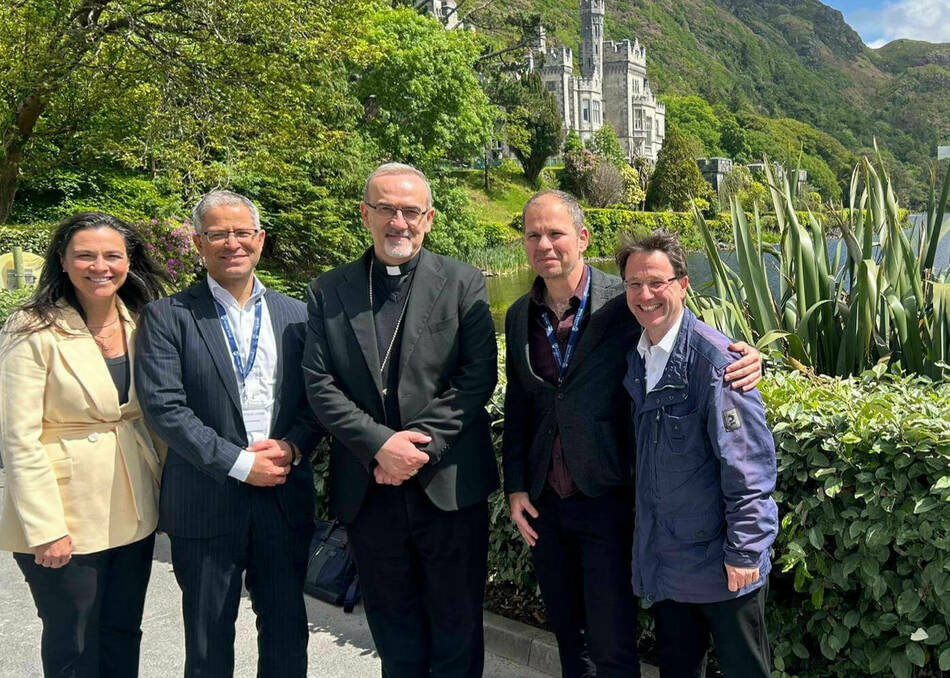
 H.B. Cardinal Pizzaballa with the Notre Dame team that included Lisa Caulfield, director of Notre Dame Kylemore, Daniel Schwake, director of Notre Dame Jerusalem, Gabriel Schwake (Vrije Universiteit Amsterdam), and Clemens Sedmak, director of the Nanovic Institute for European Studies at Kylemore Abbey
Active listening is a powerful tool, especially in times of great conflict. That’s why when the Latin Patriarch of Jerusalem, His Beatitude Cardinal Pierbattista Pizzaballa, approached a team from the University of Notre Dame, they readily agreed to support him in an initiative to facilitate a respectful exchange of thought.
The team included Dr. Daniel Schwake, Avraham Burg, and Gabriel Mitchell from Notre Dame Global, and colleagues from the Keough School of Global Affairs, Professor Asher Kaufman, director of the Kroc Institute for International Peace Studies, and Professor Clemens Sedmak, director of the Nanovic Institute for European Studies. Other Notre Dame colleagues who either attended some or helped facilitate the sessions were Lisa Caulfield, director of the Notre Dame Kylemore; Fr. John Paul, rector of the Tantur Ecumenical Institute; and graduate students of the University, Daniel Bannoura, and Alyssa Paylor, and Shir Bram.
The project studied the Christian prism through which the situation in the Holy Land is perceived, described, and analyzed. The Patriarch of Jerusalem, who is already very knowledgeable and experienced, sought to deepen his understanding of the different perspectives (political, economic, and religious) that frame the current state of Israeli and Palestinian societies, their attitudes toward one another, and their visions for the future of the Land.
This involved him engaging directly in open discussions with people that could shed new light on the perspectives of Palestinians and Israelis. The Notre Dame team offered its theoretical knowledge, practical experience, and regional network to help the local Catholic leadership further their thinking process about the current situation in the Holy Land and identify potential ways forward.
“The antidote of violence is to create hope, to spread hope, and to educate hope. Universities have a key role in this. […] These are the places where the confrontation [...] should be expressed freely and serenely [...]. It is there, in the universities, in the place of information, that we start building new bridges, not barriers, bridges of love and human fraternity that transcend walls of politics, geography, or religion. It is there that you may become prophets of peace. There, we may truly learn to know, to trust, and to appreciate each other.” —Cardinal Pierbattista Pizzaballa
The project included two main workshops: one with Palestinian scholars and practitioners at Kylemore Abbey and one for Israeli scholars and practitioners at the Tantur campus in Jerusalem. Contrary to the more familiar workshop models executed on the conflict, the workshops were designed to challenge participants to think about their societies' future visions that are anchored but not limited to historical narratives or contemporary circumstances. This model was enacted through several mechanisms, including participant presentations about their proposed “visions” of the future, a political simulation, and strategic deliberations on points that arose from the vision statements and simulation.
The workshops generated new insights and hopeful discussions by recruiting diverse participants, executing a methodology focused on the future and using the framework of Catholic Social Teaching. Most importantly, they offered the opportunity to hear different perspectives within Palestinian and Israeli society during challenging circumstances and created a space to envision a better future. One participant said, “Hope can be lost, but it can also be gained.”
Professor Clemans Sedmak is a faculty fellow with the Ansari Institute for Global Engagement with Religion.
Originally published by at jerusalem.nd.edu on December 16, 2024.