Andrew Dickson is an Ansari Institute Global Fellow who recently completed an ESRC-funded PhD in International Relations at the University of Sussex, where he served as program coordinator for the University's Religion and Foreign Policy Initiative. His research explores religion and secularism in International Relations across foreign and development policy, de-radicalization programs, and human rights advocacy. He also holds an MA in Conflict, Security and Development from King’s College London, and a BA in Philosophy, Politics and Economics from Hertford College, Oxford. He was previously center manager for the LSE Faith Center and Religion and Global Society Research Unit, and research and projects manager for the Lokahi Foundation.

Editor's Note: This conversation took place several months ago; some references may reflect past events.
Tell me a little bit about yourself, how you came to work on the topic you're working on, and how you got to your dissertation.
This topic builds on a lot of long-standing academic interests, as well as some work I had been doing in the field. I attended the University of Oxford for my undergraduate degree in Philosophy, Politics, and Economics, where I was particularly interested in political theory and philosophy of religion. I did a master's at King’s College London in Conflict, Security, and Development, where I looked at recent research into radicalization. I also spent several years working for an organization called the Lokahi Foundation which did a lot of interfaith work and research, and projects working with local communities. I was working with different religious groups and civil society actors exploring how they were tackling different social issues, engaging with state services like the police. I was also conducting research on the Prevent program in the U.K. – which is Britain’s de-radicalization strategy, looking at how governments had worked with grassroots de-radicalization ‘intervention’ providers.
I then started working on a big EU-funded program in 2017, which was really tackling the main topic of my thesis in the end. There were a range of experts and policy officials exploring how the EEAS (the EU equivalent of a ministry of foreign affairs) could increase its engagement or outreach with religious leaders or faith-based organizations within the EU’s work, because of the multiple ways that religion contributes to tackling a range of social issues around the world. But those policy officials were really at a "blank piece of paper" stage. So the charity I was working for set up a pilot program. We ran weeklong courses bringing together civil society people, religious leaders, NGOs, people working with the UN, and so on, who – in different ways – were dealing with social or political issues that either had a religious dimension, or where they were working with religion as part of their attempt to tackle these problems. It was a really interesting program.
Yet, it is also an agenda that I had ambivalent feelings about, just because I also had this background of the de-radicalization world, where the relationship – a lot of people would say – was very exploitative. In order to prevent further Islamophobic narratives and logics in the UK, a lot of religious leaders or community members received a little bit of government support for a bit but they lost a lot of credibility. Or they had government support only if they were saying the “right things” – funding which eventually got pulled. I had been thinking about doing a PhD for a while, but I began to think, “there is a topic there,” comparing what is going on internationally and what's happened with de-radicalization.
So these were the kinds of questions I had: what's going on? Are these religious leaders and religious civil society actors, who are doing really interesting work, actually going to benefit from working more closely with big government organizations like the EU? Or is it going to be exploitative? What are the agendas being furthered? And more theoretically, what does it say about secularism if we have supposedly very secular countries and secular government organizations suddenly saying, “oh, actually, we need to be prioritizing religion because of the ways that prioritizing religion can help us achieve our goals?”
So that was the background and then the project took off from that.
You talked a bit about the comparative work above. Can you explain that a bit further?
The initial idea – it has changed a bit since then – was basically to compare how the British state worked with grassroot Muslim groups on de-radicalization versus how they work with religious actors on international religious freedom or international development. However, it didn't really work because the different case studies were so different: the dynamics, the role of race, the power disparities, the political agendas. There were so many differences that it couldn't really fit into a comparative study, so I ended up instead providing a broad historical sweep of 17th-, 18th-, 19th-century British imperial history into the present day. Then I tried to include what has happened with the War on Terror as part of that historical background to see how we got to where we are now. Then I used all of that material to contextualize what's going on with foreign policy.
Would you call yourself a historian? A social scientist?
I would love to be a historian. I am absolutely not. I have jumped between lots of different disciplines. I started in philosophy and then did things which were much more practical – a master's degree in conflict, security, and development. Then my PhD was in International Relations, so it's been lots of jumping between different disciplines. Recently, I found it most interesting diving into history and using that to tell a particular story. I guess if I had to pick, I would say a social scientist, but, some people are very attached to saying, “I am in this discipline, and this is what this discipline should be about, and this is what it should do.” That is less my thinking. My thinking is, “what do these different tools let us explore about the world around us?”
What I wanted to do was provide a bit more theoretical grounding for the question of what even is “religious engagement”? Religion is big and means lots of different things. And what are governments trying to get out of engaging? The main finding in my PhD was that if you look at the Foreign, Commonwealth & Development Office in the UK, the overarching approach they have taken is to focus on how religion can solve problems. It is a very problem-solving approach. Other academics have shown that other nation-states are interested in soft power, for instance, and suggested religious engagement can help them with that. However, soft power was less the case with the UK. It was about problem-solving.

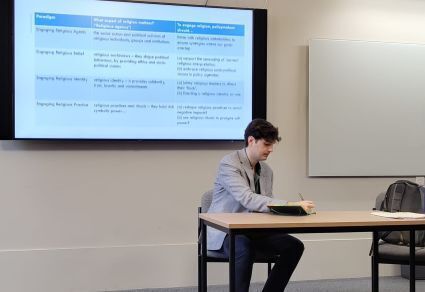
The other finding involved looking at different ways of thinking about religion. So I came up with this set of – what I called – religious engagement paradigms. These were basically different understandings of how religion matters, how policymakers think religion is going to help them achieve their goals. I proposed four, where the first three were based on a popular typology within the social sciences for studying religion. That typology highlights three elements: belief, behavior, and belonging. So religious belief (religious worldviews), religious belonging (things like religious identity, solidarities), and religious behavior (things like ritual and practice).
I suggested that in a similar way, governments could try to engage religious beliefs, engage religious identities, or engage religious practices. Engaging religious beliefs has been a big theme in counter-terrorism, for example: governments suggesting you need to “tackle the ideology” and propose counter-narratives. There are also lots of experts and practitioners suggesting that religious worldviews have really rich, fulfilling understandings of human flourishing and social organization, which can provide innovative answers to policy problems and global challenges: policymakers could embrace some of those ideas, which is another way for governments to engage religious belief. When thinking about the other two paradigms, there is also lots of recent research on governments seeking to embrace religious identity through religious nationalism, or funding and promoting religious rituals, to try and win the loyalty of religious communities or promote their standing internationally.
However, my finding was that British foreign policymakers actually do not use these three paradigms all that much. That’s where this fourth paradigm comes in, which I called ‘engaging religious agents’. Instead of focusing on belief, identity or practices, that paradigm basically says “well, none of that really matters to us - we’re really just talking about powerful people, institutions, and leaders. We don't really need to get involved in the theology. Let's just work with the most powerful socio-political actors. If they happen to be religious, that's great. We'll just work with them the same way that we would with anybody else.” That's the approach and the way of thinking about religion that I say has been really dominant, in the UK, and also internationally.
I conducted interviews with diplomats, met with different religious organizations and charities that have been involved in this kind of world, and I analyzed those data sets. Interviews were the main driver for the contemporary analysis, and the history was to help us to understand what the religious context is in the UK, because it is very different from the US, or France, or Turkey, or any other country that has different relationships between the religion and the state, or different understandings of what secularism means.
Did you only interview individuals who had identified religion as part of why they do what they do explicitly? For example, religious leaders or individuals for whom religion is important in their life? Or did you also interview people who happened to be the leader of an organization or governmental unit, without any knowledge of their religion?
For most of the people I interviewed, religion was a part of their work: people working on freedom of religion or belief, people who worked on policy dialogues, people who were ambassadors to countries where religion was a key theme. But they were not all explicitly focused on religion, or encouraging more engagement with religion. For instance, I interviewed a high-profile former ambassador to a Middle Eastern country, who saw religion as very relevant in that context, but really was not pushing for religion to be a bigger theme for diplomats to think about across the board. He said, “well, we already get why religion matters, and we already do think about it. If it's important, diplomats engage, and if it is not, they do not.” So the interviews were a bit of a mix.
What is your next step now that you are engaging in this year as a Global Fellow?
I am going to do a few more interviews, because I think another five or 10 would provide a slightly bigger picture. I like interviews. I like meeting people, and chatting, and seeing how people view the world. Then, it is hard to say, because I've obviously never written a book before, but I think the big thing is going to be starting to think about my audience for the book. I think this is the space to sit back and think about the kind of impact I want this book to make and what my contribution should be. Then lots of redrafting chapters, sending book proposals to publishers, and starting to think about the next project after this one!
Do you have a sense yet of the thesis of this book?
I do not know if I do, I am still searching for the elevator pitch. That is partly why I want a few more interviews to get a slightly bigger picture. I may be closer than I think, and I just need a bit of space from my dissertation, and a slightly different angle from some newer material.
Do you think there are going to be some policy implications from your work? And if so, do you have any idea what those might be?
I have tried to stay away from those. Yet, as much as I say “I am just here to analyze what's happened, I am not saying what governments should do instead”, people kind of expect you to propose an alternative anyway. I think putting forward clear policy implications would be a very different project, really. But the big thing I feel at the moment is that I see so much power within religion when it comes to fighting back against a lot of scary things that are happening, including (or especially) where aspects of religion are contributing to those problems. But yes, religion can often be a real force for emancipatory politics, building coalitions, and fighting back against anti-immigration sentiment and so on. It is doing a lot of that at the grassroots level already. The big question is, how much do governments want to do that? And is religious engagement actually going to achieve what religious communities want to achieve? I do not really know what the answer to that is yet. So that may be what I should be looking into over the next year.
How do you think, being part of this cohort of international scholars as part of the Global Fellows program will help over this next year?
I am really excited by it. There are lots of shared challenges we are facing, which means that there is much to learn from each other's work. Additionally, there is the fact that it is such a specialist group. We are doing different things but with a lot of overlap. For instance, I am new to the scholarship on religious freedom in South America, but there are loads of similarities with my research on freedom of religion or belief in British foreign policy. This is my first time working with a group of academic colleagues that together are focused on this sub-discipline of religion and politics, and you can already see how the various methods and subject areas complement one another. So, I'm really excited. I think it is a really intellectually stimulating year and it is a really supportive, very friendly cohort.