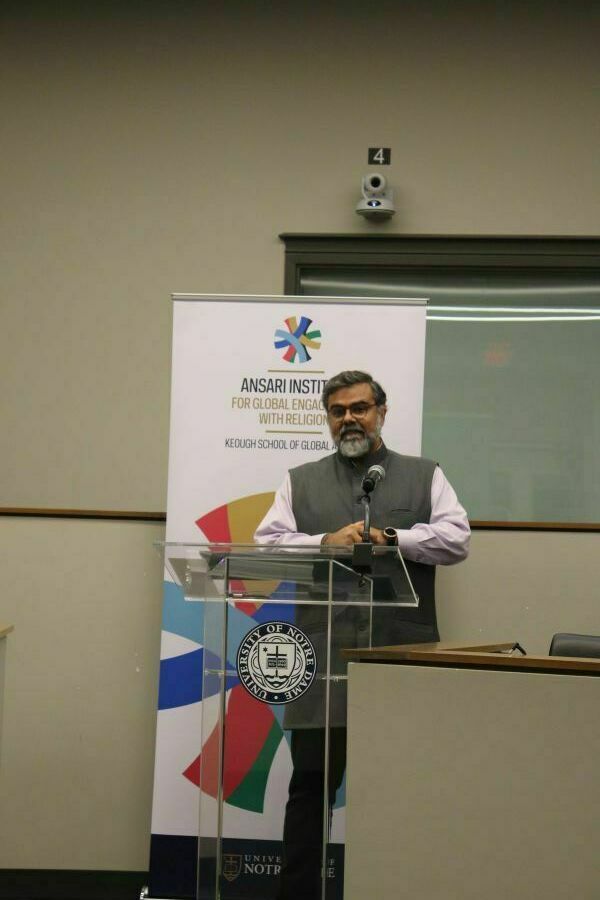
On Sunday, August 11, Mahan Mirza, Executive Director of the Ansari Institute welcomed a group of South Bend residents to the mediation room in the Keough School of Global Affairs. His task: to talk about the Ansari Institute and its role in peacemaking and to discuss – as a member of the Islamic Society of Michiana– the effects of October 7th and its aftermath on the local Muslim community.
His interactive session was the final piece of a three day immersion sponsored by South Bend City Church. This was the second immersion that the church has held, piloted and modeled after pilgrimages led by their partner The Telos Group. The immersion, its purpose, and the interconnection between the Church and the Ansari Institute make for a dynamic story.
South Bend City Church
South Bend City Church was founded in 2016 by pastor Jason Miller. It is a “Jesus-centered community for believers and doubters” where those who participate can “ask difficult questions and wrestle with the tensions of an ancient faith in a modern world.” From its beginning SBCC has said that it wants to be a “community of grace and peace for our city and the world.” So beginning in 2019, SBCC began partnering with The Telos Group, an NGO whose mission is to form American peacemakers across lines of difference.
Miller’s relationship with Telos preceded his founding of SBCC and – in some ways – informed its genesis. So, when SBCC began contributing to the mission and work of the Telos Group in 2019, the intention was always to move beyond just financial contributions to a mutually beneficial relationship. Thus while Covid temporarily disrupted those plans, in the Fall of 2022 a small group from SBCC finally joined the Telos Group on one of its peacemaking pilgrimages.
Telos’ focus has historically been on Israel/Palestine and that is where the group traveled. In May of 2024, following the most recent conflict, SBCC Executive Pastor Matt Graybill returned to the Holy Land at Telos’ invitation (read about his experience in his interview here).Yet, even before this most recent trip, Graybill says, plans were in motion for the South Bend Immersion Experience, “I remember when we were in Israel/Palestine… coming back home, I think we wanted to take that same posture of learning and curiosity and history. We started to really look at the tensions that exist in South Bend. There's a number of them. There's racial tension... Redlining.... Educational... Tension in history… Then, once we have listened, we feel like we can carry the principles of peacemaking into our community.”
South Bend Immersion Experience

The South Bend Immersion Experience through SBCC has been designed with the Telos trip in mind but focused on the stories and experiences particular to South Bend. Cam Stillson is a member of South Bend City Church who attended and said, “I am involved in community-based work for my job at the University [of Notre Dame] and so I went in a little bit arrogant thinking ‘oh, I know a lot of the stuff we are going to hear’ but it actually takes several times hearing things to actually remember them and to let them sink in. And also hearing them in places and having embodied experiences in that way - that was really humbling.”
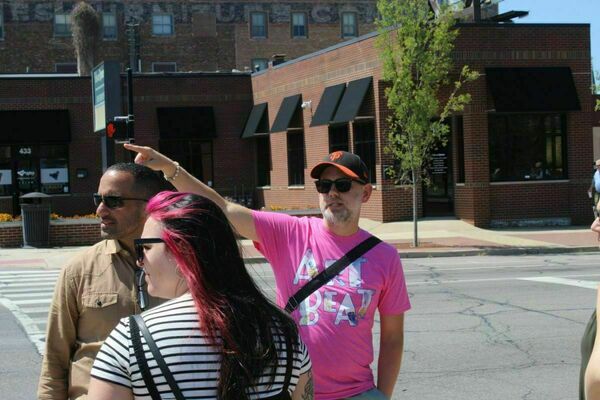
For the South Bend Immersion Experience participants were also able to hear histories of the region from two different perspectives: one from Travis Childs at the History Museum which emphasizes the ingenuity and entrepreneurship of white settlers who came to Northern Indiana in the early-to-mid 1800s and the other from George Garner at the Civil Rights Heritage Center that centered the struggles of those who came to the area before and during the great migration - and who were not necessarily warmly welcomed or celebrated. The participants also heard from the Executive Director of La Casa de Amistad, Juan Constantino, who spoke of his own experience as an immigrant and also talked about La Casa’s work as an organization that continues to help immigrants who arrive to the area on an ongoing basis. They were able to go on a walk in downtown South Bend with the City’s Director of Unsheltered, Carl Hetler and hear about those who are chronically homeless and the challenges they face. And finally, they heard from Takisha Jacobs, co-founder of Connect 2 Be the Change, about how gun violence has impacted her life personally and how it led her to co-found an organization that will help young people choose a different path for themselves. As they participated, individuals from SBCC were also introduced to Telos’ principles and practices of peacemaking.
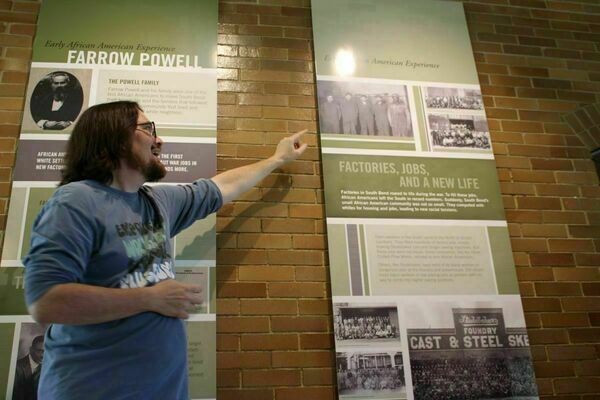
Needless to say, after two days of listening to stories and traveling to different parts of South Bend, the group from SBCC had been introduced to quite a lot (even the choices of food from local vendors such as recently resettled refugees from Afghanistan allowed for the sharing of stories) and it was against this backdrop that they sat down to hear from the Ansari Institute’s Executive Director Mahan Mirza.
The World As It Should Be
First Mirza provided a brief overview of the Keough School, the first College or School established at the University in over 100 years - a direct recognition of the fact that the world had become more globally interconnected. Then Mirza spoke about the Ansari Institute and its purpose to study, learn from, and collaborate with religious communities worldwide to inform the work of the Keough School since religion is an important part of the fabric of societies everywhere. Finally, he talked about the mediation room - where the group was meeting - and the power of narrative empathy. He said that narrative empathy is a core value of the Ansari Institute’s and reverberates throughout the strategic plan.
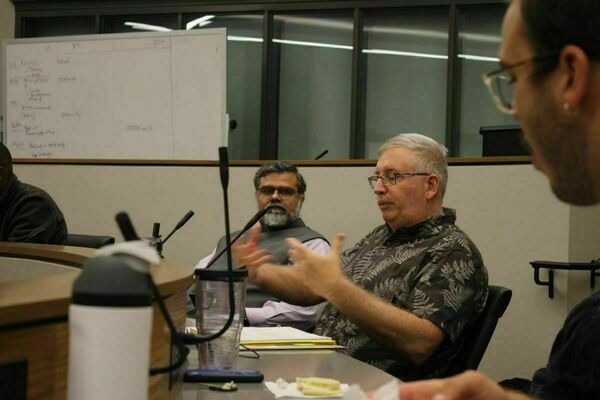
Mirza then spoke about the events of October 7th and how they have affected the local Muslim community. Afterall, he was asked by the Imam to address the community on the Friday after the initial events. He noted that they have many members who are from Gaza - and many who have lost family members. He notes the incredible sorrow and pain within their community and yet he says that broadly he feels as though they have felt supported overall. “There is no shortage of empathy,” he noted. “What they are asking for is a change in policy.”
Mirza also discussed his role in eliciting generative conversations both in the community and on the University’s campus. In response to the conflict that arose on October 7th, he proposed the Ansari Institute's Abrahamic Faith Fireside Chat wherein he, along with Tzvi Novick, and Charles Powell shared perspectives from the three Abrahamic faiths. He and Novick have also been asked to organize both a class and a series of on-campus conversations that will help the College campus see two faculty members - from Muslim and Jewish faith traditions - bring divergent viewpoints into conversation.
When asked about the project that he is co-leading, Mirza notes that the planning has not been easy nor has the response been one of universal support. “Some people have voiced the legitimate concern that ‘you cannot give a platform to an alternative narrative because in doing so you give them legitimacy.’ But we are an academic community. We do this all the time when it comes to religion and philosophy. Why not also in geopolitics?? We have to begin somewhere and I believe that we can show others that we can sit in tension with competing narratives. And that is what education is all about.”
A Bridge
Towards the end of the conversation, Stillson raised his hand to offer his reflections and to ask Mirza for his advice. He was visibly frustrated. After more than two days of seeing the ways in which South Bend was not always equitably treating members of its community, he asked, why talk more? “Where has dialogue gotten us?” That’s where the most powerful part of the immersion experience happened for him:
“I realized later that part of the reason was that it is hard for me to want to have conversations when there are overt power discrepancies being leveraged to enact violence on oppressed groups. And at the same time I do think it's important to listen to understand. So when I asked Mahan what I should do with that and he said, ‘don’t lose it - that tension! That is a gift! You are holding that tension - standing in between – and that will allow you to be a bridge.’ That was the most gracious and present response he could have offered and I needed that to sustain me in my work.”
Looking Forward
South Bend City Church held a debrief of their immersion experience on Wednesday evening. It is actually the second immersion that they have conducted locally. So members from both the first and second cohort were invited as well as participants in the original pilgrimage to Israel/Palestine. The Church is also exploring joining Telos on one of their ReStory trips to the American South and have already sent some leadership. They are also helping Telos develop materials for churches that want to develop their own domestic immersion programs and are in conversations with Telos as they develop a pilgrimage to Ireland.
Additionally, The Ansari Institute’s Mirza will be launching the undergrad course he has developed with Theology Professor Tzvi Novick in just a few weeks. Entitled Israel, Palestine, and What We Owe Each Other it promises to offer “a multi-narrative lens on the Israeli-Palestinian conflict to understand how we got to October 7 and its aftermath, and to think about where we go from here” and clearly states that the purpose of the course is not for participants – over the course of the class – to reach agreement, but rather to improve “the quality of their disagreements.” At the same time Mirza and Novick will host a series of public lectures over the course of the academic year with the same purpose, while also bearing witness to the increasingly rarely demonstrated ability to publicly and respectfully disagree. In doing so, they are in fact, practicing one of the Telos principles of peacemaking which is to “hold competing perspectives in tension.”