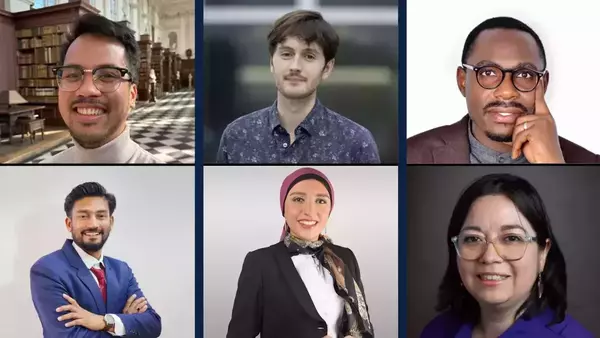
The Ansari Institute for Global Engagement with Religion is pleased to announce the launch of its inaugural class of Global Fellows. Six holders of newly minted PhDs are participating in a year-long process of transforming their dissertations into monographs, by subjecting their manuscripts-in-progress to the constructive criticism of their peers and senior colleagues in the study of “religion and global politics,” broadly considered. For the majority of the 2025-’26 academic year, they work from their current locations around the world and gather virtually on a regular basis. They will meet in person for a culminating conference at year’s end.
“The Ansari Institute is committed to fostering interdisciplinary scholarship that examines the complex roles of religion in global affairs,” noted Executive Director, Mahan Mirza. “This innovative program introduces a new kind of fellowship that brings scholars residing across the world as active members of our scholarly community. It advances our aspiration to be a truly global institution of higher learning that integrates dynamic modes of collaboration and engagement for the generation of new knowledge.”
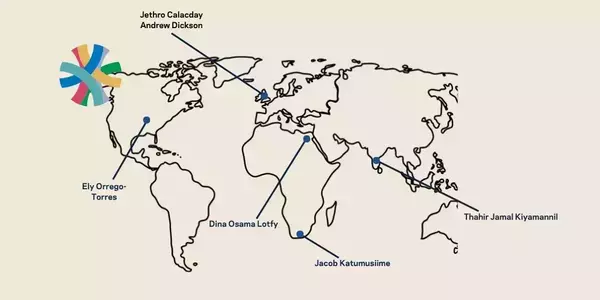
Collectively the six global fellows hail from the disciplines of political science, international relations, history, sociology, and comparative literature; their works-in-progress draw on relevant insights and literatures of theology, religious studies and postcolonial studies. Their narratives and arguments address, inter alia, the conditions under which religious organizations and movements foster democratic or autocratic systems, religious warrants for political violence, the integration of religious communities and interests into statecraft, international diplomacy and debates over religious freedom, and attempts by civil society to advance integral human development. The authors paint on a global and regional canvas that features cases from India, Mexico, North Africa, East Africa, the Philippines and the United Kingdom.
Selected from a competitive pool of international applicants, this group of early-career scholars has begun bi-weekly cohort meetings with a select group of senior scholars from Notre Dame and other universities who serve as their mentors. Each mentor participates in the virtual seminars and advises their mentee throughout the fellowship year.
A key component of the Global Fellows Program is a culminating academic symposium, to be held in Rome in late June, that will feature sessions dedicated to the themes addressed in the work of the global fellows. The event will allow the authors to present their work to a wider community of scholars prior to publication.
The global fellows celebrate the opportunity provided by the program to expand their networks and build an intellectual community dedicated to advancing the subfield of global religion and politics. Current fellow Andrew Dickson observes that “there are lots of shared challenges we are going to face, which means that there is much to learn from each other's work.” The cohort represents several areas of specialization, Dickson adds: “We're doing such different things – for example, I am new to the fascinating scholarship on religious freedom in South America.This is the closest I've ever come to having a group of colleagues that together are focused on this discipline of religion and politics and how the various methods and subject areas complement one another.“
The program, which opened applications in late July and began in earnest in early September, is already showing promise of being worthy of replication. As current fellow Jethro Calacday remarks “it is a marvel to have this opportunity to focus — to just sit down and write and think in collaboration with peers. I don't even have to relocate, which I am very thankful for.”
Read more about each of the global fellows ahead:
Jethro Calacday
PhD: Trinity College, Cambridge
Discipline: History
Current Location: Cambridge, UK
Project: Jethro seeks to revise our understanding of the agency of the Catholic Church in advancing U.S. imperial ambitions in the Philippines at the turn of the twentieth century.

Andrew Dickson
PhD: School of Global Studies, University of Sussex
Discipline: International Relations
Current Location: London, UK
Project: Andrew’s work analyzes and evaluates the paradigms by which the British Foreign, Commonwealth and Development Office engages with religion around the globe.

Jacob Katumusiime
PhD: Makerere University (Kampala, Uganda)
Discipline: Interdisciplinary PhD (Religion and Politics)
Current Location: Johannesburg, South Africa
Project: Jacob seeks to make sense of independent religious movements in Africa, and the occasional eruption of extreme violence, locating them in the Separationist Legacy of Colonialism.

Thahir Jamal Kiliyamannil
PhD: University of Hyderabad, India
Discipline: Comparative Literature
Current Location: Hyderabad, India
Project: Thahir is interrogating and revisings accounts of the historical process whereby Muslims became minority subjects in South India.

Dina Osama Lotfy
PhD: Cairo University, Egypt
Discipline: Political Science
Current Location: Cairo, Egypt
Project: Dina is mapping the roles that religious groups play in patterns of autocratization in North Africa and beyond.

Ely Orrego-Torres
PhD: Northwestern University
Discipline: Political Science
Current Location: Chicago, IL
Project: Ely is scrutinizing how transnational civil society actors enact and contest "religious freedom" within the Organization of American States.