Dr. Jethro A. E. A. Calacday is an Ansari Institute Global Fellow and a scholar of global history whose research explores the entanglement of religion and empire in the making of the modern world. He works on the histories of the US in the World, the Philippines, Papal diplomacy, global Catholicism, and Southeast Asia. His first monograph-in-progress, Catholic Empire: The American Colonial State and the Roman Catholic Church in the Transimperial Philippines, examines how the Roman Catholic Church facilitated the rise of US empire at the end of the nineteenth century, whilst revealing that the US was subsumed within older patterns of empire and religion despite its disavowal of the Spanish empire. This first monograph is based on his Cambridge dissertation "American Imperialism and the Roman Catholic Church in the Philippines," which was recognised by the Society for Historians of American Foreign Relations (SHAFR) in 2024 with its Marilyn B Young Fellowship. His scholarly works have appeared in Diplomatic History, Church History, Philippine Studies: Historical and Ethnographic Viewpoints, H-Net, and Saysay: The Journal of Bikol History.
Tell me a little bit about yourself and your background, and how you ended up doing the work that you do.
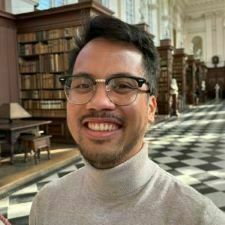
My name's Jethro Calacday, and I'm a recent PhD in history from Trinity College, Cambridge.
If I were to interpret my trajectory so far, I would say that it has been a journey of constant discovery and intellectual expansion. I come from the Philippines, and grew up in the countryside in Albay; so I'm a provincial boy. I went to a Catholic seminary in the local diocese for high school with the aim of becoming a diocesan priest. But at the end of high school, I thought that I wanted to become a Jesuit. So, I went to the Jesuit university in Manila, majored in history, but at the end of the program, I discovered my love for academia. So, again, my trajectory changed.
I wanted to do academic work as a way of satisfying a need to create. After a year of working as an editorial assistant at my alma mater, Ateneo de Manila University, I went to Yale Divinity School in 2019 to get my Master of Arts in Religion. I got a scholarship and spent two years there during the pandemic.
That period at Yale was very instructive because it broadened my horizon as a historian. Geographically, it expanded my vista, because if you're a historian or you study the humanities in the Global South, in the “Third World”, the expectation is that you will study your own country. There are hardly any programs, even in the top universities, that study other parts of the world or other humanistic fields, excepting theology and philosophy. But during my time at Yale, I was able to read about Latin America, South Asia, and early modern Europe. I learned Latin and Spanish more deeply. I was also exposed to theoretical approaches to religion and secularism. Most importantly, I was introduced to American religious history.

Nevertheless, I was intellectually drawn back to the Philippines, but this time, employing a broader, global perspective. In 2021, I began doctoral studies at Cambridge under the supervision of Andrew Preston, one of the major figures in the study of American foreign relations history. I settled on a project that asks, “Why did the Catholic Church continue to be an influential institution in the Philippines when the Americans took over, despite the imposition of church-state separation?”
Before the Americans came in 1898, the Spanish colonial state controlled the church through the system of the Patronato Real, Royal Patronage. This system, which developed from the fifteenth century as Spain became a global empire, empowered the Crown to appoint bishops and oversee church property and revenue. However, even when the US defeated Spain in 1898 and installed a putatively secular state, I was left wondering why the Catholic Church’s influence survived. How did it survive?
I became keenly interested in answering these “why” and “how” questions because they ultimately reveal how power and empire works. Whereas the convention now in US empire studies has been to interpret rhetoric, culture, and ideas, I wanted to examine actual structures that supported the imperial edifice of the US.
Moreover, my interest in Catholic history is largely informed by my upbringing. In the province, the church is a central fact of life. Holidays and public gatherings are either overtly Catholic or Catholic-inflected. I also grew up in a devout Catholic family. In a sense, studying the history of Catholicism was a way of understanding myself.
Can you talk a little bit about what your findings have been through your dissertation process, and why you think the Catholic Church remained influential or continues to be influential in the Philippines?
Just a brief background on the Philippines:
The Philippines is a Southeast Asian, archipelagic nation. From the early modern period to the modern period it was colonized by three successive imperial regimes. From 1565 to 1898, you have the Spanish. The Philippines was one of the last colonies that the Spanish empire shedded. The Philippine Revolution in 1898 toppled three centuries of Spanish rule. Then from 1898 to 1946, you have the Americans. The Philippines is perhaps the largest, colonial outpost of the United States–as it is larger than the island nation of Puerto Rico. Then from 1942 to 1945, you have the Japanese during World War II. They occupied the Philippines and expelled the Americans briefly. So three successive regimes. That's the setting.

It's an imperial setting that, although artificial, shows the place of the Philippines in world history. Of course, this is not to say that the Philippines only became significant because of European contact. Prior to the invasion of Spain, the inhabitants of the islands that we now know as the Philippines were trading with their Asian neighbors. Before Christianity arrived, Islamic missionaries converted a major portion of the population: in fact, the southern islands of the archipelago are still predominantly Muslim. As part of Southeast Asia, some islands trace linkages to other neighbours through what the great O. W. Wolters termed the mandala political system–a system of alliances that expanded or contracted “in concertina-like fashion.” Given the early development of maritime navigation, precolonial natives migrated widely, such that the linguistic affinity of Philippine languages (we have at least eight major languages) extends beyond Asia to reach the Pacific Islands and even Madagascar. So these prove the pre-Hispanic global setting of the present-day Philippines.
Nevertheless, my point is that I prefer to think of the Philippines in terms of world history. How can the Philippines, long considered a periphery in humanistic study, answer broader questions about church-state separation, church-state relations, secularism, American empire, and the global Catholic Church? How does studying the Philippines change our views about those big topics?
The argument that I settled with is: U.S. empire at the beginning of the twentieth century was facilitated by the Roman Catholic Church. And the Philippines is not only a case study, but an essential part of the evidence to prove that point. My dissertation shows that the United States used the structures of the institutional church to project its power on the new colony.

This argument flies in the face of established historiography. First, the history of American foreign relations has for so long emphasized the role of Protestant missionaries and divines in US politics and empire. Second, the history of the Philippines has been conventionally perceived as a transition from a “Spanish Catholic past” to an “American secular” dispensation. My research contradicts these longheld assumptions.
The evidence to support this rather counterintuitive assertion came from more than 25 archives and repositories in the US, the UK, Spain, the Philippines, and, most importantly, the Vatican. These sources ranged from diplomatic correspondence, financial ledgers and even prayer books and flyers. The global scope of the evidence necessitated that I learn more languages–the major ones being Latin, French, Italian, Spanish. In the Philippines, I had to learn Cebuano and Hiligaynon in addition to my native Bicol language and the lingua franca, Tagalog. Funny: I had to learn Cebuano on the spot when I was in Cebu for a week. Ditto French on my first day in the Vatican archives.
My insistence on language acquisition and assiduous study of locales is a way for me to merge the expansive perspective of global/world/imperial history with area studies. We cannot be truly global historians if we do not pay attention to local context. Likewise, we cannot understand local contexts apart from a global frame.
I make my case by also innovating conceptually: first, I propose the concept of transimperialism. Currently, transimperialism, or the trans-imperial, is understood as the relation of empires. That could mean formal state-to-state relations, but it could also be informal, such as those relations related to culture or those outside formal structures.
However, I conceive of transimperialism as the inter-borrowing of techniques of imperial domination between two empires across time. So time is the grid. So, what you have here in the Philippine case is transition – transition and succession (in time) from Spain to the United States. You see that very clearly in US colonial rule that didn’t really overhaul Spanish practices completely, but redeployed them. For instance, the United States has a common law tradition but when it came to the Philippines McKinley and his government decided to fuse Anglo-American common law with Spanish civil law (similar to Louisiana). So, in fact, there are two legal systems in the Philippines operating simultaneously. Hybrid.
Another example would be the United States mimicking the Spanish setup that centralized all executive power in the Governor General, which was quite different from what we see in the ideal US political setup. In the US mainland, the structure is federal. Yet in the US colonial Philippines, the American regime honored the structures of municipal and provincial governments that the Spanish colonial state made subservient to the Governor General in Manila.

As I mentioned above, Spain had this system of church-state union called the Patronato Real. This system, especially in the eighteenth century under Bourbon rulers, gave the Spanish monarch and state immense powers over church policy. The Patronato had two very important facets: first is the appointment of ecclesiastics, i.e., of bishops, parish priests, abbots, canons, and so on.The king or his representatives selected the candidates, with the pope simply preconizing these choices.
In addition to regulating personnel, the crown also supported the church financially by not only providing the salaries of priests and the funds for the upkeep of the church, but also overseeing the exaction of stole fees and the licensing of new religious establishments. Internal revenue, in particular, had specific appropriations for the church through separate taxes called the diezmos prediales (tithes) and the sanctorum.
What I found out in my work is that these patterns of control remained under American rule. Inconceivable, since we know that the US presented itself as the opposite of “theocratic” and “backward” Spain (read: Black Legend). For instance, President Teddy Roosevelt and then-Civil Governor of the Philippines William Howard Taft put forward names of American clergy to be appointed as papal representatives and bishops in the islands. President William McKinley requested the Vatican for the appointment of Archbishop Placide Louis Chapelle (of New Orleans) as apostolic delegate to the Philippines (later on, Chapelle had a falling out with Taft and Secretary of War Elihu Root).
The most prominent example of this Patronato/control dynamic surviving under the Americans would be the Friar Lands Purchase of 1903. The US government approached Pope Leo XIII in 1902 to negotiate the terms for this, sending Taft for the errand. I show empirically that the purchase was simply the pretext for the main demand of the Americans which was the expulsion of Spanish friars who were detested by the natives. The continued presence of these friars (Dominicans, Augustinians, Augustinian Recollects, and Franciscans) were deemed by the Americans an impediment to pacification.
Under Roosevelt's presidency the US government forcibly expropriated 450,000 acres of agricultural estates that the Spanish friars owned in the Philippines, invoking the power of eminent domain. In 1903, the US government, with the cooperation of the Holy See, compelled the Spanish friars to sell their lands for USD 7 million.

Furthermore–-and most intriguingly–the Roosevelt administration urged the Pope to create what is termed in Vatican documentation as the Fondo Filipine, the Philippine Fund, to support the Catholic Church in the Philippines now without financial aid from official sources. The US saw it as a strategy to keep the church–whose influence they wanted to harness–on good financial footing. The fund was created, with much bickering between the Spanish friars and the Vatican, from a portion of the entire friar lands purchase sum. It was put under the supervision of the Amministrazione dei Beni della Santa Sede (Administration for the Assets of the Holy See), and was invested in the Banco di Roma. The interests from the principal were sent back to the Philippines to support cash poor bishops and their dioceses.
So you are currently done with your dissertation and your goal now is to make this into a monograph. Tell me a little bit about what you are hoping to do in this next year as an Ansari Global Fellow.
I want to restructure the chapters of the dissertation, because they're very long. The rich documentation numbed me to the fact that I was writing way too much for a British PhD. So, in terms of the nitty-gritty of the editing process, it's really a matter of dividing the chapters and removing the bits that are very technical. However, I'm also going to reinsert a revised version of a published paper; I am also going to write a new chapter. Both of these didn’t make it to the dissertation.
The other thing that I want to do is to overhaul the introduction and sharpen my claim. I want to see the through line more clearly and to articulate that very effectively in a few pages.

My hope is to have a draft of the monograph by early summer or autumn 2026, at the end of my Ansari stint. The (rather ambitious) goal is to submit the manuscript for peer review shortly thereafter because I want to move on to the next project.The workshopping that we are doing as part of the Global Fellows program will help me accomplish that.
I proposed a very big dissertation at Cambridge. In reality, my final dissertation only tells the first half of the story I wanted to convey. The other half will be written as a second monograph as soon as I finish this first one.
Tell me about how the Ansari Global Fellows program will benefit your research.
I was really lucky to have gotten this fellowship. As all academics know, the job market today is really bad, and to get this opportunity to sit down, write, and think is a marvel. I don't even have to relocate, for which I am very thankful. Having the dissertation done is just half the battle. The other half is overhauling it and polishing it to make it tell the story effectively. The fellowship is helping me do that.
I do have other responsibilities, though. Currently, I'm remotely teaching (pro bono) Philippine history to Catholic seminarians. I am also supervising for two Cambridge courses this academic year.