
Dr. Matthew Cressler is scholar of religion, a writer, a comics creator, and the chief of staff of the Corporation for Public Interest Technology.
He is the author of Authentically Black and Truly Catholic: The Rise of Black Catholicism in the Great Migrations published by NYU Press in 2017 and the creator of Bad Catholics, Good Trouble, the educational webcomic series that brings to life true stories of Catholic injustice and the people of faith who confronted white supremacy and colonial violence in their communities. He is currently co-writing Body & Blood: Catholic Horror in America, with Jack Lee Downey, Kathleen Holscher, and Michael Pasquier. He has written for America Magazine, The Atlantic, National Catholic Reporter, Religion News Service, The Revealer, Slate, U.S. Catholic, and Zocalo Public Square.
Dr. Cressler sat down over zoom with Rebekah Go, the Ansari Institute’s Program and Communication Manager, to talk about his webcomic series that is being released and includes a Notre Dame connection. The following has been edited and abridged for clarity and length.
You have a PhD in Religion from Northwestern University and were a Professor of Religious Studies at College of Charleston and Earlham College until recently; and now you are creator of webcomics - which seems like a fairly dramatic pivot. Please tell me a little bit about this transition and what motivated this change.

I think it was a progressive shift over the course of my career rooted in values that were core to my training and the context in which I was becoming a scholar and a teacher. As far back as undergrad I was studying and passionate about the intersection of religion and justice, and by that time I was doing a PhD that was really at the intersection of African American studies and religious studies. African American studies as a discipline was born out of activism in the 1960s and 70s. So, certainly by the time I was a grad student I had a sense that I wanted my scholarship to be not just for scholars; I wanted my scholarship to speak to wider audiences and to contribute to the making of a better world. I wanted my dissertation and my first book, which was on Black Catholics in Chicago, to not only be legible to scholars, but to be legible to Black Catholics, and particularly those, you know, who had some rootedness in the Chicago community.
Then my first teaching job was a joint appointment between Religion and African American studies at Earlham and my first year of teaching was the year that Mike Brown was murdered in Ferguson. So I already had these seeds that I wanted to be a scholar who was contributing to conversations within academia. But then, in the midst of the Black Lives Matter movement, this felt not just important but urgent. So that led me to speaking - in a sense - to my own community as a white Catholic scholar of Catholics and race.
I experimented in what we would traditionally call public facing scholarship: writing op-eds, writing online think pieces. But as weird as it seems, I think the webcomic is maybe the purest form of that for me because the webcomic is really designed not just to speak beyond academia, but to speak to everyone, from 10-year-olds to church elders. A webcomic can basically speak to anybody who can look at a picture and read a word bubble and be compelled by a story.
I am not entirely clear on what a webcomic is; nor on whether Bad Catholics, Good Trouble is the name of the overarching project or something else. However, it is a fascinating name and I'm imagining there’s a story there. Can you clarify what a webcomic is, what Bad Catholics, Good Trouble is relative to the webcomic, and then also share where that name came from?

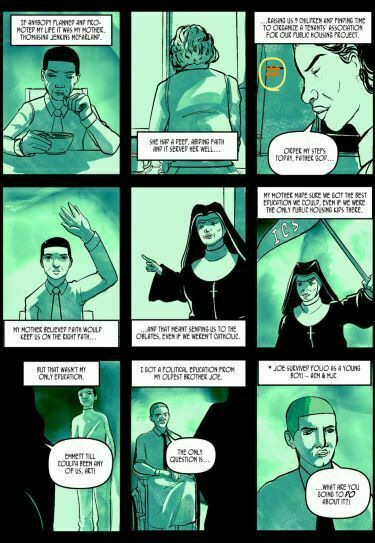
With the help of a Luce-AAR Advancing Public Scholarship Grant, I was able to create this digital project, the title of which is Bad Catholics, Good Trouble. So that is the overarching umbrella of this broader project within which there are multiple stories. The first Bad Catholics, Good Trouble story is “An Exception to the Rule,” which is a webcomic about Sister Angelica Schultz, who was a nun who was marching for open housing in 1966 in Chicago and was hit in the head by a brick for her troubles. Then “What Are You Going to Do?” is the title of our second Bad Catholics, Good Trouble story, which is actually about a Notre Dame grad (Class of 1970). The second story has been funded by The Crossroads Project, which is an African American Religious Studies project based in Princeton and funded by the Luce Foundation as well.
If you're a comic book fan, Bad Catholics, Good Trouble is the brand or the publisher, like DC or Marvel. And I gotta take a moment to shout out my collaborating artist, Marcus Jimenez, and web designer, Dr. Megan Goodwin, for their instrumental roles in bringing this project to life. Without their hard work, all this would be just a dream in my head.
A webcomic is basically taking the comic book medium and making it digital so that you can read them on your desktop or tablet or mobile device. It is designed to be accessible in a digital medium which allows you to scroll through the panels with more freedom, and - because it's digital - can be more playful and interactive with the things you can include. You can embed - as we have - links to other resources. So as you're reading “An Exception to the Rule” you'll see a little hashtag in the corner of a panel and if you click on the hashtag it'll bring you to a primary source. The primary source could be a photo that inspired that particular image or a snippet of an academic article that served as the inspiration for the story. You can also have other pages with embedded lesson plans or prayer guides.
But you also were asking where the title Bad Catholics, Good Trouble came from and you're right, there's a story there. It actually starts with an academic article that I wrote for the journal Religion and American Culture. And that article was about the hundreds and hundreds of white Catholics in Chicago who wrote letters to the Archdiocese to express how outraged they were that the Church was supporting the civil rights movement. And the people who wrote these letters - many of which were overtly racist and explicitly endorsing violence against civil rights activists or, at the very least, resisting integration - were insisting they were “real good and sincere Catholics.”

So these people were both arguing that Black people should not be allowed to move into their neighborhoods, or that they should not have to send their white children into schools with Black students, or that Martin Luther King is a Communist fraud; and they're also saying “I go to church every day, I receive the Eucharist every morning, and I am a ‘good Catholic.’” They were saying that those other people - those nuns and priests who are marching for civil rights - they're the “bad Catholics.”
I say all of that is to say, the “Bad Catholics” part of the title is a challenge and an invitation for readers to think about what it means to be a bad Catholic or a good Catholic in the first place - especially when so many Catholics who've been engaged in racial justice work have been labeled “bad Catholics” and so many people who are explicitly in support of racist hierarchies and structures and institutions think of themselves as “good Catholics.” That was where the name “Bad Catholics” came up. The second part of the title “Good Trouble” is, of course, a quote from the late John Lewis, the civil rights freedom fighter and Congressman. The title is trying to provoke people into thinking, what does it mean to be a good or bad Catholic? What does it mean to get into trouble? And when can trouble be good trouble?
So as a parent, I thought it was interesting you chose webcomics as your storytelling vehicle. Can you talk a little bit about how you chose that, or what motivated that?
Well, the very short version is that I love comic books and as a lover of comics I have this keen sense of how compelling they are as a storytelling medium. You know, short of making a movie which is a lot more expensive and labor intensive, a comic book is a medium that combines the visual and the textual that brings stories to life. And as a father of three children I also just see how my kids are constantly reading comic books, graphic art history books that are translated into graphic novels, and their favorite book series, but the comic book version. So I think anyone with kids or any teacher in a classroom has a sense that this visual and textual medium is one that young people find really compelling.
So when the question became: well, if the point of my scholarship is to not just talk to scholars about Catholic complicity in racism, Catholic struggles for justice, and the entanglement of white supremacy and US Catholicism, but to actually have ordinary Catholics understand, engage, and think critically about these issues, the webcomic became a medium that made sense. As I said, my 10-year-old can read a webcomic. A church elder can read a webcomic. They don't need to have attended a grad class on US Catholic history.
And actually, I will say that my eldest child was the first editor on the script of the first story. So when I wrote the script the first thing I did was I gave it to my eldest child and I gave them a pen and said, “circle all the words you don't understand; point to the places where you're getting bored.” And the best review of the first story was when the first chapter came out and I gave it to them to read and they got really upset that there wasn't yet a chapter 2. So that was a sign that things were going well.

You have a new story that is in the process of being released that has a Notre Dame angle, is that correct? Can you please tell me about it?
Yes, so Notre Dame was actually kind of an origin story for this project itself. The second webcomic is based on an oral history that I conducted with a friend of mine, Arthur C. McFarland (Notre Dame, Class of 1970), who is a native of Charleston, South Carolina. He is a national and local Black Catholic leader and when I first met him I just knew him as a leader in the Charleston interreligious justice movement. But when I got to know him a little bit more, he started telling me stories of his life and my jaw just dropped.
He’s from Charleston. His family's church growing up was Mother Emmanuel AME. He was going to school at the local Black Catholic High School because it was the Jim Crow era. He was involved in the civil rights protests in Charleston. Then he was one of the students who desegregated the white Catholic High School in Charleston in 1964.
Then Arthur went to Notre Dame for undergrad - in 1966 - and while he was there he was involved in Black student organizing on Notre Dame's campus that led to the founding of the Afro-American Society, the first Black student organization at Notre Dame. This was in the height of the Black Power era: 1967, 1968, 1969. So in that context they were leading protests on campus. They led a protest when Strom Thurmond, the South Carolina governor and rabid racist Senator, was invited to speak at Notre Dame. They led a protest at a nationally televised Notre Dame football game against Georgia Tech, bringing a list of demands to Father Theodore Hesburgh, the President of Notre Dame at the time. They had a sit-in at President Hesburgh's office. They threatened another protest at a Notre Dame UCLA basketball game.

They were engaged in the wave of student organizing and protest that was sweeping the country in the late 1960s in the same way that we've been seeing in the waves of student protests that have been moving in and out of college campuses for the better part of the last, like 5, 10 years; and especially in the midst of the the ongoing crisis in Israel/Palestine. So he was telling me these stories, and I was like, “I don't know what I'm gonna do with this but I've got to interview you and do something with this.” So when the webcomic project got off the ground, I knew this would be perfect for a webcomic because you really want something that's action packed. I'm really proud of the story that Arthur and I are telling together in the second story.
We are seeing this rise of college students and other activists using the same tactics that we saw in the civil rights movement - generally, nonviolent protests tactics - with the goal of trying to effect change. Yet it's been interesting to see this tension between students and college/university administrators who are responding as though these approaches are completely new, incredibly offensive, and totally unrealistic. I am very curious what you would say, as a person who has lived on the edge of this scholar/activism space for a while?
Yeah, that's a big question. I have a lot of thoughts in a lot of different directions. To go back to the title Bad Catholics, Good Trouble, when folks today look back at the civil rights era, I imagine that many of them look back with pride and with admiration. There is a sense of triumph that there were these incredible freedom-seeking, justice-seeking folks who were fighting the good fight, speaking truth to power, and bringing about a better world - and everyone would like to imagine that was the side that they would have been on, right? Yet in the Sixties and Seventies, the students who engaged in those nonviolent - and also disruptive - protests were labeled “bad Catholics.” They were labeled rabble rousers and trouble makers. They were told that they were not realistic, they were disruptive; if they could just be more patient, if they could just be more reasonable, then maybe they would get more done. So if it's not obvious already, everything that is being said of students now was said of the people that we now look back to in the Sixties and Seventies and laud for their kind of moral courage, right?
That's my first thought. This may just be the historian in me, but when I see what is happening on college campuses today and the ways that protesters are being delegitimized and criminalized and are being attacked and incarcerated by their very own institutions and administrations, I see a lot of parallels to what happened in the Sixties and Seventies. Actually part of what the webcomic is trying to do is demystify and deromanticize how we imagine the Sixties and Seventies, because I think that when we have a clear eyed sense of what happened, we can see with clear eyes what's happening around us today.
I think in terms of the student activists and protests themselves, I’d use these two words together - you said nonviolent and I added the word disruptive. And I think that “disruptive” is really important. These student movements are, by and large, nonviolent. Yet a lot of people who object to them don't think of them as “nonviolent” because they experience them as disruptive and they associate disruption - or the upsetting of the order of things - with violence. They think of nonviolence as somehow everybody hugging each other and singing Kumbaya. But that has not been the defining feature of nonviolent resistance throughout its entire history, or at the very least, over the past 100 years or more.
So I think it's important to say that these movements are nonviolent and that they are intentionally disruptive. The point is to both make demands on people in power to create a more just and equitable institution, country, and world. Yet also at its most basic, urgent, prophetic level, to say, “we cannot act as if the world isn't on fire right now.” And I think that often what people in positions of power, whether they be administrators or just simply people who live in comfort and affluence, I think that's what they often object to: the disruption of their daily lives. But I do think that is part of the point of student protests and protests generally: to shout from the rooftops “wake up! We cannot go about our ordinary lives while people are dying!”
As you mentioned earlier, In 2020 you wrote an article “Real, Good, and Sincere Catholics” where you argue “in order to fully understand U.S. Catholicism in the twentieth century, scholars must reckon with the ways racial whiteness shaped the Catholicness of white Catholics.” What is the danger for Catholics in forgetting their history or revising it so that it’s more palatable, or where they make themselves the heroes of the story?
I really appreciate the way you frame the question because I think that is the insistence: that we Catholics, and particularly white Catholics, have a clear-eyed sense of ourselves and our history. That was the bedrock of that piece and, in some sense, all of my work on Catholic history from grad school to today. It's very clear that the danger has been and remains to this day that white Catholics have in the United States long assumed that the way they live their Catholicism is what all Catholicism is. So that all the other ways of living Catholicism are aberrations: they are not real, are not legitimate, are not authentic. They are not really “sincerely good Catholics”, you know? Not “good Catholicism.”

That completely ignores the fact that there have been Catholics of African descent since there have been Catholics. It forgets the fact that even if we're just talking about Catholicism in the Western hemisphere, the majority of Catholics in the Americas have never been white in any kind of straightforward sense of the term. And that the majority of Black religious folk in the Americas have also been Catholic. So part of what I was trying to do in that piece was - building on the work of other scholars - trying to say we should be thinking about the Catholicism of white Catholics as racialized in similar ways to the ways that we think about other religious communities being shaped by their racialization, right? So there are books published on Latino Catholicism. There are books published on Black Catholicism. But often when we're talking about the Catholicism of Irish and Polish, and my people (Italian Americans), they're often just spoken of as American Catholics. Their whiteness has only recently begun to be considered in any serious context.
So, if we don't do that critical work of trying to identify the ways in which for white Catholics, the line between Catholic religious identity and white racial identity has never been disentangled, then we contribute to the mythologies of Catholicism. And we see that up to today, right? I mean the arguments around kind of “reclaiming” the Church, emphasizing distinctively Western Christendom or that Eurocentric conception, is that very legacy, you know? It's the Catholics and other Christians who have allied themselves with right wing political organizations and nationalist movements; that have attacked the Catholic practices and rituals of Indigenous peoples; and that have bought hook, line, and sinker into a certain mythology about what it means to be Catholic in the first place. So that article is trying to - in a small way - to dig into that and really kind of help us see it for what it actually is.
What has been the reception for the webcomics that you have completed? What more would you like to see done? Have you gotten pushback, or are they generally being well received?
Yes. Ha ha ha!

Whenever I have the privilege to give a talk on this subject or have an article come out on the subject, I inevitably get both sorts of responses. I get people who write to me or speak to me afterwards in a kind of confessional tone and say, “Oh, my God! You're talking about white Catholic racism… get a load of my uncle or the school that I was raised in!” There's almost always an affirmative: the story you're telling is a story that I'm familiar with - often from white Catholics themselves or people who are white and were raised Catholic. So it is depressing but also affirming that I'm not wildly off base here. It resonates with people's experiences.
At the same time, I get a lot of pushback from folks who think I'm being anti-Catholic or anti-white or who think that I'm not a “good Catholic.” Proving the point of the title of the webcomic, I get labeled as a bad Catholic or somebody who has an agenda, right? So I would say that I get both.
On the webcomic in particular, I would say that the feedback has largely been really positive. That may be partly self-selective in the sense that the people who read something titled Bad Catholics, Good Trouble are already buying into commitment to Catholic racial justice efforts. But especially in the midst of the Black Lives Matter racial justice movement that's been happening, there has been a growing sense among certain communities of Catholics that it is their duty to engage in racial justice efforts, but there were not a lot of resources. I think that in that realm the webcomic has been really well received, because it is another helpful resource.
The website is really richly developed and the stories within the project are all really great opportunities for people to kind of deepen their faith and challenge their preconceptions so that they can hopefully do the inner work, so that they can be involved in the outer work. How do you hope that people might use these?
Thank you for that. It's really meant to be a resource, to be useful, and to be an invitation into thinking more deeply about ourselves, our church, and our place in the world. So yeah, that's my hope. Thank you for saying that.