
Nirvikar Singh is currently Co-Director of the Center for Analytical Finance at UCSC, of which he was the founding Director. From 2010 to 2020, he held the Sarbjit Singh Aurora Chair of Sikh and Punjabi Studies at UCSC. He has previously directed the UCSC South Asian Studies Initiative. He has served as a member of the Advisory Group to the Finance Minister of India on G-20 matters, and Consultant to the Chief Economic Adviser, Ministry of Finance, Government of India. He is currently serving on the Expert Group on post-Covid-19 economic recovery formed by the Chief Minister of Punjab state in India. At UCSC, he has previously served as Director of the Santa Cruz Center for International Economics, Co-Director of the Center for Global, International and Regional Studies, and Special Advisor to the Chancellor. In the 1990s, he organized one of the first major US conferences on Indian economic reform. He received his PhD from the University of California, Berkeley, and his BSc and MSc from the London School of Economics, where he was awarded the Allyn Young Prize, Gonner Prize and Ely Devons Prize. He has authored over 100 research papers and co-authored or co-edited six books and served as an advisor for several startups and knowledge services firms in Silicon Valley and in India.
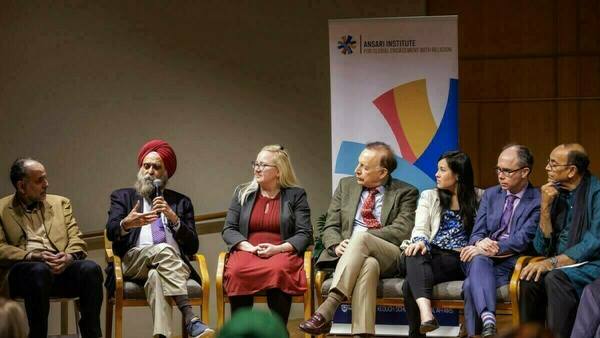
In February of 2024, Professor Singh joined the Ansari Institute for its Multi-faith Symposium where he was specifically invited to respond to Anthony Annett’s book Cathonomics: How Catholic Tradition Can Create a More Just Economy from the Sikh perspective.
Dr. Singh sat down over Zoom with Rebekah Go, the Ansari Institute’s Program and Communication Manager, to talk about the Sikh faith and the history of the Sikh people both in the United States and the diaspora. The following has been edited and abridged for clarity and length.
You have a pretty amazing depth of history of the Sikh people. Is that common for people with a Sikh background? To know their Sikh history and their relationship within the United States?
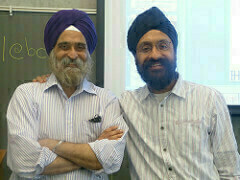
Yes, that's a lovely question. I'll give a two-part answer. I would say most Sikhs anywhere, either in India or the diaspora, know quite a bit about the history of the origins of the tradition and its evolution in the first couple of hundred years, because it is in some ways integral to how we emerged as a faith community. And also, because this history is relatively recent.
Guru Nanak was born in 1469 and he is believed to have had a divine revelation -- though I'm not sure if “revelation” is the ideal word -- around 1499. That's typically considered to be the start of the Sikh tradition. Subsequently he traveled widely and then founded a community in about 1520 – or possibly a little earlier. Basically, every Sikh knows this and it's reasonably well documented, because it's a period where you have written histories, though there are also stories of miracles and so on. While, every history has different facets and interpretations I would say that most Sikhs have a very intimate understanding of their history over the first 200 years or so, because that's the period that spans the lifetime of the ten human gurus and each guru is considered to be a spiritual successor to Guru Nanak, the founder.
The last human Guru is Guru Gobind Singh, who is succeeded by the Guru Granth Sahib, which is our sacred text. The text is also considered to embody the same spirit, the same “light”, as the human gurus. So, I think there would be a rare exception where somebody who has a connection to the Sikh tradition, through belonging or heritage, does not know this history. It's made us who we are.
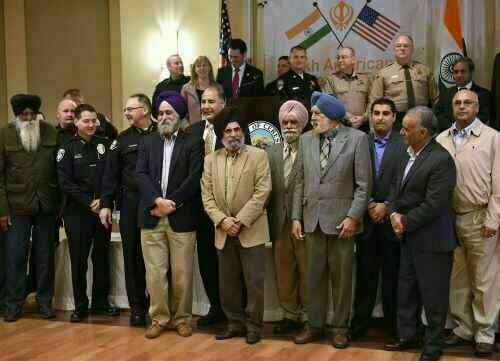
The second part, the history of the Sikhs in the diaspora, is much less well known. Sikhs in India would know very little, and even Sikhs now in the diaspora just focus on where they are. Because the US, Canada, the UK… are each a little different as host environments. A lot of the diaspora experience has just been finding one's footing, finding one's place, and dealing with the kinds of restrictions that you deal with as an immigrant. Sometimes these restrictions are legal, sometimes social. But I would say that after a little over a hundred years, Sikhs in the US, and also, I think, in Canada and the UK, each are trying to make our experiences and our history in these countries visible and known to people – to ourselves, to our children, our grandchildren – but also to people outside our community. And it's not easy because often as a small minority our history gets appropriated by others who want to decide who we are and what our story and our identity should be.
Can you give an example of that?
Yes, I can. Some scholars of Sikhs in the US have made normative statements that imply that Sikhs who give up some of their traditions are somehow more cosmopolitan and in my opinion that’s a very assimilationist perspective. It’s dressed up in scholarly language but it basically reflects a particular assimilationist perspective.
On the other hand, there are scholars who have been more detached or neutral, and I will give you an example. A retired colleague of mine who doesn't get recognized as much as she should is Margaret Gibson and she did significant fieldwork in California. She's a professor of education. She studied the Sikh community in Yuba City – though the name is disguised – and she very empathetically describes the struggles of that community to be part of larger society but at the same time preserve their religious traditions. And of course, as you know, many of those religious traditions include things that make us stand out, such as uncut hair. The title of Margaret Gibson's book is Accommodation Without Assimilation. She wrote that book in 1988, and I feel like that was very forward looking in terms of how America was starting to change in terms of the usual metaphor.
The old metaphor for America was a “melting pot” and now it is a “salad bowl.” I feel like that's the wonderful thing about how America has been evolving but it's not been easy. We're seeing that dificulty in contemporary politics. But there's a lot of acceptance of diversity, finding many areas of common ground based on things that transcend the particularities of what one's background is. And this applies to race and sexuality as well as to religion.
In this context, it’s surprising that some academics still push an assimilationist view of the Sikh experience and continue to get a lot of prominence. I relate much more to somebody like Margaret Gibson, who I think has a much more sound scholarly perspective. That is in the sense that she's not taking sides – even though every time a scholar writes, some subjectivity is going to come in. I guess I'm saying I prefer Margaret Gibson's view of accommodation without assimilation. It appeals to me. I don't want to assimilate completely. I don't want my name to be anglicized. I'm not going to hold it against any Sikh who does, however – and many Sikhs say, “we want to blend in” and that's fine, too, it's not my job to judge that.
However, with this alternative non-assimilationist perspective, I think, religion somehow becomes a special target. Somehow, if you're religious that makes you less cosmopolitan. I find that really problematic. I feel like it's actually a misuse or a misapplication of this idea of cosmopolitanism. This idea has other historical antecedents in early 20th century Europe, where there was a lot of pressure on the Jewish inhabitants to assimilate. If you were an assimilated Jew in interwar Europe, you were "cosmopolitan" and I feel like that's a very biased view of what "cosmopolitan" is.
These are all academic nuances, but at some level academics frame these ideas and have an impact on how everyday people live. I don't want Sikhs who are growing up in California to feel like being true to what they see as their heritage – this strong historical tradition that has shaped our community – I don't want them to feel that in order to be cool or to be cosmopolitan, they have to give that up.
If I may digress a little bit, I was reading up on the whole issue of religious headgear and apparently up until as recently as 2019 no one was allowed to wear a head covering in the US Congress. That law was passed in 1837. So, if you were an observant Jewish member of Congress, you could not wear your kippah into the Congressional chambers. That law was finally changed in 2019 by a Democratic Congress and the event that caused that change to take place was the election of Ilhan Omar.
So, these are the positives that I see in how America is evolving as it becomes more diverse, and Sikhs are part of that process.

Within the Catholic Church there is often talk about Sacred Scripture, Sacred Tradition, and the Teaching Authority of the Church as the ways of knowing what is right and true. And the authority, of course, is ultimately the Pope. Within the Sikh tradition is there a similar arrangement as regards a sacred text and a person or persons who are in charge or who have authority?
Yes. There are two layers to that issue of authority and I think it parallels pretty much every religion. We have a sacred text. It actually has a very clear history. Every word of it, in some sense, has been authenticated by one of the Sikh Gurus. The original text was written down by a single individual: the scribe was a relative of the fifth Sikh Guru, Arjan. But you have places where the Guru has written, “this is correct.” So, it's a highly authenticated text and so, in that sense, it is the supreme authority.
But of course, a text like that does not give you guidance for every single instance of decision making or how you live your life. There are some very clear statements: treat everybody with respect, treat everybody equally, being connected to the divine is available to everybody irrespective of gender, social status, caste, or anything else. That is a very radical egalitarian view that I think is very clear in the text. But there are many things which are subject to interpretation and I'll give you a very specific example. Some Sikhs will read parts of the text and say, “well, we should be vegetarians” and other Sikhs will read the text and say, “eating meat is fine.” And how this works out is that many of them just agree to disagree on some of these things.
My knowledge of other religious traditions is obviously not as strong as for my own, but, for example, in Islam you also have texts which provide specific guidance related to daily conduct. However, we Sikhs don't have a text with that kind of status. But what has evolved, starting at least from the late 17th century – during the lifetime of Guru Gobind Singh, the last human Sikh Guru -- are multiple, varied attempts to define a code of conduct. In the 1920s a central institution was created. It goes by its initials SGPC which stands for Shiromani Gurdwara Parbandhak Committee. Shiromani means respected or exalted. Gurdwara is the Sikh house of worship and "Parbandhak" just means management. It is an elected body.
Their main responsibilities are to manage Sikh places of worship which are associated with the history of the community, such as where a Guru was born, or where he was executed, preserving our heritage in the form of these sacred sites. But the SGPC also took on the responsibility of creating a code of conduct. What happened in the interwar period was that a large committee of scholars was created -- I think there are parallels in Christianity -- in formalizing, “what should Sikhs do, what should be the correct beliefs, and so on?” What was essentially the current version was approved in 1945, with minor updates a few years later. I couldn't tell you every detail of it from memory. But it basically says, here is the definition of a Sikh, and here are the daily responsibilities of a Sikh. Sometimes it's in very general terms. It emphasizes service to others but it doesn't say in detail how you should practice service to others. In terms of maintaining the external markers of a Sikh, such as uncut hair, it actually has somewhat of a compromise. It says, “this is the ideal and, if you are Sikh, you should believe in this ideal.” So, it's a way of being inclusive of those who don’t precisely follow the ideal, while still recognizing that maintaining these external articles of faith is a very important part of the Sikh tradition.
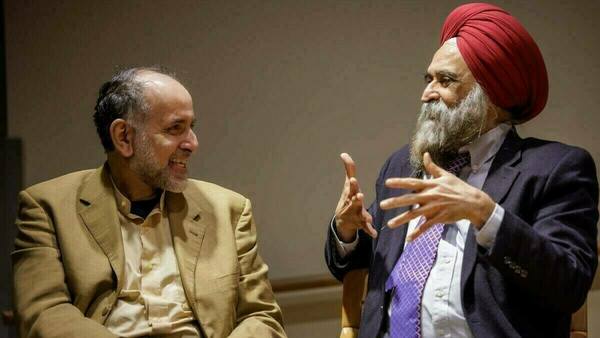
Sikh institutions are much more decentralized than the Catholic Church. Maybe in some respects even more decentralized than many Protestant denominations, because the level of authority is not always clear. I'll give you an example. If you go to a Sikh house of worship anywhere in the world, Sikhs will still sit on the floor in a traditional way, just as they would in a mosque. In the last couple of decades, the governing body for Sikhs has said, we will allow some kind of seating accommodation at the back for people who can't sit on the floor. So that is now also standard practice, even in many historical gurdwaras (Sikh houses of worship). In the early Sikh diaspora in the US, at one stage, congregants sought permission from the SGPC to all sit on chairs, which was granted. But later migrants reverted to tradition, and it is unlikely that the SGPC, or the other Sikh seat of authority, the Akal Takht, whose leader is appointed by the SGPC, would now grant exceptions.
In the case of the Sikh institution of Langar, where people also sit on the floor in rows, and are served food which has been blessed, practice has been less uniform. The practice of Langar is a way of enacting equality -- everybody shares the same food without any social distinction. While it may seem unremarkable in the Western context, in India it's very radical to do that. At one stage in the last few decades the Akal Takht said that Langar should require sitting on the floor, and not at tables and chairs. But smaller gurdwaras in the diaspora have no dedicated space to sit on the floor for Langar. So, they have tables outside and people just stand or sit on chairs. And no authority is going to come and say, “well, now, you're no longer Sikh.”
Ultimately, the approach is one of saying “here are the ideals,” but also an element of pragmatism and acceptance of decentralized management within the specific context. I'm sure every religious tradition makes these kinds of adjustments, and accepts a certain amount of diversity. People know where to draw the boundary for behavior in most cases. And it varies over time and place. So, I don’t think Sikhs are different in this way from other religious traditions, and many differences of how authority is defined and exercised are matters of degree.
Last year a gentleman was killed in Canada, and then an individual was attacked in the US. And in both cases, I believe, there were accusations that this was done by people in India. My understanding is very limited; however, I believe that this was a movement or group within India carrying out attacks on behalf of the Indian Government against Sikh leaders in other parts of the world to exert authority over the Sikh people, which is both confusing and scary to me as an outsider. At the same time, I read an article that there was a group of Sikhs in California that actually lined up and said, “we want a Sikh state in India. We want to separate from India.” So, to me it is interesting. Earlier we talked about Sikh assimilation in the US. Yet within India there is a movement to do almost the opposite – to become a separate state. I just wondered if you could talk a little bit about this situation and help me, as an outsider, understand the tension there. Likely there are historical contexts that I don't understand, but it seems like kind of a fraught time to be a Sikh person.
This is a very, very, very complicated issue. And as you said there's a lot of history. I'll try to summarize for you. Sikhs are a small, very small, minority. While India was under British rule, Sikhs would have been maybe 1% of the population. After India was split into Pakistan and India, Sikhs would have been about 2% of the population in India. And as a small minority there is, even in India, concern among Sikhs about assimilation. There is an ideology in India which says that if you are Indian then that really means that you should be Hindu and that is the ideology of the current ruling party. But that ideology has existed for a while at some level or other. That's the root cause of the tension.
There is also just a desire among Sikhs to preserve their separate heritage and identity as a religious tradition and sometimes that means having some authority over territory, in the sense that allows for decisions with respect to language, culture, and other aspects of heritage.
Another complication is the geographic position of Punjab, where most Sikhs live, and where their history has unfolded. In 1947, when the British left India, Punjab was divided, with the larger part going to Pakistan because it was Muslim majority. The other, eastern part, primarily was populated by a mix of Hindus and Sikhs and went to India. Continuing political tension between Pakistan and India has also made it difficult for the Sikhs, because, even though they're all on the Indian side of the border, they are caught in the middle of this tension.
In this situation, Sikhs have sought recognition as a separate minority within the framework of the Indian constitutional republic. Some Sikhs have felt like that's not enough and they want an independent state. But I would say that for a long time this position was held by a very small minority -- and mostly by people who were actually not living in India, part of a diaspora that was much smaller at that time than it is now. The process of Sikhs seeking recognition and autonomy continued for decades, compounded by increasing economic insecurities and political maneuvering. There was heightened conflict in the early 1980s, but still within a normally manageable realm. But the Indian government – in my opinion – overreacted to what it saw as a separatist threat, and in 1984 the government sent the army, with tanks and artillery, into the Sikhs’ most revered site, the Harmandir Sahib, known in the West as the Golden Temple. The Sikh “militants” in tht location were killed, but so were thousands of innocent Sikh pilgrims.
What followed was a spiral of violence and effectively a decade of military rule in Punjab. The extremists or militants were all killed over that time, but so were many more innocent civilians. Even though, as I said before, only a very small minority of the Sikh population might have supported a separate nation, this period left deep scars on the Sikh population of Punjab, particularly those in rural areas, and created hurt, anger, and lasting resentment and suspicion of the Indian government. Some of the Sikh victims of that period, or their relatives, now live in places like Canada or California, so the impacts of the violence were globalized while remaining unresolved.
For the Indian government the security of its borders is primary. So, whether it's Punjab or Kashmir, or the northeastern parts of India, the government is always willing to use force to maintain its borders. You would see something like that in every country, but in India, the problem is that the borders are occupied by religious and ethnic minorities. So, there's an asymmetry of power and belonging at the heart of the situation.
I would say most Sikhs just want the same autonomy that would be accorded to any minority in a decentralized democracy. They would say, “let us be who we are.” But there is now a deep level of mistrust on both sides, government and people, and many Sikhs feel that the injustice done to them has not been acknowledged, let alone rectified.
To give you an example, a few years ago, Sikhs in California weren't advocating for a separate state. All they were doing was going to city councils where there were significant Sikh populations like Fresno, and saying, “could you please pass a resolution condemning what the Indian Government did in 1984 as a genocide?” The events in question were pogroms against Sikhs that followed the assassination of India’s Prime Minister by her Sikh bodyguards, itself a retribution for the assault on the Golden Temple. Apparently, the Indian Consul General based in San Francisco then started going to those cities and saying “please don't do that,” which was clearly overstepping the bounds of authority of an Indian government official. Such actions perpetuate mistrust.
I was speaking with Mahan about something totally different, but at one point he mentioned something about the Muslim faith not having an explicitly pacifist or anti-violent bent. Personally, I am a pacifist though I am not clear if the Catholic faith - which I was raised in - is actually pacifist (I do know there are some parts of the tradition that have argued for a just war theory). However, I've noticed in the Sikh tradition, that at least there is a knife element that would seem to have sort of a violent outward appearance. So, I just wondered about the Sikh outlook on violence and war particularly as the articles of faith include a sword.
I'll give you a kind of "historical evolution" answer. Guru Nanak, the founder, in his writings very explicitly condemns the violence of rulers. This is not just military violence, but also other kinds of violence, like corruption and exploitation. And, in some sense, that was fine for the next few decades because, at that time, the Mughal State was relatively stable and peaceful.
But in 1606, the fifth Sikh Guru, who compiled the sacred text, was executed at the orders of the Mughal Emperor. I won’t go into the reasons here. His son, Guru Hargobind, who succeeded him, effectively said, “we have to defend ourselves.” Throughout the 1600s, the Sikhs were trying to preserve their faith and their identity. It was not just a religious issue, but also a political issue. The Mughal Empire saw this community attracting followers from the peasantry because it was offering a radical egalitarianism, a view of what life should be, what society should be. The Mughal Empire wanted to control it, control this movement. In 1675, the ninth Sikh Guru (Guru Hargobind's son) was also executed by the Mughals. Then his son, Guru Gobind Singh said, “well, it’s even more important to emphasize this need to stand up for ourselves.” So, the external markers of Sikhism date to Guru Gobind Singh, where he says, “you are going to be fearless. And to be fearless, you are going to stand out. You can never deny who you are.”
In simplified language, that's the origin of the uncut hair and turban for men, and to some extent, for women. The sword, another such marker, all Sikhs would agree, is a symbol of self-defense, but also of standing up against oppression of any kind.
Now from there things got worse in the sense that a succession of Mughal rulers or officials tried to wipe out the Sikhs. Guru Gobind Singh lost all four of his sons in this struggle for survival. Sikhs’ external markers come from that struggle, and have been reinforced by it. “We're going to stand up for ourselves and for anybody who needs support.”
Sometimes that attitude also connects to a different ideal of Sikhism, which again, you find in other religions: the idea of selfless service. Wherever there's a natural disaster, Sikhs will go and help. One of the interesting things about Covid was how Sikhs everywhere set up free kitchens because we have this tradition of community kitchens, the Langar we spoke of earlier. Sikhs were very well equipped to do that. They said “we are just going to feed everybody who needs to be fed.”
Ultimately, however, these attitudes, of service and support for others, are supposed to flow from being a good person first. And being a good person comes from understanding Sikh ethics.
Can you share with me more about Sikh ethics?
There are five vices to avoid. And in this you will see some parallels with the Christian tradition.
These are anger, lust, greed, undue attachment -- like being too attached to worldly things, which is the complement of greed -- and, in Punjabi, ahankar, a feeling of self-importance or pride.
The ultimate goal is to get away from the sense that somehow you are more important than everything else or everybody else. That's the prime message of the Sikh Gurus: you are part of this wonderful creation and web of existence. And you need to live in a way that helps you to see how you fit into that.
Then there are also virtues. One is directly from the Sikh sacred text. Meditating on the divine, or reflection, sort of like prayer, but a little different context. Being generous, being charitable, giving. Being open to others. Being pure of heart, pure of mind.
There's also a somewhat subsidiary idea which often gets used nowadays, though it is not directly in the Sikh sacred text, based on three virtues. These three aspects of virtue are sometimes called the Three Pillars of Sikhism: the first is meditating on the divine, in this context we use the term “nam” to represent the divine. Nam literally means “name,” but it means “sense of the divine.” This is from the sacred text as I just described. The second part is: earn an honest living. This is an important message in Sikhism. Don't be an ascetic, be a householder, be part of the world, be productive. The third component tempers this: share. You have the fruits of your labor. You worked honestly and as a result have received. Now, share it. Give.