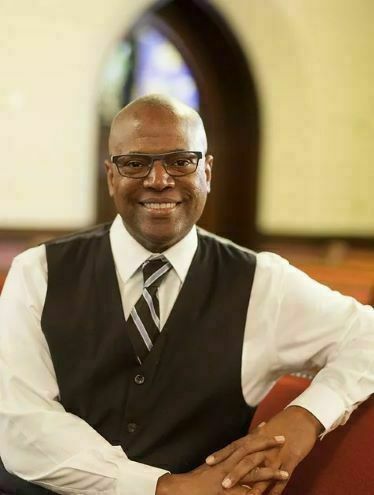
The Rev. Dr. Michael Nabors is senior pastor of the historic Second Baptist Church in Evanston, Illinois, where he has continued to lead the church in its role as a trumpeter for Christ and social justice advocate. He was a contributor to Faith in the Story: Trialogues for Enhancing Religious Literacy, a multi-year series of workshops at the Ansari Institute that brought together media professionals, faith leaders, and scholars of religion to improve the conversation about religion in the public sphere.
Under his guidance, Second Baptist Church has become a leading faith center in America in facilitating Race Talk Solidarity Circles in local communities. Dr. Nabors earned an undergraduate degree in English and Creative Writing at Western Michigan University, a Master of Divinity and Master of Theology from Princeton Theological Seminary, and a Doctor of Ministry from the United Theological Seminary. In 2023 Dr. Nabors and a colleague, Dr. Michael Woolf, were awarded the Edwin T. Dahlberg Peace and Justice Awardees by the American Baptist Churches in San Juan, Puerto Rico. The award was given for their work and partnership on race, reparations and reconciliation. Former Dahlberg recipients have been Dr Martin Luther King, Jr., William Sloan Coffin (Riverside Church in New York City) President Jimmy Carter, Marian Wright Edelman, and Congressman John Lewis.
Rev. Nabors sat down over zoom with Rebekah Go, the Ansari Institute’s Program and Communication Manager, to talk about his work as a minister and as a champion for reparations. The following has been edited and abridged for length and clarity.
*****************************************************************
I was reading your impressive bio and one thing that struck me was that you only moved to the Chicago area within the last ten years and you are already fully engrossed in the community - even currently serving as the President of the NAACP Evanston Branch and playing a key role in the local reparations work. Can you share your views on how faith influences your civic engagement?
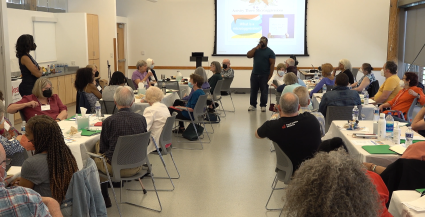
That's a good question. I first engaged in my faith experience as a teenager in Kalamazoo, Michigan. I grew up in a traditional conservative African American Baptist congregation. One of the things that impressed me about the ministers in the town that I grew up in is that they were all members of the NAACP and every year there would be a fundraiser where the black ministers in the city played a basketball game against the NAACP officers. So what they would do is they would cheat both sides and they would recruit young people - because they could only stay out there for about 5 min (laughs). So I was one of those kids that were recruited when I was about 13 or 14 and I saw such mutual cooperation and the joy of folks who were serious about their faith and also serious about civic engagement and particularly civil rights. So it started there. And every place that I've been in ministry since, I served as president of those branches of the NAACP.
So when I arrived here, the NAACP asked me right away if I would be the President and I said: “No. I can't be the President. I don't even know you all. I don't know the ethos. We have to wait.” So a couple of years went by and I became very active with the branch during that time. Then they asked me to run and I ran unopposed. Since then, I've run unopposed for 3 terms.
I see that in order for me to understand the importance of God at work in human affairs, I have to be in human affairs myself, especially for Matthew 25 - feeding the hungry, giving drink to those who are thirsty, welcoming the stranger, visiting the sick and those in prison. All of that, to me, is social justice.
It seems to me that not all faith leaders see engagement in the local community as part of their job. Instead they see their job as primarily - and maybe even only - as serving their flock. However, you seem to view your role differently and it has impacted that kind of work that your church is engaged with. Can you talk about that a little bit?
You know, I think that there are just some churches, and in every major city in the country, that just have a history of carrying the social justice baton. New York City has Abyssinian Baptist Church in Harlem that goes all the way back to Adam Clayton Powell, Jr, who was a Congressman and also the pastor of that church. If you go to Philadelphia there was Bright Hope Baptist Church - where Congressman Bill Gray III served. Another one was Mt Zion Baptist Church and the late Leon Sullivan. In Washington, DC, Walter Fauntroy was the pastor of a Baptist church but he was also a Congressman. In Detroit it was Hartford Memorial Baptist Church, going all the way back to Dr. Hill, who served that church in the 1920s and was very involved in the formation of auto industry unions. Those were folks that I greatly admired and studied.
So when I looked at Second Baptist it became apparent to me that there was a potential match. I looked at their history. I looked at their former pastors. One of them was William Holmes Borders, who served in the 1930s who was just an incredible presence in Atlanta prior to the Civil Rights movement and during the Civil Rights movement. Martin Luther King, Jr. used to skip church - his dad’s church, Ebenezer - and run down the street to hear William Holmes Borders who had this national radio program. Second Baptist later also had an incredible pastor named Hycel B. Taylor, who served here for about 40 years. At one point he was both President of the Rainbow Coalition and Operation Push, and pastor of Second Baptist at the same time. So yeah, that's my belief and philosophy in how religion is supposed to intersect with work in the community.
Do you get frustrated with other faith leaders who don't do their part?
Maybe 20 years ago when I was younger, I let everything frustrate me. But now that I'm older, I recognize that a church like Second Baptist is a gift for me. A church having a history of social justice and a church that believes so much in it that it gives me the freedom, the space, and the time to commit myself to community activism. Other churches would never have that from their pastors. In fact, some pastors are bi-vocational. So, what time do they have to go to every rally and every single board meeting and every city council meeting? I have time to do that because I don't have to work from 9 to 5, and my congregation appreciates that and accepts that.
I listened to a wonderful conversation that you had with Lisa Sharon Harper on her Freedom Road Podcast. You discussed solidarity circles on race with different houses of worship in the community. Can you share a little bit about that here?
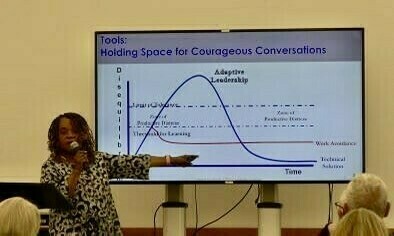
She's brilliant, I want you to know that. Absolutely brilliant. Right around the time of the pandemic we were trying to start a prison ministry and we were going into local places where folks are incarcerated and doing some creative things with them as an African American congregation. Then COVID-19 came, and everything shut down. So what we decided to do - because we had created an infrastructure for a ministry - was, we said, “how can we make this shift? How can we maintain the enthusiasm and the energy and shift to something else?” So we got together and we came up with the idea of doing race talks through solidarity circles.
The reason why we came up with that issue is because Evanston is always talking about how it is the most wonderfully diverse city in the country. Yet, one of the former superintendents of the school district, Dr. Eric Withersberg (a white guy, by the way), would say, “Yeah, we have the greatest drive by diversity that you'd ever want to see.” Suggesting you have to dig down deeper, not just surface level.
When I was in Princeton as a very young pastor, we did solidarity circles on race talks through the United States Justice Department, and that idea kinda came back to me. So we put together a curriculum with some really brilliant members of the congregation. Then we reached out to other houses of worship in Evanston through our network with the interfaith group and we started this movement. We trained facilitators over a period of 4 to 6 months. It was all on zoom - remember, by this time COVID had come around. Then there was a list of houses of worship that wanted to sign up and engage in these circles. And so we did it! Via zoom!
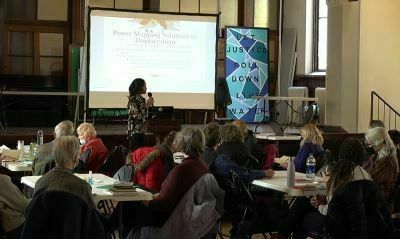
Over a couple of years we reached 16 congregations and over 600 different people participated in those circles. The overarching goal was: what can we do to partner and eliminate racism in Evanston? How can we eliminate racism in the world? What can we do about it within the United States? And all of a sudden we had the reparations resolution that was passed by our city council. So all of this started coming together. All at the same time. The city and the politicians were working on trying to handle race and we were in the interfaith community doing the same thing and it just exploded, and we did a documentary on it as well.
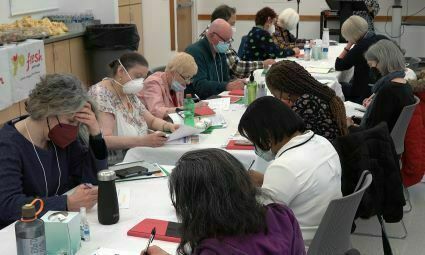
We also had a chance to create ten different workshops above and beyond the solidarity circles, and we opened those up to everyone in the community, and they were very well attended. Probably about 100 people attended each of the different workshop sessions. Each was conducted by professionals who facilitated from that umbrella subject, eliminating racism.
In preparing for this interview I was reading an old blog post from Austin Channing Brown on Unlearning. She says - in part - “I am unlearning the need to be all things to all {white} people... I am choosing when I want to teach and when I don't. I am learning that I don't have to bust out my scars to prove their presence. I no longer feel the need to change the minds of white people by showing them how great we (black folks) can be. If you don't know, your loss… But I first unlearn my "duty" to teach anyone who expresses even a passing interest.” What that tells me is that this work comes at a cost – a personal cost to live and relive past trauma and pain. How do you balance that for yourself? And how do you encourage members of your community to engage in this work without further exposure to suffering? I admit I ask this sheepishly as a white woman myself.
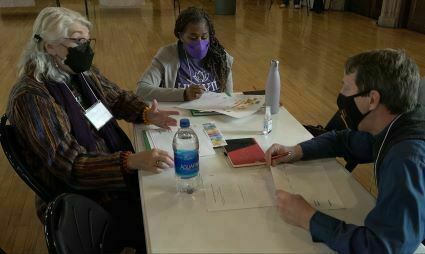
That is a very serious issue for black people in general. In beginning to engage in the work here at Second Baptist those were the questions that we raised ourselves. How do we find balance, especially in the solidarity circles? We went from house of worship to house of worship - from Beth Emmett Synagogue to St. Luke's Episcopal Church to Northminster Presbyterian Church - but often it was the same people from Second Baptist. So the question became: how do we not burn ourselves out? How do we not find ourselves in anguish by reliving these same stories over and over again?
So I think articulating that concern before we began gave a nice warning about how to find a way to balance. You don't have to necessarily tell the same story every single time. Some of the solidarity circles are not just black people talking and telling their story, but also white people talking and telling their story. “When were you first confronted with racism? When did you first know that racism existed?” That sort of thing.
It takes a particular kind of person to be able to engage in that kind of dialogue for an extended period. When civil rights was first born, people did not burn out because they knew the urgency of the moment. I'm not so sure that people feel the same kind of urgency today to eliminate racism that our parents and our grandparents did a generation and two generations ago. I think that's another way of coping. Being able to say: “It did not disappear with our grandparents. It did not disappear with our parents. So we can't believe that it's gonna disappear in our generation.”
We also encourage our folks to take time to get away. We encourage things like meditation and yoga. We have yoga instructors in our congregation that are especially helpful for folks who are engaged in this kind of work. Then for me, I've been here nine years and I'm taking a sabbatical in two weeks and I'll be gone for three months.
What are you going to do?
We actually did a timeline and planned on taking several trips to retrace the movement of my family through the help of Quakers in the United States and also my family’s involvement in wars in the United States over the years. I come from one of those rare black families that can trace my relatives' time on this North American continent back to 1761, in the birth of Britain Jones, who was a soldier in the American Revolution at the age of 15. He had another cousin that came along that started on my mom's side, James Ampy. He was born in 1793, and fought in the war of 1812. My great, great, great grandfather, Isomy, fought in the Civil War with three brothers. So four brothers from the same family fought in the Civil war, two in the 54th Regiment out of Massachusetts, and two more, one in Ohio and one in Illinois regiments. One of them was killed in the 54th.
Then my mom's grandfather, her mom, my grandfather on her mom's side, fought in the Spanish American war. It goes on and on. I have great uncles who fought in World War I. I have uncles who fought in World War II. I have uncles who fought in the Korean war, and 3 brothers who fought in the Vietnam War. So I am going to all of those different places and retracing that work. I've done a slide deck that includes my family and the history of all of that.
So I'm really excited. We have all of these incredible stories. They're great stories, and they're also stories about my family starting out in Virginia and North Carolina and Dinwiddie County and Guilford County respectively, in both of those States. I can trace a marriage in 1823 with James - who was in the war of 1812 - and his wife in Guilford County. They were escorted out of Guildford County by a Quaker named George Menden Hall to Mount Pleasant, Ohio. Mount Pleasant, Ohio, in the 1820s was a bastion for the abolition movement begun by Quakers. Then when things got bad in Ohio they moved a few years later to Wayne County, Indiana. Wayne County, and Richmond, Indiana, was another bastion for the abolition movement. So my great, great, great, great grandparents actually worked with Levi and Catherine Coffin, who are considered the grandparents of the Underground Railroad in Richmond, Indiana. I read about them when I was a kid but I never read about my great, great, great grandparents. Now I have documentation that they actually lived in the same space and worked together. That's just incredible to me.
Your bio states that you have served on the Steering Committee for Evanston Reparations, the first municipal reparations program in the United States since 2019. That program allocates 10 million dollars to Black Evanstonians to repair historical damages due to racism. How is that being distributed? Actual cash payments? Or is it investment in things like housing, education, and healthcare?
That was the big question initially. When we found out that the city council voted eight to one in favor of the reparations - the only vote against was a black councilperson, I will say - we recognized that the big issues were going to be, how will the money be found and how will the money be distributed? Soon enough we were able to discover that we could get 10 million dollars through taxation on cannabis sales. So that's where the first 10 million dollars came from. Then the mayor, at the time Steve Haggerty, actually appointed a reparation subcommittee working under City Council to come up with a determination for how the money was going to be expended.
Our resident local historian - that's his hobby, not his profession - Dino Robinson has something called Shorefront Legacy Center, where he's been archiving stories of black people in Evanston in the North Shore for 30 years. The reparations subcommittee went to Dino and said, “what area do you think we can most quickly find evidence of racism that existed for the past 100 years?” Without blinking he said, “housing. We have all of the documentation. We have all of the maps.” So it became evident that housing was the number one piece.
So when the initial folks were eligible they had to show that their families were discriminated against by racism through housing. The $25,000 had to go towards a specific purpose. Are you gonna replace your roof? Are you gonna build new steps? Are you gonna pay down on your mortgage? But a year later, the city and the subcommittee came to the conclusion that they really didn't have any business telling these people how they were gonna spend that money; so those stipulations went away. Now there is more. It's gone up to 25 million dollars now. The really big issue legal counsel is still trying to figure out is whether or not the folks have to be taxed on that $25,000.
Once the reparation program was off and running with the city, the faith community of Evanston came together in the summer of 2022 and had an outdoor rally at Fountain Square to show the community that they were in support of reparations. In the meantime, a few of us - Dino Robinson, myself, and another councilperson at the time Peter Brace - went to the Evanston Community Foundation. We asked them to help us establish a nonprofit organization dedicated to reparations. So we started the Reparation Stakeholders Authority (RSA) of Evanston. The purpose was so that, in the event that the City Council decides they’re “done with reparations,” we have an organization for philanthropists and altruists to give perpetually. That non-profit started in 2022 and in January of 2023, 18 houses of worship presented the RSA with $940,000.
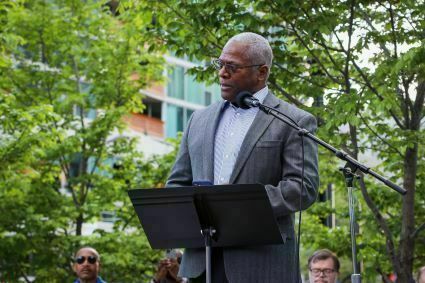
They raised that money in 6 months! So we're now determining how that money will be expended to the community and it's not the same as the city reparations. The RSA is a nonprofit organization that's run by black people. The board is black, the president is black and there's so many exciting ideas.
Reverend Martin Luther King Jr. once famously said, “It is appalling that the most segregated hour of Christian America is 11 o’clock on Sunday morning.” Can you share your perspective on this and ways we can continue to work together for the common good?
Unfortunately, I think that racism is growing in our country and not lessening. There's evidence of that in the political climate and I think that manifests itself in religious communities as well. So the idea of faith communities becoming interracial and intercultural, while that may have been a real goal 20 years ago, I think that has changed now. There are not many folks that I know of who are intensely interested and focused on trying to have an interracial congregation.
Still, I have been very interested in that during my time in Evanston because I think Evanston is a community where that kind of intentional effort would probably create extreme growth. But I also respect the fact that I serve a 142 year old African American congregation and that congregation is steeped in African American religious tradition and history and ways of worship and liturgy. So I know the congregation I serve right now would be looking kind of strange if overnight we ended up having as many white folks as black. But we do have white people who are members of the congregation and we have white people that attend every Sunday as visitors.
So I'm trying to figure out how I can allay the concerns and fears and doubts of many of the African Americans with regard to a potential change. How I can create a spirit that is even more welcoming to every racial group and every ethnic group as part of our worship. So part of my vision is seeing that. But part of my reality is not being exactly sure how to make that happen in the context that I'm in right now.
It's frustrating. It's very frustrating.
At the same time I share with our congregation that has some reticence about it: “look, we have white members and we have white people attending a church that is an African American church. We sing a certain way. That's the nature of our history and our tradition. And that's something they're embracing. That's a part of what is attracting them to us.” I really do believe and hope. I've been trying to share this with the congregation through my teaching and through my preaching. We can experience incredible growth if we expand our horizons.
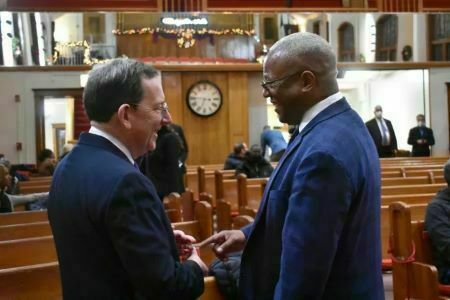
Last question – and this a bit of a departure on what we have been discussing so far – but you wrote a guest essay in the Evanston Roundtable on the protests at Northwestern where you encourage people on both sides of the conflict in Gaza to find middle ground. What are some of the virtues that you feel we need to cultivate to find a middle ground? What are things we could all do better in order to ensure better dialogue amongst difference?
I would say, from a Christian perspective and maybe even Judeo Christian, if you talk about the Bible, the Old Testament and the New. I would go specifically to Scriptures that talk about the human family as one. I would go to Genesis 2 and 7 with God forming man from the dust of the earth and breathing into his nostrils. That's one origin of the human family based upon our faith and it talks about the oneness of the human family.
Then we have the Old Testament riddled with laws that talk about a requirement to entertain the stranger, to be welcoming to those who are unlike you, who are different from you. That's almost like a mandate in the Hebrew days of the Old Testament. Then we shift over to the New Testament and one of my favorite texts in the entire Bible is Act 17: 26, and Paul says, “with just one blood, God made all nations to live on the face of the earth.” All of that talks about unity.
So what are the virtues that we need to possess to have that common ground? I believe it is embracing your particularity while at the same time reaching out for a universal relationship with everybody else. So embrace your particularity. You're born a certain way. You're born into a certain family, a certain culture, all of that. But don't let that be a straitjacket. Don't let that minimize your ability to be in relationship with everybody.
Just last night I was on the campus of Northwestern speaking to a group of students and many of them were the protest leaders, and I shared with them that the key to moving the world forward is finding common ground. When you find common ground, that's the only way that you can move to higher ground. You can't get to higher ground all by yourself. I also shared with them that I was very proud of them and the college president for coming to an agreement to end the protest and to honor many of the requests that the protesters were asking for. For example: hiring Palestinian faculty members, having scholarships for Palestinian students, building a house for Muslims on campus, just like there's a house for black students and of course the Jewish faith has its own house. The Catholic faith has its own house. So you know, I thought all of that was just important. A wonderful model for what is going on with other college campuses around the country.

I got a lot of comments and a lot of feedback from folks about the letter that I submitted to the Round Table and I have to say most of it was really very positive. The negatives were the folks who were extremists on both sides and my heart goes out to them as well, because they live in trauma. Jewish people are just so upset about people appearing to be pro Palestinian because they're not far away from the Holocaust and Palestinian people are also living trauma, which didn't just start October seventh.
When I have time to talk to people I let them know that I've been to Israel and Palestine. I was there in 2019 and I did go behind the green line. I ate dinners and lunches with Palestinian leaders with a group of very interracial and interfaith groups. It was with Interfaith Action of Evanston that was led by Rabbi Andrea London from Beth Emet Synagogue and we also had representatives from Grace Lutheran Church, and a dear friend, Pastor Daniel Ruen, who is now located in Saint Paul, Minnesota. But we were the three clergy that went over along with a group of laypeople. We asked for two guides for 12 days - a Jewish guide and a Muslim guide. Our guides were both young men, in their early thirties: Amit and Ameen. Every time we went somewhere one of them would tell the story, “such and such happened here” and it was a beautiful story, and then the other one after the first one was finished would say, “on the other hand…” But we loved it. Two different stories but there was no animosity between the two of them. We heard the differences of stories that date back thousands of years.
Are there any questions you wish I had asked?
I don't think so. The one question folks always ask is what is the future of the church? What is the future of people of faith? And if you look at the George Barna and Gallup polls that specialize in religious movement they're really disconcerting. They're talking about the out migration of folks from traditional churches and everybody becoming spiritual. We see that happening in seminaries around the country so seminaries like Garrett have to sell their student housing because students are going to school online as opposed to coming together.
I don't know what the future holds for that because coming together means that you're learning about social and cultural differences that are different than your own, even if they're all from the same faith, like Christianity. So if you were to ask me that question. I would say, that's an excellent question and I really do have great concerns about the future of traditional faith communities. But I don't have great concern about the future of Christianity. I just think it's gonna look very, very different from what we have seen over the centuries.