On January 28, 2026, The Ansari Institute for Global Engagement with Religion, held a colloquium entitled, “The Intersection of Faith and Sustainability” in collaboration with Seed Global Development. Practitioners from Seed Global Development and students from the Keough School Master of Global Affairs (MGA) program gathered to discuss how faith and religion influence communities’ views on sustainability and their responses to development challenges.

Seed Global Development is a newly established social impact consultancy firm founded by former MGA students. Headquartered in the United Arab Emirates, the firm works at the intersection of climate resilience, sustainable agriculture, and inclusive policy advisory. Rooted in commitments to human dignity and the common good, Seed seeks to bridge research, policy, and community practice.
Sustainability efforts are often framed in technical or policy-driven terms. But as climate change intensifies, food systems grow more fragile, and inequalities deepen, the wager of this symposium was that a broader perspective is needed to face the challenges ahead. Faith traditions, religious leaders, and community institutions continue to influence values, behavior, and collective action worldwide. Sometimes this influence is visible in advocacy spaces. At other times, it is embedded quietly in local practices and community norms. In either case, however, reflecting on traditions and practices offers an opportunity to think more broadly about what makes sustainability efforts effective.
The faith-sustainability nexus in policy and practice
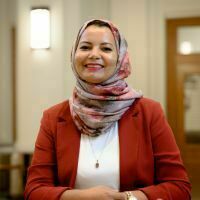
Olfa Jelassi, Strategy and Partnerships Lead at Seed Global Development and a 2024 MGA graduate, began the discussion by introducing the connection between faith and sustainability. Drawing on her experience in climate advocacy and development, she described how faith-based organizations add moral authority, social trust, and institutional strength to sustainability work.
From international climate negotiations to local food systems programming, faith actors are increasingly recognized as key stakeholders. Jelassi highlighted the growing presence of faith organizations at global climate conferences and noted that major religious institutions mobilize significant financial and social resources to aid sustainability initiatives. In the United States alone, donations to religious organizations totaled approximately 145 billion dollars in 2023, far exceeding contributions directed specifically to environmental causes. While these funds are not necessarily directed toward environmental initiatives, the scale of financial resources controlled by religious institutions highlights their potential to influence sustainability outcomes. Faith-based organizations not only fund social programs, but also manage extensive networks of schools, hospitals, land, and community programs, all of which shape community behaviors, resource use, and local development pathways. As Jelassi argued, mobilizing even a small portion of these financial and institutional resources toward climate and sustainability initiatives could have significant impacts on advancing the SDGs. Globally, faith-based organizations reach an estimated 80 percent of the world’s population through networks of schools, hospitals, land holdings, and community centers. These resources, Jelassi contended, can be mobilized to support sustainability initiatives.
While these funds are not necessarily directed toward environmental initiatives, the scale of financial resources controlled by religious institutions highlights their potential to influence sustainability outcomes. Faith-based organizations not only fund social programs, but also manage extensive networks of schools, hospitals, land, and community programs, all of which shape community behaviors, resource use, and local development pathways. As Jelassi argued, mobilizing even a small portion of these financial and institutional resources toward climate and sustainability initiatives could have significant impacts on advancing the SDGs.

One example of such mobilizations are those members of faith communities who have actively engaged in climate advocacy at the global level. Since the formation of an interfaith caucus at COP14 in 2008, faith-based organizations have maintained a consistent presence in climate negotiations. Pope Francis’s encyclical Laudato Si’ framed climate action as a moral duty to both people and the planet, reinforcing climate justice as a faith-rooted responsibility. At COP28 in 2023, nearly 100 faith-based organizations participated in the first-ever Faith Pavilion, which included a video address from the Pope. These examples demonstrate that faith actors are not peripheral observers but engaged participants who are shaping global climate discourse. Scholars such as Kristian Noll have argued that a just climate transition cannot succeed without faith organizations, as they connect local communities, manage resources, and translate climate justice principles into moral and social action.
Jelassi stressed that faith traditions provide values that technocratic approaches alone do not. They are involved in sustainability through ethical commitments such as caring for the common good, looking out for future generations, and protecting the natural world. When these values are combined with strong social networks and local trust, they can drive climate advocacy, food security, and poverty reduction.
Jelassi urged students to change how they think about working with faith groups. Instead of bringing them to the table just for appearances, development professionals should recognize their strengths and work together with them in meaningful ways. Sustainable solutions often depend on changing behaviors and building community trust, areas where faith communities can play a key role.
Sustainability as a space for interfaith cooperation: lived experiences from Bangladesh

Chad Stout, an MGA student in sustainable development, shared his experience working with the Mennonite Central Committee in Bangladesh. As a Christian international NGO in a religiously diverse setting, MCC worked with both faith-based and secular local groups on projects in food security, livelihoods, education, and peacebuilding.
Stout described how his organization framed sustainability as having the right relationships among people, God, and the earth. This religious perspective shaped their understanding of climate change and justice, especially in Bangladesh, where Christians form a small minority. Project teams had to remain attentive to the religious composition of the communities they served. In practical terms, this meant being sensitive to livestock distribution preferences and social norms. More deeply, it required navigating social cohesion among Christian, Hindu, and Muslim participants.

Stout noticed that sustainability projects often helped people find common ground. When facing shared problems such as declining water tables and lower crop yields, people from different faiths developed a sense of shared purpose. These programs not only tackled resource shortages but also helped build stronger community ties.
Faith as everyday governance in Upper Mustang, Nepal
Suraj Parajuli, an MGA student in governance and policy, shared insights from his fieldwork in Upper Mustang, a high-altitude area of Nepal. In this remote and fragile place, sustainability is not just a policy idea but a daily practice for survival.
While conducting public health research with older adults in the region, Parajuli noticed that there were no formal environmental regulations. Despite this fact, for centuries, local communities have managed limited water, fragile soil, and harsh winters successfully

Parajuli found that Buddhist faith provides a set of values that make it possible to manage sustainability. Old irrigation channels called kulos are seen as shared heritage, not private property. Taking more water than your share is not just inefficient but morally wrong because it upsets the balance and brings negative karma. People follow the rules not because of official penalties, but because their faith shapes their sense of responsibility.
A similar pattern is evident in farming practices. Crop rotation, organic fertilization, and controlled grazing are based on values such as moderation and avoiding harm. Monasteries and local leaders help guide planting and resource use. Here, faith shapes ethics, ethics guide actions, and these actions help keep ecosystems healthy.
Parajuli argued that development policies should recognize and include traditional knowledge. Approaches that respect local beliefs are more likely to get community support and succeed over the long term.
Faith as both a challenge and an enabler
Shiza Kamil, an MGA student in sustainable development, shared her experience from two years of working on lung health in underserved areas of Pakistan. In rural province Sindh, where Hindu communities are a religious minority, her team started out approaching these communities cautiously to make sure to respect their religious and cultural norms. However, these communities were very close-knit and worked well together, which made tuberculosis screening programs more effective.

In contrast, working in Karachi, Pakistan’s largest metropolitan city, where family and community structures looked different, there were different challenges. In one district with strong religious conservatism, women were not allowed to leave their homes. To address this, Kamil and her team set up women-only tuberculosis screening camps, creating safe spaces that respected social norms and still provided care.
These different experiences highlighted a main theme of the colloquium: faith is never neutral in development work. It can create obstacles, but it can also build trust, encourage participation, and support lasting change. Sustainability efforts work best when they take these factors into account.
Bridging ethics and action
The discussion ended by returning to Seed Global Development’s mission. As noted previously, Seed works to connect research, policy, and community practice in climate resilience and sustainable food systems. The organization is committed to human dignity and the common good, aiming to translate ethical principles into concrete development outcomes.

Seed Global Development’s projects, such as reviewing the United Arab Emirates Food Systems NDC Scorecard and contributing to a global report on modern slavery, demonstrate this approach in action. In each case, Seed brings together environmental, social, and religious considerations rather than treating them separately.
The colloquium highlighted an important point: sustainability is not just technical or scientific. It is also ethical, cultural, and spiritual. When faith shapes values and those values guide behavior, communities are better able to find solutions that are fair, inclusive, and lasting.
- Giving USA Foundation, Giving USA: A Look at American Philanthropy in 2023, Friends of the Foundation for Development, 2024, https://www.friendsoffdf.org/giving-usa-a-look-at-american-philanthropy-in-2023/
- Noll, K. (2024, November 15). Why engaging faith-based organisations at this year’s climate negotiations is important. London School of Economics Grantham Research Institute.